
Webinar Recap: Outgrowing Small Business, Using AI to Write and Win Like a Prime

Procurement Sciences recently joined APMP for a webinar on one of the most challenging transitions in government contracting: what happens when a small business outgrows its set-aside protections and has to compete in the full and open market against primes with ten times the resources.
Sam Cooper, Director of Solutions Consulting at Procurement Sciences, led the session. Sam works daily with small businesses, mid-tier companies, and large primes, which gives him a ground-level view of where the gaps actually are and where AI makes the biggest difference.
What Actually Changes When You Graduate
The instinct is to think of graduating from small business set-asides as primarily an eligibility change. Sam reframed it from the start: treat it as a capability problem, not a paperwork problem.
When the safety net disappears, the competitive field does not grow incrementally. It grows dramatically. The same pool that once contained a handful of similarly sized competitors now includes large primes with dedicated capture teams, established proposal shops that run as shared resources across multiple business units, mature BD processes, and substantially larger budgets. The way a small business won contracts, often through cultivated relationships, targeted pursuit, and in some cases sole-source arrangements, frequently stops working at full and open scale.
Three specific gaps consistently show up at this transition.
Intelligence. Small businesses often have deep knowledge of a handful of customers and limited visibility into everyone else. Primes have broad market awareness, know the incumbents, understand the competitive landscape, and have the resources to invest in knowing before they bid. For a graduating small, branching into new customers without that foundation is genuinely hard.
Compliance and execution. Proposal compliance, shredding an RFP, building a compliance matrix, producing a content plan: these are things every proposal professional knows they should do rigorously. At large primes, they get done. At small businesses, they often get abbreviated or skipped because there simply is not enough bandwidth. The gap between knowing best practice and executing it is almost entirely a resource problem.
Content quality at volume. When the competitive landscape doubles or triples overnight, so does the expected proposal throughput. Maintaining the quality of tailored, compelling content while producing more of it, with the same team, is the core challenge.
Where AI Actually Levels the Playing Field
Intelligence. AI can automate the market research that used to consume hours or days. Which agencies are spending in your NAICS codes? Who has upcoming recompetes? What are government leaders saying publicly about the problems they need solved? With the right tools and data integration, a comprehensive intelligence briefing on an opportunity can be ready in under a minute. That kind of speed changes what is possible at the top of the funnel, where graduating companies need to be building pipeline quickly across a much wider set of customers than they are used to tracking.
Capture. One of Sam's earliest customers at Procurement Sciences was a small business that had no formalized gate review process. Rather than trying to write one from scratch, they used AI to build it and standardize it across the team: what do we do at six months out from RFP, at three months, at one month. AI can also prepare your team for customer conversations, pulling together everything available on a decision-maker before a networking event, industry day, or meeting. The intel a large prime's relationship manager walks in with, AI can assemble for a lean team in minutes.
Compliance. Shredding an RFP and building a compliance matrix manually can take days. AI brings that down to minutes. The same applies to content planning, outlining, and proposal structure. These are exactly the tasks that graduating companies know they should be doing rigorously but cannot afford to do at full pace without help. AI solves the resource problem directly.
Content. This is where the impact is most immediate. AI can learn your voice, your past performance, your differentiators, and your preferences, then draft tailored technical content, past performance write-ups, management narratives, and more, quickly and consistently. The problem small businesses face is not that their content is bad; it is that producing tailored content at the volume full and open competition demands is exhausting and often leads to falling back on boilerplate. AI eliminates that trade-off. With the right foundation in place, you can produce more content that is more specific, not less.
Where the Human Has to Stay In the Loop
Bid and no-bid decisions can be informed heavily by AI research, but the final call belongs to the humans in the room. Win themes and competitive positioning benefit from AI research into competitors and customers, but the strategic judgment about what actually differentiates your offer requires people who know the customer and the context. Pricing and price-to-win research can be supported by AI, but the final pricing decision should always have human eyes on it. Teaming decisions require relationships, judgment, and accountability that AI cannot replicate.
The overarching principle Sam returned to: humans decide. AI can surface every piece of information relevant to a decision faster than any team could gather it manually. It cannot and should not be the one making the decision. The human also owns the final output, not in a legal disclaimer sense, but in the sense that what goes out the door is a reflection of your company and your reputation with that customer.
There is also a real risk in over-relying on AI in capture strategy, specifically around win themes and competitive positioning. These are areas where it is tempting to take what AI produces as settled analysis. They are also the areas where the quality of human judgment is most directly connected to whether you win.
On Hallucinations and Generic Tools
Several questions during the session touched on hallucinations and the limits of generic AI tools, and Sam's answer was consistent: the problem is not just prompting, it is what the tool was built for.
You can tell a general-purpose AI not to make things up and ask it to cite sources, and it will do better. But tools like Claude or ChatGPT were not built specifically for the proposal and capture process. They do not understand your company, your past performance, your competitive position, or your customer relationships. They will produce something that looks professional and is often generic in ways that matter. That is not a prompting failure. It is a fundamental limitation of tools designed for general use.
The practical answer for hallucinations: ask the AI to cite sources, be direct in your prompts about not inventing information, and use a platform built specifically for government contracting where the underlying model has been conditioned for this domain.
A Practical Roadmap for Getting Started
Sam offered a staged approach that works whether you are preparing to graduate or already in the transition.
Start with two or three high-ROI use cases. The criteria for picking them is simple: what takes your team the most time right now? Proposal compliance is almost always on the list. Pipeline building and opportunity triage are often there too. The goal is to find value quickly, which both proves out the ROI and builds genuine enthusiasm on the team.
Build your AI's data foundation. The quality of what AI produces is directly tied to the quality of what you feed it. Your past performance, your proposals, your capabilities, your preferences, your corporate voice. The more of this the AI has access to, the more tailored and useful its output will be. Sam recommended actually using AI to help with this process: give it access to your SharePoint or proposal library and let it surface what is most useful.
Define guardrails before you need them. Know where you will use AI and where you will not, before a situation forces the question. Data security is a significant factor for companies working with Controlled Unclassified Information. Not all AI tools handle CUI compliantly. Know where your data is going.
Track metrics. Win rate, proposal cycle time, compliance accuracy, throughput. Pick a few that matter to your business and track them. This is what lets you demonstrate ROI and understand what is actually working.
The Competitive Advantage Question
One of the most interesting questions from the session: if everyone is using the same AI tools, where does competitive differentiation come from?
Your moat is the same as it was before AI. It is your company's specific knowledge of the customer, your relationships, your past performance, your discriminators, your understanding of what actually makes you different. AI does not erase that. If anything, it makes it more important, because AI has made it easy for anyone to produce a proposal that looks competent. The proposals that win in that environment are the ones where the underlying substance, the real differentiation, is strong. Generic tools cannot manufacture that. You have to bring it yourself.
What AI does is let you move faster, handle more volume, and express that differentiation more consistently and clearly across every section of every proposal you write.
Watch the webinar to learn more.
Want to see how Procurement Sciences helps small businesses and growing government contractors compete at prime level? Book a demo to talk through your specific use cases.
Click here to schedule a demo to get the full scoop on how our product actually works and discover how AI can transform your approach to government contracting.
Explore More Resources
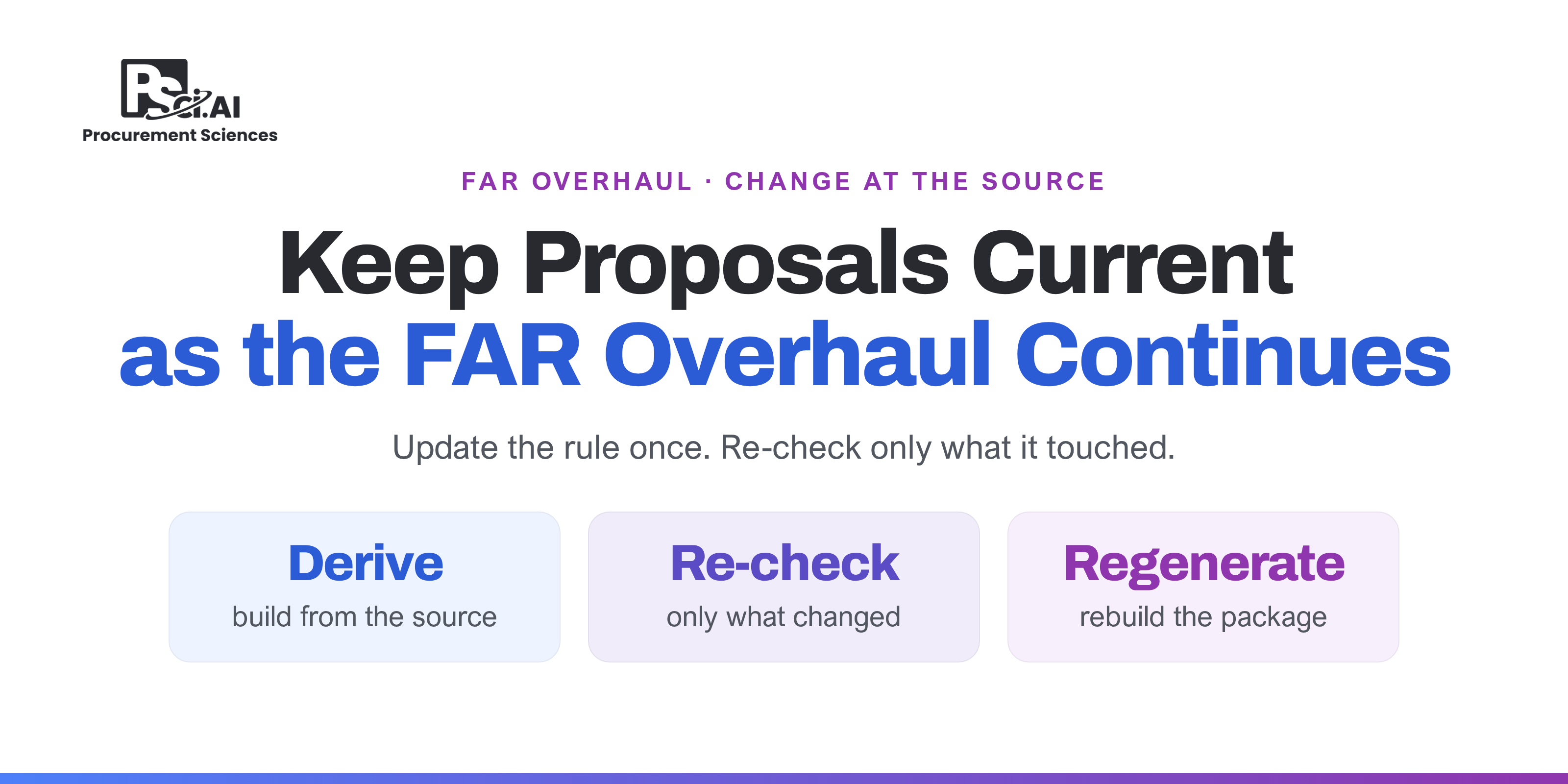
How to Keep Proposals Current as the FAR Overhaul Continues
The FAR overhaul means the rules governing your bid can change while you write it. The fastest way to keep up is to organize your proposal content so every item traces back to the rule it relies on. Update the rule once, and you know exactly what to re-check. We call this Change at the Source.
How to Keep Proposals Current as the FAR Overhaul Continues
Microsoft Copilot Alternatives for Government Contracting: What GovCon Teams Should Know
Microsoft Copilot has become a significant part of the enterprise AI landscape, bringing generative AI directly into applications many government contractors already use every day.
Microsoft Copilot Alternatives for Government Contracting: What GovCon Teams Should Know
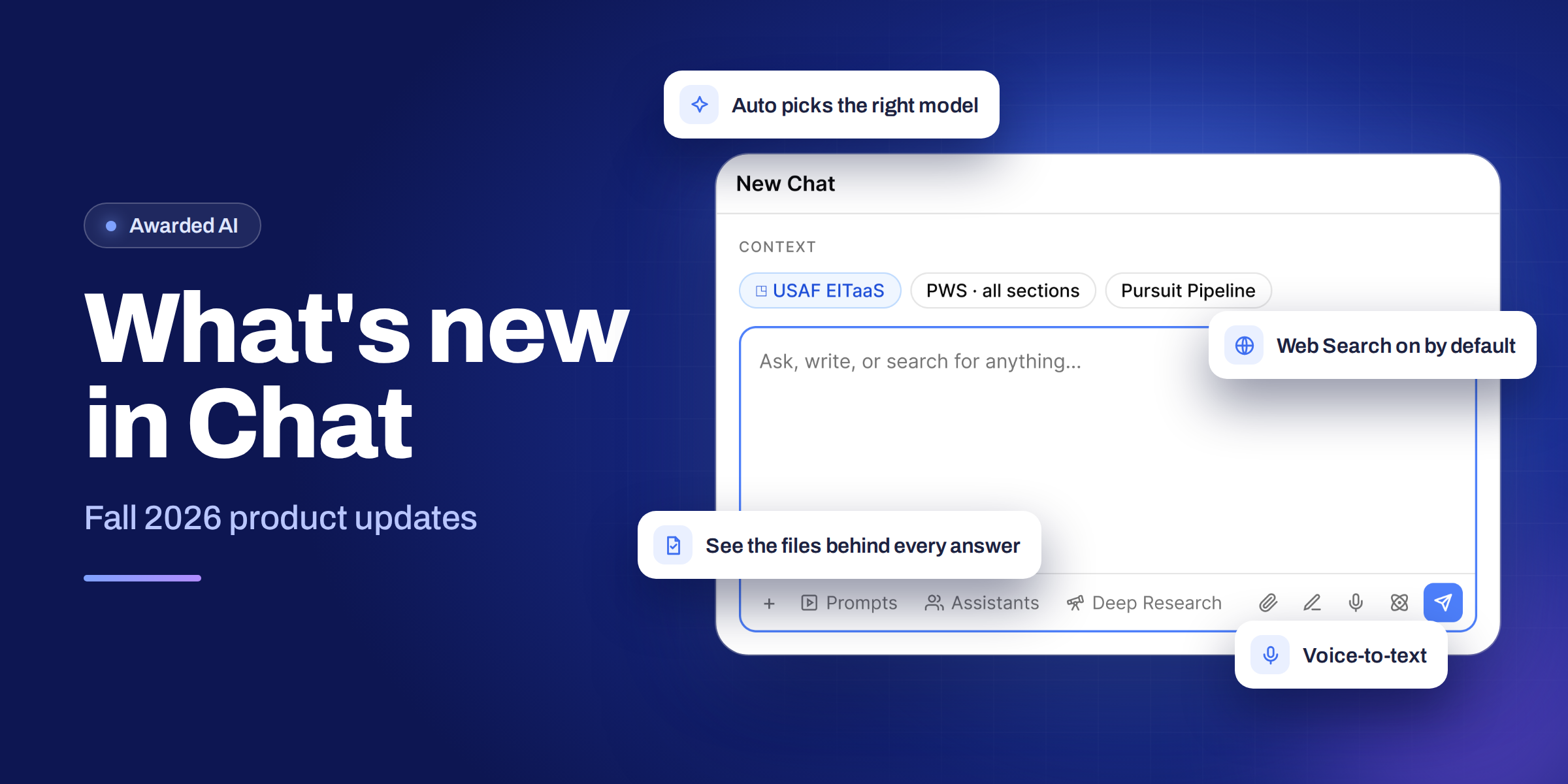
What's New in Awarded AI Chat: Fall 2026 Product Updates
Over the last few weeks, we shipped a steady run of small but mighty improvements to Chat in Awarded AI. Together, they change how it feels to do real capture and proposal work in Chat.
What's New in Awarded AI Chat: Fall 2026 Product Updates