
How to Keep Proposals Current as the FAR Overhaul Continues

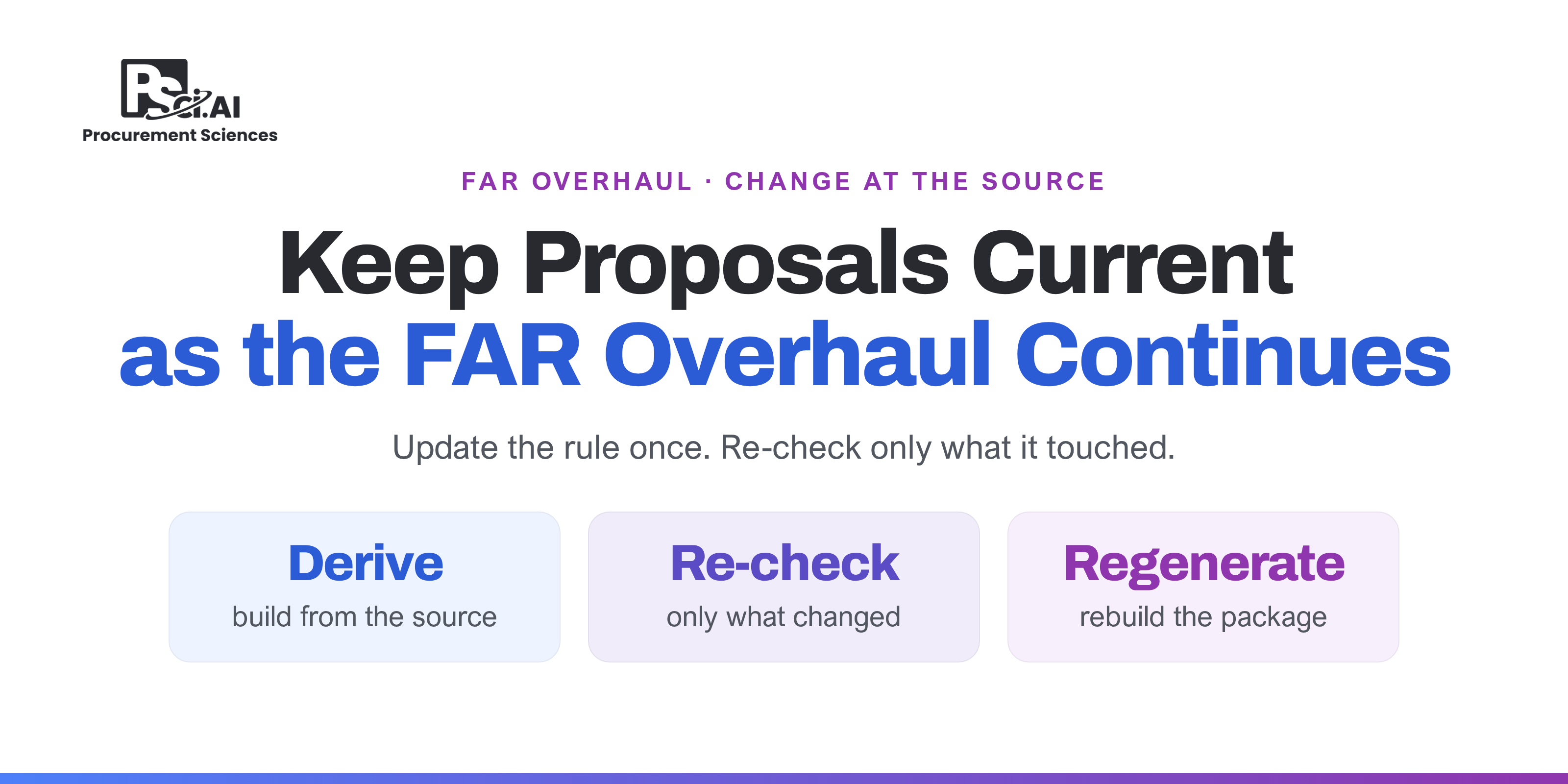
The FAR overhaul means the rules governing your bid can change while you write it. The fastest way to keep up is to organize your proposal content so every item traces back to the rule it relies on. Update the rule once, and you know exactly what to re-check. We call this Change at the Source.
Change at the Source gives your business development (BD) and contracts teams one source for all data, external and internal. A change is entered once, flows to everything that depends on it, and triggers a re-check of only what it touched. AI makes your proposal process faster, and it earns your trust when it cites the correct, current rules.
Here’s a real example. On April 17, 2026, the Federal Acquisition Regulation (FAR) Council issued a memorandum and class deviation (an authorized departure from the FAR text for a category of contracts) adding clause 52.222-90, “Addressing DEI Discrimination by Federal Contractors,” in response to Executive Order (EO) 14398 on diversity, equity, and inclusion (DEI). Agencies were directed to use it in new solicitations beginning April 24 and to amend open solicitations on dates that varied by agency. The clause flows down to subcontracts at every tier, except those where delivery or performance is outside the United States (FAR Council memo).
If you had proposals in flight, you had to find every compliance statement, boilerplate paragraph, and teaming flowdown (a required clause the prime passes down to its subcontractors) the clause touched. Most companies did this manually across active proposals and the content library. Change at the Source replaces that hunt with a single update, and AI helps you find everything affected.
What is Change at the Source?
Change at the Source is a way of organizing your BD content so that every product traces back to its sources, each with an owner and a currency date (the date it was last confirmed). When an acquisition policy changes, you update the source once with the new regulation or statute, and everything built from that source updates with it. Only affected products are flagged for re-checking, and everything else keeps its sign-off.
The source holds two kinds of data. External data comes from outside your company: the solicitation and its amendments, the acquisition rules that govern it, competitor intelligence, and capture research. Internal data is what you bring: representations and certifications, rates and labor categories, boilerplate, past performance, resumes, management plans, and pricing templates. Each internal item is tagged to the external data it relies on, so when a FAR clause, an amendment, or a capture call changes, the tags flag exactly the internal data that depends on it.
This post focuses on one kind of external data, acquisition policy. The same method applies to anything that affects opportunity qualification, capture, and proposal development.
Why does the Revolutionary FAR Overhaul (RFO) make mid-bid change the new normal?
Each agency adopted the overhaul through its own class deviations on its own schedule, so there is no single rulebook, and two solicitations from the same week can rest on different rule sets. Solicitations have always depended on the acquiring agency’s FAR supplement as well as the FAR. Treat each solicitation as if it rests on its own mix of rules, because that mix can change while you write your proposal.
The RFO began in April 2025 with EO 14275, “Restoring Common Sense to Federal Procurement,” which directed that the FAR keep only what statute requires or sound procurement demands (Reed Smith). The FAR Council released model text part by part, and each agency adopted it through its own class deviations (acquisition.gov). The FAR Council published the first proposed rules on June 23, 2026 and a second round on September 18, 2026, and comments on the second round were due October 19, 2026.
The class deviations stay in force while rulemaking runs, and the proposed text can differ from the text of the class deviations (Nixon Peabody). As a result, the rule that governs your bid today may differ from the rule that governs your next bid.
Statutes add changes on their own schedules. For example, the FY2026 National Defense Authorization Act (NDAA) raised the threshold for certified cost or pricing data to $10 million for contracts with the Department of War, NASA, and the Coast Guard entered into after June 30, 2026, while the FAR text still showed $2.5 million (GovConFeed; Covington). When a statute and the FAR disagree, the statute controls.
Executive orders, deviations, and rules move through the FAR process; statutes take effect on their own schedule.
You can turn this situation into an advantage. A team that tracks which rules govern each bid can answer an amendment by checking only what changed. As of October 2026, acquisition.gov lists each agency’s deviations by FAR part, so check it at kickoff for every pursuit.
What happens when you add AI to your current proposal process?
Many proposal teams have added AI for proposals to the process they already run, so drafts may arrive in hours instead of days, but a policy change still sets off the same manual hunt.
AI can also add a confident answer based on old rules. A general-purpose AI model may know the FAR only as it stood when the model was trained, so it can cite clause text that a class deviation has since been replaced, with no sign that it’s out of date. In proposal work, that error lands in a representation, a certification, or a compliance matrix row, and when AI chains steps together, an early error travels farther before anyone corrects it.
The risk is real. In 2025, the Government Accountability Office (GAO) flagged legal citations that don’t exist in nine bid protest filings, and in one case, Oready, LLC (B-423649), dismissed the protest as a sanction (Washington Technology). Those were protest filings, not proposals, but the lesson carries over: a confident citation needs a check before it goes out.
Our eBook, The Rebuilders, explains why the organizations getting real returns from AI redesign around it instead of adding it to the old process. Change at the Source is one piece of that redesign.
How does Change at the Source work?
Change at the Source rests on three design choices. Each one replaces a habit from the traditional process.
- Derive, don’t copy. Proposal content is built from the source, not copied from the last bid. Because every internal data item is tagged to the external data it relies on, a change to one external item identifies everything downstream of it.
- Re-check only what changed. A change resets the review on the products that depend on it, and everything else keeps its sign-off. Each flagged item goes to the owner already named for it.
- Regenerate, don’t repair. Once flagged content is corrected and re-checked, the proposal is rebuilt from the source. A late fix made only in the assembled document never reaches the source, so the next bid may inherit the old text.
Here’s how the April 2026 clause change plays out under each approach.
The last row is the payoff. Instead of re-reading every live proposal and the library, the team works a short list with a name next to each item.
Where does AI fit in Change at the Source?
AI belongs inside Change at the Source, as part of the process. Whatever AI platform you use, hold it to four requirements.
- Start from the requirements. The AI platform builds its work from the solicitation’s requirements. Everything it produces, from a compliance matrix row to a draft paragraph, should trace to a specific paragraph or amendment in the request for proposal (RFP) and, for clauses incorporated by reference, to the current text of the clause.
- Check the clause list itself. Compare each clause and its date in the solicitation against the governing deviation, flag versions that have been replaced, and raise mismatches through the Q&A process (the period when offerors can submit questions). In a subcontract RFP, also check whether each flowed-down clause applies; FAR 52.222-90, for example, flows to subcontracts performed or delivered in the United States (FAR Council memo). The AI platform can flag candidates, and the contracts manager makes the call.
- Cite current rule text. Whenever the AI platform states what a clause requires or what a threshold is, it should cite the current rule text behind it. A statement with no citation is a claim to check, not a fact.
- Flag what it can’t support. When the source material doesn’t support something it’s asked to write or answer, the AI platform should say so instead of filling the gap with fluent text.
The AI platform doesn’t redesign your process. Tagging content to the rules it relies on, naming owners, and deciding what gets re-checked are part of the process you design around it.
Awarded AI, our proposal platform, builds a structured requirement set and compliance matrix directly from the solicitation, and it provides citations to your source documents and knowledge base that your team can check. The proposal process remains yours to design.
How do you build the case for Change at the Source?
Change at the Source changes how capture, contracts, pricing, and proposal teams work with information, so it needs an executive sponsor. Restructuring a proposal workflow, assigning content ownership across departments, and funding a content library owner all take authority beyond any individual BD contributor.
Start with evidence from work your team has already done. Each step below takes a few hours, needs no new tools, and produces a number for the sponsor conversation.
- Trace one recent policy change. Pick a clause change your team handled this year, such as FAR 52.222-90. List every place it touched across live bids and your content library, how each one was found, how many hours it took, and anything caught late or missed. The hours are your rework cost for one change made manually.
- Count the copies. Choose three or four boilerplate paragraphs you reuse often and find every version of each in your last ten bids. The count shows how many places a typical change has to reach.
- Audit your most-reused content. For the 20 library items your team reuses most, check whether each has a named owner and a date, and whether any still cite rule text that a deviation has replaced. Every stale item is a discrepancy an evaluator or contracting officer could find.
- Map the rules behind your live bids. For each live bid, list which agency deviation governs its key FAR parts, using the deviation lists on acquisition.gov. The number of different rule sets shows what “no single rulebook” means for your own pipeline.
- Test your AI tool on a recent change. Ask it for the current threshold for certified cost or pricing data on a defense contract, or what FAR 52.222-90 requires. Record whether it cites current rule text, outdated rule text, or an answer with no valid source.
- Put it on one page. Show the hours from the trace, the number of copies, the stale items, the number of rule sets, and the AI test result. That page starts your business case.
A current example: the $10 million threshold
The $10 million threshold reaches smaller defense contractors and subcontractors first, because that band covers many of the sole-source awards, follow-on contracts, and subcontracts they depend on. As of October 2026, FAR 15.403-4 still shows the lower figure. A small company that can’t produce certified cost or pricing data, and that reads the FAR instead of the statute, may pass on defense work between $2.5 million and $10 million that it could now pursue. That’s a bid/no-bid decision made before anyone writes an estimate, because a person or an AI tool worked from the FAR text instead of the statute.
Two limits apply. A subcontract entered into after June 30, 2026 may still use the $2.5 million threshold if the prime contract was entered into on or before that date. And even when certified data is no longer required, the contracting officer must still find the price fair and reasonable and may ask for other data, so keep your pricing support organized (Covington).
To trace the incidence of this event, find every place the old threshold lives (pricing policies, purchasing procedures, subcontract templates, and bid/no-bid criteria), then count the live defense estimates between $2.5 million and $10 million and the opportunities in that range you passed on since June 30.
Frequently asked questions
What is the Revolutionary FAR Overhaul (RFO)?
The RFO is the rewrite of the Federal Acquisition Regulation launched under EO 14275 in April 2025. The FAR Council released rewritten text part by part, agencies adopted it through their own class deviations, and formal rulemaking began with proposed rules in June 2026.
What’s the difference between a class deviation and a final rule?
A class deviation lets an agency depart from the FAR text for a category of contracts until the FAR itself is amended. A final rule changes the FAR after public notice and comment. Under the RFO, deviations came first, so the text in force can differ from both the old FAR and the proposed rules.
Do the RFO class deviations still apply while the proposed rules are pending?
Yes. As of October 2026, the class deviations stay in force while formal rulemaking runs, and a proposed rule applies to a solicitation only once it’s final (Nixon Peabody). Check acquisition.gov for the buying agency’s current deviation for each FAR part.
How do I know which rule set governs a specific solicitation?
Start with the solicitation itself: its date, the clauses it lists, and any deviation notices. Then compare those against the buying agency’s deviation for each key FAR part. If the two differ, ask through the Q&A process before you write to either version.
Can I trust AI to answer questions about the FAR?
Yes, when it shows you the current rule text it relied on. A general-purpose AI model may know the FAR only as it stood when the model was trained, so treat any answer without a citation as a claim to check.
Is Change at the Source practical for a small business?
Yes. A small team has fewer live bids and a smaller content library to tag, so the starting effort is smaller too. Begin with the 20 items you reuse most and the steps in “How do you build the case for Change at the Source?” above.
The bottom line
Policy will keep changing as the RFO moves from class deviations to final rules. The teams that keep up hold one source for all data, update it once, and re-check only what changed. Start with one recent policy change: tracing it through your bids shows what it cost and makes the case for Change at the Source.
Federal buying rules are shifting on several fronts at once. For another recent change that affects how you submit, read our guide to DoW proposal submission through PIEE. For one that affects who can bid, see our breakdown of the SBA small business size standards changes. For a broader overview of the overhaul, see more here.
See Change at the Source on a live pursuit
Bring one live pursuit and we’ll trace the latest policy change through it with you. Request a demo to learn more about Procurement Sciences.
Want the full method? Download our eBook, The Rebuilders, on redesigning proposal development for AI.
Sources
- FAR Council guidance to implement EO 14398 (acquisition.gov): the April 17, 2026 memorandum and clause 52.222-90
- Reed Smith, FAR overhaul underway: EO 14275 and the aims of the overhaul
- FAR overhaul part deviation guide (acquisition.gov): class deviations by FAR part
- Wiley, FAR overhaul rulemaking and second round of proposed rules: the proposed rules and the October 19 comment deadline
- Nixon Peabody, second round of proposed rules: the class deviations during rulemaking
- Covington, The $10 million TINA threshold is now in effect and GovConFeed, dollar thresholds: the NDAA change
- FAR 15.403-4 (acquisition.gov): the threshold in the FAR text
- Washington Technology, Think AI can write your company’s bid protest? Think again: the GAO decisions
About the author
Bruce Feldman is AI Platform Strategist at Procurement Sciences, with 35+ years in GovCon BD. He was Chief Growth Officer at Engility, SVP for Growth at SAIC, and AI practice lead at Lohfeld Consulting. He is a retired Lt Col, USAFR.
Click here to schedule a demo to get the full scoop on how our product actually works and discover how AI can transform your approach to government contracting.
Explore More Resources

Webinar Recap: Outgrowing Small Business, Using AI to Write and Win Like a Prime
Procurement Sciences recently joined APMP for a webinar on one of the most challenging transitions in government contracting: what happens when a small business outgrows its set-aside protections and has to compete in the full and open market against primes with ten times the resources.
Webinar Recap: Outgrowing Small Business, Using AI to Write and Win Like a Prime
Microsoft Copilot Alternatives for Government Contracting: What GovCon Teams Should Know
Microsoft Copilot has become a significant part of the enterprise AI landscape, bringing generative AI directly into applications many government contractors already use every day.
Microsoft Copilot Alternatives for Government Contracting: What GovCon Teams Should Know
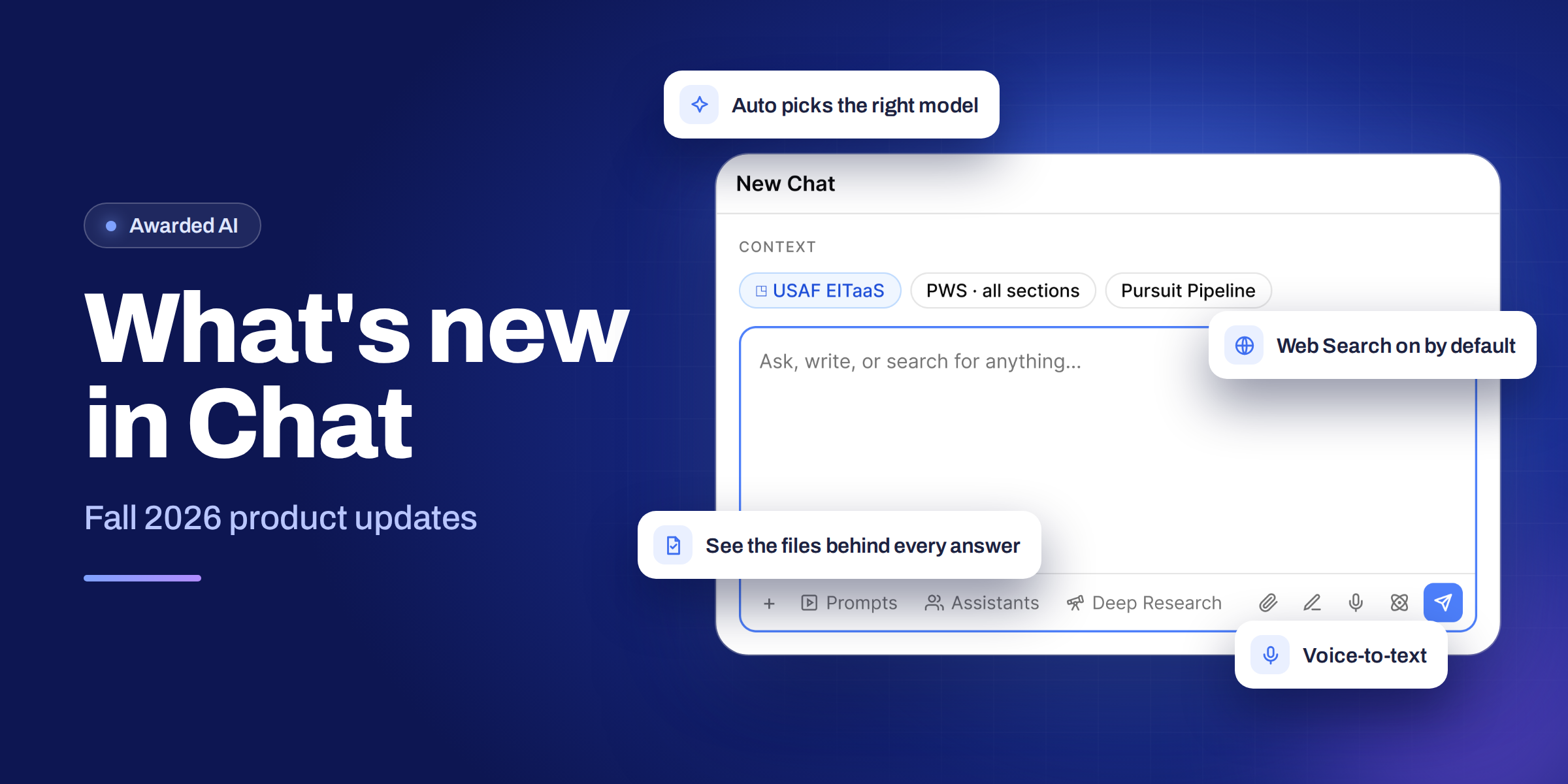
What's New in Awarded AI Chat: Fall 2026 Product Updates
Over the last few weeks, we shipped a steady run of small but mighty improvements to Chat in Awarded AI. Together, they change how it feels to do real capture and proposal work in Chat.
What's New in Awarded AI Chat: Fall 2026 Product Updates