
SBA Small Business Size Standards Are Changing: Here's What Government Contractors Need to Know

On August 20, 2026, the Small Business Administration (SBA) published a proposed rule that would rewrite its small business size standards, the thresholds that determine which companies qualify as "small" for federal contracting, SBA loans, and related programs. It's the most significant change to these size standards in over a decade, and if finalized, it could reshape the competitive landscape across IT, engineering, and professional services in the federal market.
This proposal isn't final. Comments close September 21, 2026, and any change still requires a final rule. But the numbers behind it are worth understanding now, not after they've already reshaped a recompete you're tracking.
What are SBA size standards?
SBA size standards are the revenue or employee-count thresholds the Small Business Administration uses to decide whether a company counts as a "small business" for a given industry.
Each size standard is tied to a NAICS code (the federal system for classifying industries), and determines eligibility for small-business set-aside contracts, SBA loan programs, and other federal small-business benefits. By law, SBA reviews these size standards every five years and adjusts them to reflect current market conditions
$531 million: The new threshold for custom computer programming
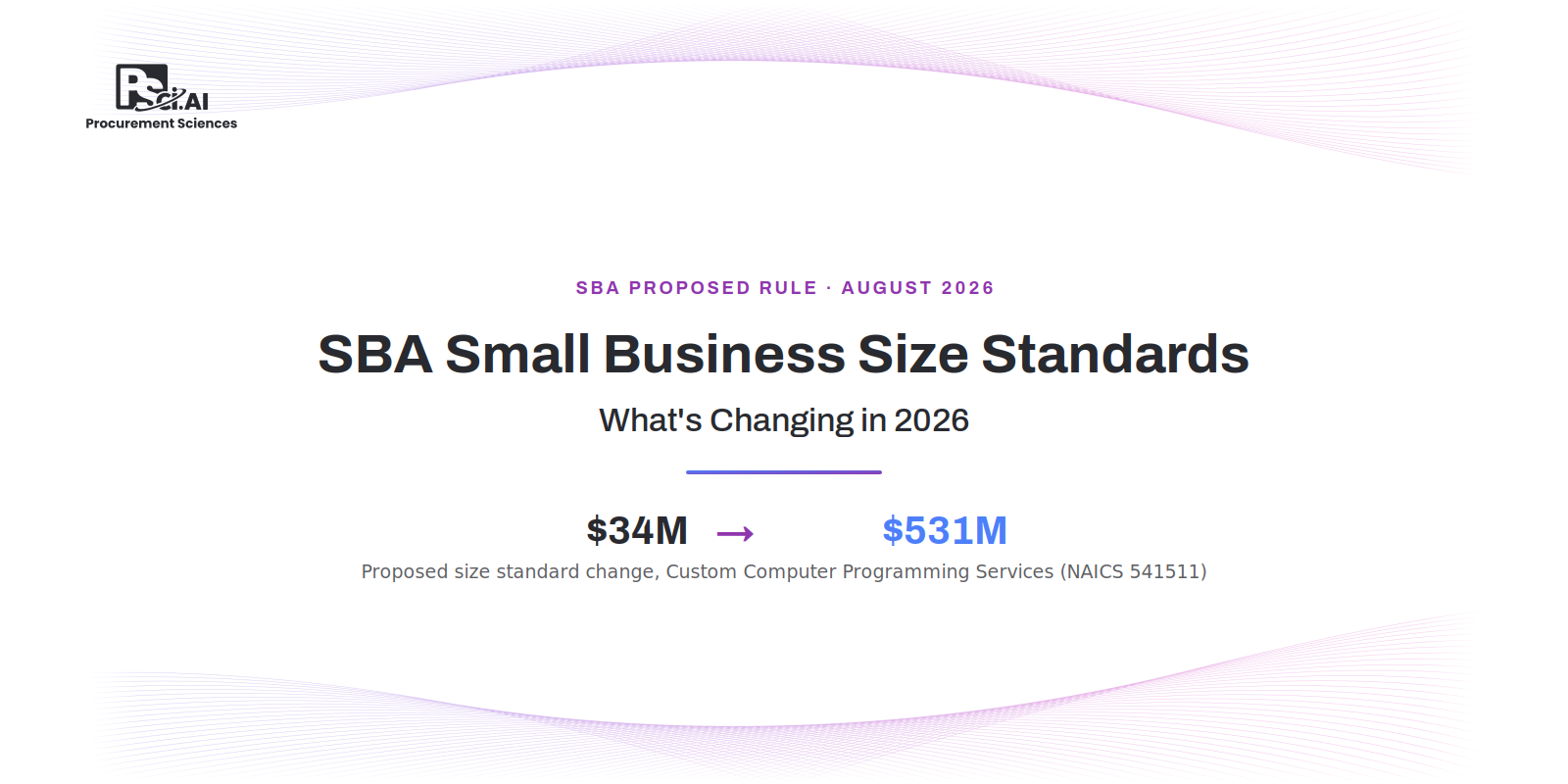
That's not a typo. Today, a custom computer programming contractor (NAICS 541511) qualifies as small at $34 million in average annual receipts. Under SBA's proposal, that threshold would rise to $531 million, nearly a sixteen-fold increase.
It's one of the largest single changes in the proposal, but it isn't isolated. Several of the NAICS codes that matter most for IT services, engineering, and professional-services contractors would see similarly dramatic jumps:
A contractor doing $150 million a year in custom computer programming work is, today, far too large to qualify as small. Under the proposal, that same contractor would sit comfortably inside a $531 million standard.
What's SBA is actually changing
SBA wants to simplify its small business size standards as much as it wants to raise them. Instead of nearly 1,000 separate size standards spread across 978 six-digit NAICS industries, the agency is proposing 338 standards set at the broader 4-digit industry group or 5-digit industry level.
In practice, that means SBA's NAICS codes will still identify a business's industry, but fewer distinct size standards will apply across them.
A few structural changes matter more than the headline thresholds:
- NAICS consolidation. SBA is moving size standards from the 6-digit code level to a mix of 4-digit industry groups (276 of the 338 new standards) and 5-digit industries (the remaining 62). Six-digit NAICS codes themselves aren't disappearing, but the size standard that applies to a business will now be set at the broader group level, and all 18 current subindustry exceptions go away.
- A new methodology. SBA's prior approach averaged seven separate factors (firm size, market concentration, federal contracting disparity ratios, and others) to set each standard, with a hard ceiling. The new approach calculates a single "average market size" for each industry group, combining total industry size, the number of distinct geographic markets, and an import/export adjustment, and removes the maximum cap entirely (a minimum still applies).
- A shift toward employee-based standards. Where SBA has discretion, the new methodology defaults to employee-based size standards rather than receipts-based ones, aiming to reduce how often growing firms bounce between small and other-than-small status.
- A productivity adjustment, on top of inflation. Receipts-based standards will now be adjusted for both inflation and broader productivity growth in the economy, not inflation alone, which is how SBA has adjusted since 2022.
- No standards are being lowered. Even in the 45 industry groups where the new methodology's math pointed toward a lower standard, SBA is proposing to hold those at their current level rather than cut them. The only industry expected to see any businesses lose small-business status is Direct Property and Casualty Insurance Carriers (NAICS 524126), where fewer than five firms would be affected by a switch from an employee-based to a receipts-based standard.
37,002 existing federal contractors become eligible small businesses
SBA's own cost-benefit analysis puts numbers behind the scale of this change.
Total small businesses nationally would grow from an estimated 6,344,967 to 6,459,508, per SBA's contracting-focused count of employer firms. SBA's press release frames the same change against the full 36 million U.S. small businesses of all kinds as "over 110,000" newly eligible, or roughly 0.3%.
The industries with the most existing federal contractors becoming newly eligible are engineering, computer/IT services, and management consulting, all central to the federal IT and professional-services market.
What this means for federal contractors
There isn't one storyline here: there are at least three, depending on where a contractor sits today.
If you're currently a small business, this proposal doesn't shrink your opportunity set, but it does change who you're likely to be competing against. Firms several times your current size could newly qualify for the same set-asides you rely on.
If you previously graduated out of small-business status, or are sitting well above today's threshold (a common position for mid-market government contractors), this proposal may reopen a channel you'd written off. That can mean identifying new set-aside opportunities, rebuilding capture plans, and reassessing competitor sets you haven't looked at in years.
If you're a large prime, the pool of potential small-business teaming partners and subcontractors just got a lot bigger, and some incumbents who lost small-business status on past recompetes could regain eligibility.
Across all three, the practical to-do list looks similar: revisit pipeline segmentation, reassess recompete strategy and competitive sets, update teaming plans, and check assumptions about which opportunities are likely to be set aside.
Timeline
There's no implementation date yet. Comments close September 21, 2026, and SBA must issue a final rule before anything changes. Treat every number in this proposal as exactly that: proposed, not enacted, until a final rule says otherwise.
Why this matters for capture and pipeline strategy
None of this changes anything today. SBA still has to review comments, and a final rule is still required before any threshold moves. But a proposal this large, affecting NAICS codes this central to federal IT and professional services, is worth building into 2027 planning now rather than reacting to it after the fact.
Whatever side of a threshold your business sits on, the practical questions are the same: Who is likely to newly qualify for the set-asides you compete in? Which recompetes might see a different competitor set than your team assumed? Which teaming relationships might shift if a former graduate or a much larger firm regains small-business eligibility? Those are pipeline and capture questions, not just regulatory ones, and they're worth revisiting before, not after, a final rule locks the answer in.
Frequently Asked Questions
What is the SBA standard for small business? An SBA size standard is the revenue or employee-count threshold that determines whether a business qualifies as "small" for a specific industry, identified by NAICS code. SBA size standards govern eligibility for federal small-business set-asides, SBA loan programs, and related federal small-business benefits.
How often are SBA size standards updated? By law, SBA must review all size standards every five years and adjust them to reflect current market conditions. This proposal is the third such review: the first was completed in 2016, the second in 2023, and this 2026 proposal is the third.
What are the expected changes for small businesses in 2026? If finalized, SBA's proposal would consolidate nearly 1,000 size standards into 338 broader categories and raise most receipts-based thresholds substantially, in some industries by more than tenfold. SBA estimates a net increase of 114,541 newly eligible small businesses nationally, including 37,002 firms that already hold federal contracts.
What is SBA's proposed size standards rule? On August 20, 2026, SBA proposed replacing nearly 1,000 size standards set at the 6-digit NAICS level with 338 standards set at broader 4-digit and 5-digit industry groupings, and raising most receipts-based thresholds. It's a proposed rule (91 FR 53741), not a final one.
When would the new SBA size standards take effect? There's no confirmed date. Comments on the proposal close September 21, 2026, and a final rule must be issued before any change takes effect. SBA has not stated a specific implementation timeline in this proposal; late 2026 or 2027 is a plausible window if the rule proceeds substantially as written, but this is an estimate, not a confirmed date.
How many businesses would become newly eligible for small-business status? SBA estimates a net increase of 114,541 small businesses nationally, including 37,002 firms that already hold federal contracts as of FY2025. Those 37,002 firms held roughly 105,655 contracts worth more than $71 billion combined.
Would my size standard threshold go up under this proposal? Likely, if you're in an industry SBA reviewed for an increase, which was the large majority. SBA is not proposing to lower any size standard, even in the 45 industry groups where its own methodology pointed toward a decrease. Only one industry, Direct Property and Casualty Insurance Carriers (NAICS 524126), is expected to see any businesses lose small-business status, affecting fewer than five firms.
Is NAICS 541511 (Custom Computer Programming Services) changing? Yes. Its proposed threshold would rise from $34 million to $531 million in average annual receipts, one of the largest single changes in the proposal.
How can I comment on the proposed rule? Comments can be submitted through regulations.gov (Docket SBA-2026-0199) before the September 21, 2026 deadline, or by mail to SBA's Office of Government Contracting and Business Development.
Track NAICS codes and your competitors in HigherGov
See which contractors, competitors, and recompetes in your target NAICS codes could be affected if this proposal is finalized, including which set-asides you may see new competition on, and which previously-graduated firms could regain eligibility to compete or team with you.
Explore your NAICS codes and set-aside landscape in HigherGov.
Ready to act on it? Capture Planning with Awarded AI helps you rebuild competitive sets, recompete plans, and teaming strategy as thresholds shift. Schedule a demo today.
Disclaimer
This article reflects the proposed rule as published in the Federal Register on August 20, 2026 (91 FR 53741, RIN 3245-AI67, Docket SBA-2026-0199) and SBA's accompanying press release. This is a proposed rule, not a final one: figures, thresholds, and effective dates may change or may never take effect.
Click here to schedule a demo to get the full scoop on how our product actually works and discover how AI can transform your approach to government contracting.
Explore More Resources
Microsoft Copilot Alternatives for Government Contracting: What GovCon Teams Should Know
Microsoft Copilot has become a significant part of the enterprise AI landscape, bringing generative AI directly into applications many government contractors already use every day.
Microsoft Copilot Alternatives for Government Contracting: What GovCon Teams Should Know
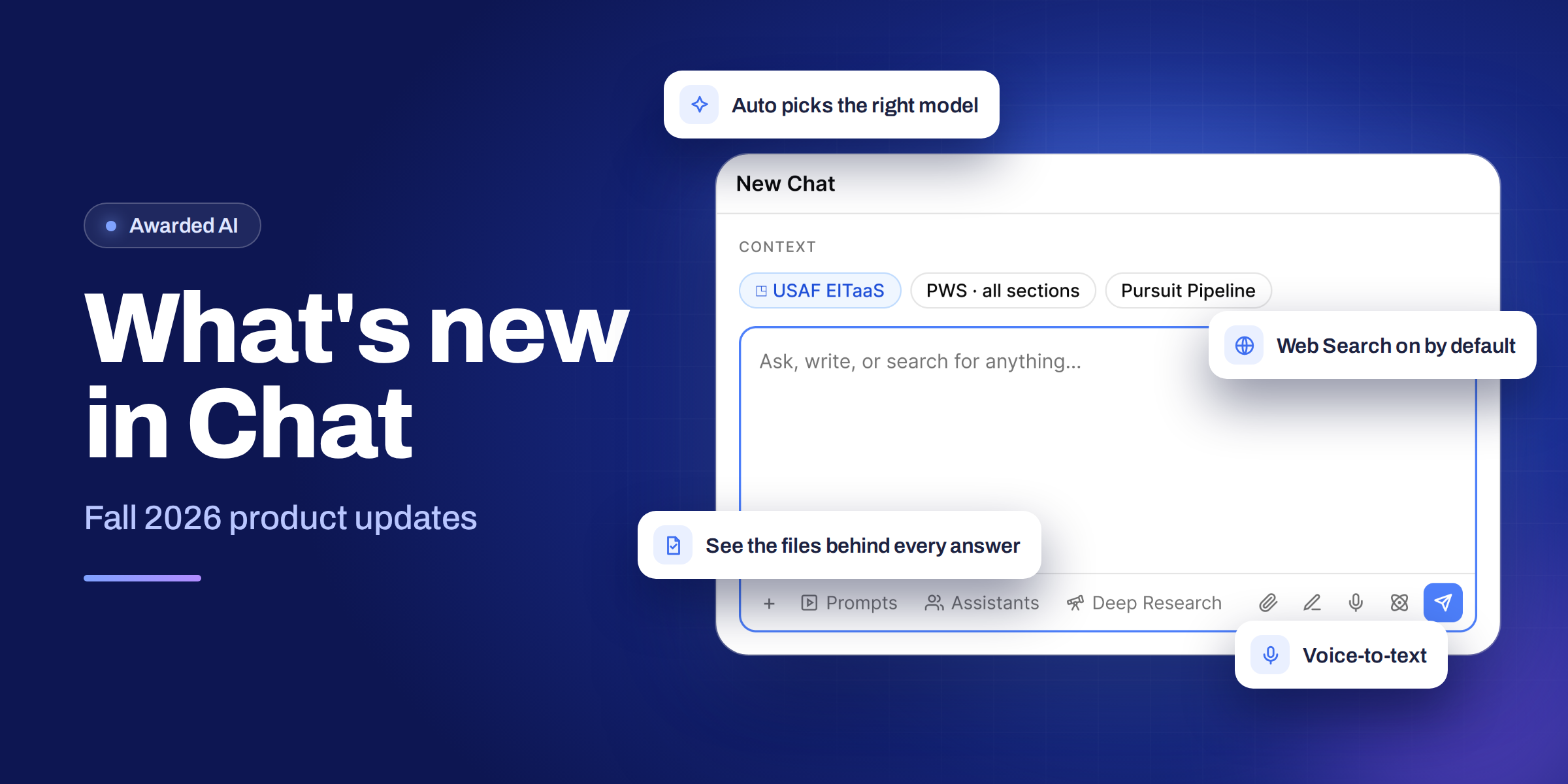
What's New in Awarded AI Chat: Fall 2026 Product Updates
Over the last few weeks, we shipped a steady run of small but mighty improvements to Chat in Awarded AI. Together, they change how it feels to do real capture and proposal work in Chat.
What's New in Awarded AI Chat: Fall 2026 Product Updates
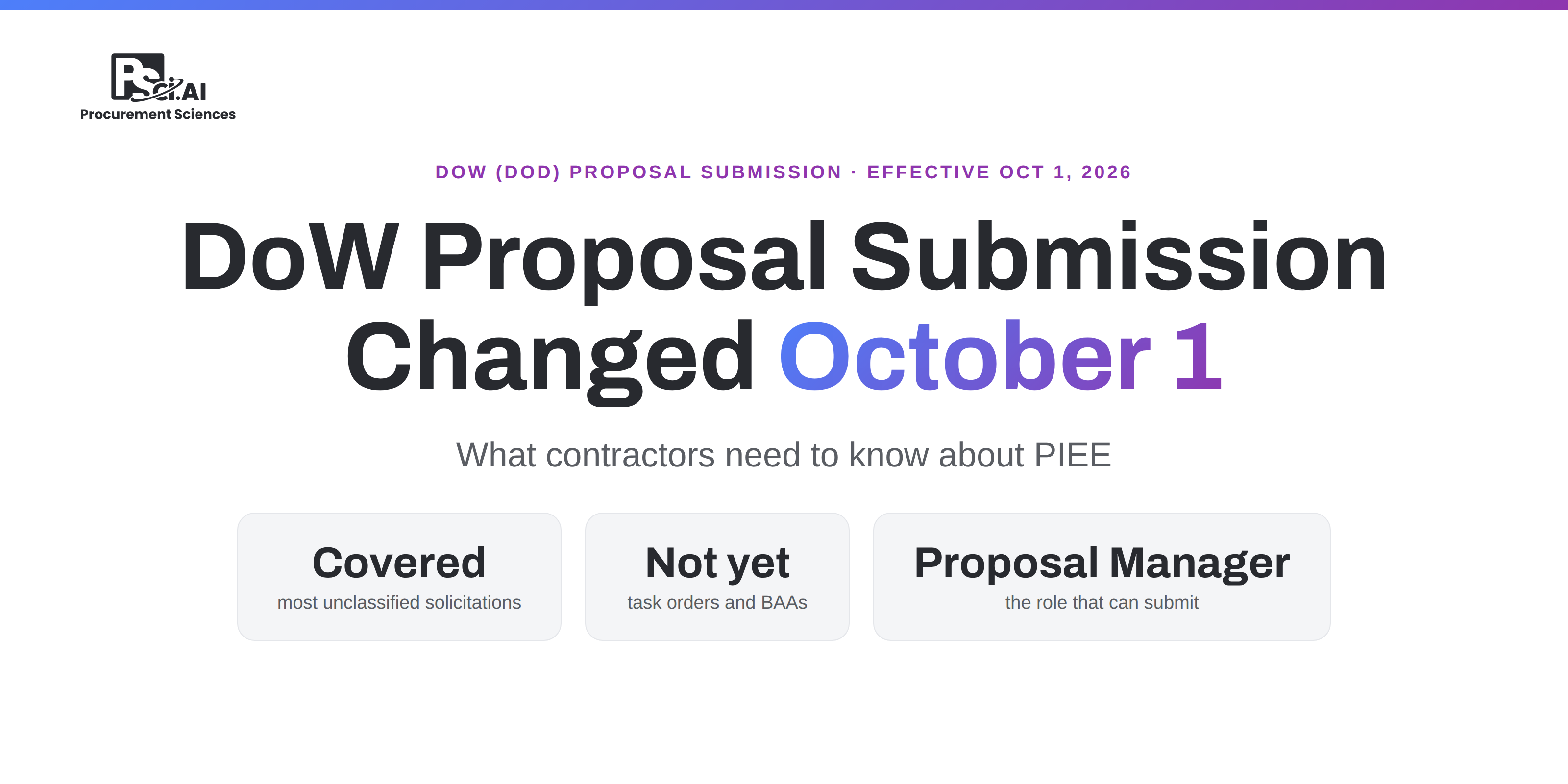
DoW Proposal Submission Changed October 1: What Contractors Need to Know About PIEE
As of October 1, 2026, Department of War (DoW) contracting officers must publish unclassified solicitations and receive offers through the PIEE Solicitation Module, unless an exception applies.
DoW Proposal Submission Changed October 1: What Contractors Need to Know About PIEE