
Microsoft Copilot Alternatives for Government Contracting: What GovCon Teams Should Know

Microsoft Copilot has become a significant part of the enterprise AI landscape, bringing generative AI directly into applications many government contractors already use every day.
For organizations built around Microsoft 365, that creates a compelling proposition: AI that can work alongside applications such as Word, Excel, PowerPoint, Outlook, Teams, and SharePoint while drawing on organizational information users already have permission to access.
But government contractors evaluating Microsoft Copilot alternatives should consider more than productivity features.
The relevant questions include which Microsoft government environment the organization uses, what information Copilot can access, which capabilities are available in that environment, and whether general-purpose workplace AI or a purpose-built GovCon platform better fits the workflows the team is trying to improve.
Here's what government contractors should know.
What Is Microsoft Copilot?
Microsoft Copilot is a family of AI experiences integrated across Microsoft's products and services.
Microsoft 365 Copilot brings AI into the Microsoft 365 environment and can use organizational context, including information users have permission to access, to help with tasks such as:
- Drafting and editing documents
- Summarizing emails and meetings
- Analyzing information
- Creating presentations
- Searching organizational knowledge
- Conducting research
- Working with spreadsheets and data
- Creating and using AI agents
- Automating certain workplace tasks
Microsoft has also expanded Copilot beyond basic AI assistance. Capabilities such as Researcher can conduct multi-step research using web and organizational information, while Agent Builder and Copilot Studio allow organizations to create agents for more specific use cases.
For government contractors already operating heavily within Microsoft 365, that can make Copilot a natural place to introduce AI into everyday work. But workplace productivity and government contracting workflow automation aren't necessarily the same thing.
Can Government Contractors Use Microsoft Copilot?
Yes. Microsoft 365 Copilot is available across several U.S. government cloud environments, although eligibility, capabilities, and deployment requirements differ.
These include:
- Government Community Cloud (GCC): Supports eligible government organizations and contractors with certain federal requirements.
- Government Community Cloud High (GCC High): Provides additional isolation for organizations handling Controlled Unclassified Information (CUI) or subject to requirements such as DFARS and ITAR/EAR.
- Department of Defense (DoD): Reserved for the U.S. Department of Defense and designed to support workloads requiring DoD Impact Level 5 protections.
Government contractors should therefore avoid treating Microsoft Copilot as one universal deployment.
The appropriate environment depends on the organization's contracts, information, security requirements, and Microsoft environment. Feature availability and licensing can also differ significantly across commercial Microsoft 365, GCC, GCC High, and DoD.
For current availability and deployment details, consult Microsoft's government cloud guidance.
What About CUI and Sensitive Government Information?
Government contractors working with CUI need to pay particular attention to where Copilot is deployed.
Microsoft identifies GCC High as an environment designed for organizations handling CUI and requirements involving FedRAMP High, DFARS, or ITAR/EAR.
Microsoft 365 Copilot also respects existing Microsoft 365 permissions. Copilot does not automatically give a user access to organizational information they could not otherwise access.
That is important, but it does not eliminate the need for governance.
Using GCC High does not automatically make an organization's AI workflows compliant. Contractors must still evaluate their specific contractual requirements, access permissions, data governance, configurations, and approved uses.
Organizations should consider:
- Whether information is stored in the appropriate Microsoft environment
- Existing SharePoint and Microsoft 365 permissions
- Overshared organizational information
- Applicable contract requirements
- Data classification and governance
- Which Copilot capabilities are available in the organization's government cloud
Government contractors should evaluate the specific Copilot environment and capabilities they plan to deploy, rather than assuming functionality available in commercial Microsoft 365 is automatically available in their government environment.
How Microsoft Copilot Is Changing
Copilot is becoming much more than an AI writing assistant.
Microsoft has introduced capabilities including Researcher and Analyst for more complex research and analysis. Copilot Search can help users find information across organizational sources, while Notebooks allow users to bring relevant materials together around a particular project.
Microsoft is also expanding its agent capabilities.
Agent Builder allows organizations to create agents grounded in internal knowledge sources, while Copilot Studio supports more advanced agents and integrations.
Some of these capabilities are available in government environments, although availability varies by product and cloud.
For GovCon teams, this matters because the distinction between general-purpose and purpose-built AI is becoming more nuanced.
Copilot can increasingly be customized around specific organizational processes.
The question becomes how much of the government contracting workflow an organization wants to design, configure, integrate, and maintain itself.
AI-Generated Content Transparency
Microsoft has also introduced AI-generated content transparency features, including watermarking and content provenance metadata for supported AI-generated outputs.
These capabilities can help identify certain content created or modified using AI, but their availability depends on the content type, product, and deployment environment.
Microsoft's watermarking policy for video and audio is not currently available to GCC, GCC High, or DoD customers.
For government contractors, these developments reinforce the importance of evaluating AI governance and content handling alongside productivity capabilities.
Where Microsoft Copilot Can Help Government Contractors
Microsoft Copilot can provide meaningful productivity improvements across GovCon organizations.
Document creation
Teams can use Copilot to help draft, edit, summarize, and work with content in Microsoft applications.
Email and meeting productivity
Copilot can help users summarize communications, meetings, and action items within the Microsoft ecosystem.
Organizational knowledge
Because Copilot can work with Microsoft 365 content a user has permission to access, it can help employees find and synthesize information spread across organizational files and communications.
Research and analysis
Copilot capabilities can support more complex research and analytical tasks using organizational information and, where available and enabled, web sources.
Custom agents
Organizations can create agents grounded in internal knowledge or configured for specific processes using Microsoft's agent capabilities.
Those are substantial capabilities.
But they start with the organization's Microsoft environment rather than with the government contracting lifecycle itself.
Microsoft Copilot vs. Purpose-Built AI for Government Contracting
The central difference is where the workflow comes from.
Microsoft Copilot brings AI into an organization's existing Microsoft productivity environment.
Procurement Sciences is built around the workflows government contractors use to identify, pursue, and win government business.
Following the acquisition of HigherGov, Procurement Sciences brings together government market intelligence and purpose-built AI workflows across the contracting lifecycle.
HigherGov helps teams discover and evaluate opportunities, understand agencies and markets, track recompetes, research competitors, and identify potential partners.
Awarded AI supports workflows across capture, proposals, pricing, reviews, and delivery.
Together, these capabilities support an expanding find-to-win platform strategy designed to connect opportunity discovery with downstream execution.
The distinction isn't that Copilot cannot perform sophisticated work.
It's that Copilot provides AI capabilities within the Microsoft ecosystem, while Procurement Sciences brings together government contracting data and workflows designed around how contractors find and pursue opportunities.
A team using Copilot can potentially build or configure processes around activities such as:
- Opportunity research
- Bid/no-bid analysis
- Competitive intelligence
- Capture planning
- Solicitation analysis
- Proposal development
- Compliance
- Pricing
- Review workflows
Procurement Sciences approaches those activities as GovCon workflows rather than general productivity tasks.
Microsoft Copilot vs. Procurement Sciences
The question therefore isn't simply whether Copilot or Procurement Sciences has more AI capabilities.
It's:
Does your team need AI embedded into its existing productivity environment, or AI and market intelligence embedded into its government contracting workflows?
For many organizations, those use cases can coexist.
What Should Teams Look for in a Microsoft Copilot Alternative?
Teams exploring Copilot alternatives should first determine what problem they are actually trying to solve.
If the primary goal is general employee productivity, alternatives may include other general-purpose AI platforms.
If the goal is improving government contracting performance, the evaluation criteria change.
GovCon teams may want to consider whether an alternative provides:
- Government opportunity and market intelligence
- Agency and competitor research
- Recompete identification
- Opportunity qualification
- Capture planning
- Proposal workflows
- Compliance support
- Pricing workflows
- Integration with existing organizational knowledge
- Security appropriate for the information being processed
The best Microsoft Copilot alternative therefore depends heavily on the intended workflow.
A general-purpose AI assistant and a GovCon platform solve different problems, even when both use advanced AI.
Microsoft Copilot Pricing and Evaluation Considerations
Microsoft Copilot pricing depends on the specific product, eligible Microsoft 365 licenses, government cloud environment, and additional capabilities an organization needs.
Government contractors should confirm government-specific licensing and availability with Microsoft or an authorized partner rather than relying exclusively on commercial Copilot pricing.
For government contractors, evaluating Copilot pricing should extend beyond the advertised per-user cost.
Organizations may also need to consider:
- Existing Microsoft licensing
- Required government cloud environment
- Number and type of users
- Copilot Studio or additional agent requirements
- Integration and configuration
- Microsoft 365 data readiness
- Permission cleanup and governance
- Internal development resources
- Training and adoption
- Ongoing administration
This becomes especially relevant when comparing Microsoft Copilot with a purpose-built platform.
An organization may already own much of the Microsoft infrastructure needed to deploy Copilot, while building GovCon-specific workflows on top of that environment may require additional configuration, development, or governance.
Should Government Contractors Use Microsoft Copilot?
For organizations already deeply invested in Microsoft 365, Copilot can be a logical part of an enterprise AI strategy.
It can improve everyday productivity, work with organizational knowledge, assist with research and analysis, and increasingly support custom agents and more sophisticated workflows.
Microsoft's government cloud offerings also give eligible organizations deployment options designed around different federal requirements.
But government contractors should distinguish between enterprise AI productivity and GovCon-specific operational workflows.
Copilot starts with the Microsoft ecosystem.
Procurement Sciences starts with government contracting.
For many organizations, that makes them complementary rather than mutually exclusive technologies.
Teams may use Copilot to improve productivity across the enterprise while using Procurement Sciences to bring together government market intelligence and AI workflows across BD, capture, proposals, pricing, and related GovCon activities.
Teams evaluating general-purpose AI platforms may also want to compare Claude for government contracting and AI for government contracting vs. ChatGPT.
For a broader overview, explore our guide to the best AI platforms for government contracting.
Frequently Asked Questions
What is Microsoft Copilot for government?
Microsoft provides Microsoft 365 Copilot across U.S. Government Community Cloud, GCC High, and DoD environments. The appropriate environment depends on the organization, information being processed, and applicable federal requirements. Capabilities and licensing can vary by environment.
Can government contractors use Microsoft Copilot?
Yes. Eligible government contractors can use Microsoft government cloud environments, including GCC and GCC High. Eligibility, licensing, and the appropriate environment depend on the organization's contracts and information requirements.
Can Microsoft Copilot be used with CUI?
Microsoft identifies GCC High as an environment designed for organizations handling CUI and requirements including FedRAMP High, DFARS, and ITAR/EAR. Contractors should verify their specific contractual, technical, and security requirements before processing CUI. Using an appropriate government environment does not automatically establish compliance.
Is Microsoft Copilot FedRAMP authorized?
Microsoft's government cloud environments have different federal compliance commitments and authorizations. Organizations should evaluate the specific Microsoft 365 environment and Copilot service they intend to use rather than relying on the compliance status of Microsoft 365 generally.
What can government contractors use Copilot for?
Microsoft Copilot can support drafting, summarization, research, data analysis, meetings, email, organizational search, document creation, and other knowledge-work tasks. Agent capabilities can also support more customized organizational processes.
Does Microsoft Copilot have AI agents?
Yes. Microsoft provides agent capabilities through Microsoft 365 Copilot, Agent Builder, and Copilot Studio. Availability and functionality differ between commercial, GCC, GCC High, and DoD environments.
What are the best Microsoft Copilot alternatives for government contractors?
The right Microsoft Copilot alternative depends on the use case. Teams looking for another general-purpose AI platform may evaluate options such as Claude or ChatGPT. Teams looking specifically for government contracting workflows may instead consider purpose-built GovCon platforms that combine market intelligence with BD, capture, proposal, and pricing workflows.
Is Microsoft Copilot built for government contracting?
Microsoft offers government-specific Copilot environments, but Microsoft Copilot is an enterprise productivity platform rather than a platform specifically designed around government contracting. Purpose-built GovCon platforms structure data, intelligence, and AI around activities such as opportunity discovery, capture, proposals, pricing, and related workflows.
Microsoft Copilot vs. Claude: What's the difference for government contractors?
Both provide advanced general-purpose AI capabilities and government deployment options, but their ecosystems differ. Microsoft Copilot is closely integrated with Microsoft 365 and organizational work data, while Claude provides Anthropic's broader AI experience and government-specific Claude deployments. Government contractors should evaluate the appropriate environment, security requirements, integrations, and intended workflows when comparing them.
Choosing the Right AI Approach for GovCon
AI adoption in government contracting is increasingly moving beyond standalone chatbots.
Microsoft Copilot brings AI directly into an ecosystem many contractors already rely on, and its expanding research and agent capabilities make it increasingly powerful. But access to AI isn't the same as having government contracting data and workflows built into the platform.
Procurement Sciences brings together HigherGov's government market intelligence with Awarded AI's purpose-built workflows across BD, capture, proposals, pricing, reviews, and delivery, with an expanding integration strategy designed to connect opportunity discovery and execution.
For contractors evaluating Microsoft Copilot alternatives, the most useful question is therefore not simply which platform has the most AI capabilities.
It's where AI needs to live in your organization and what work you need it to perform.
Request a demo to see how Procurement Sciences brings together government market intelligence and AI across the GovCon lifecycle.
Click here to schedule a demo to get the full scoop on how our product actually works and discover how AI can transform your approach to government contracting.
Explore More Resources
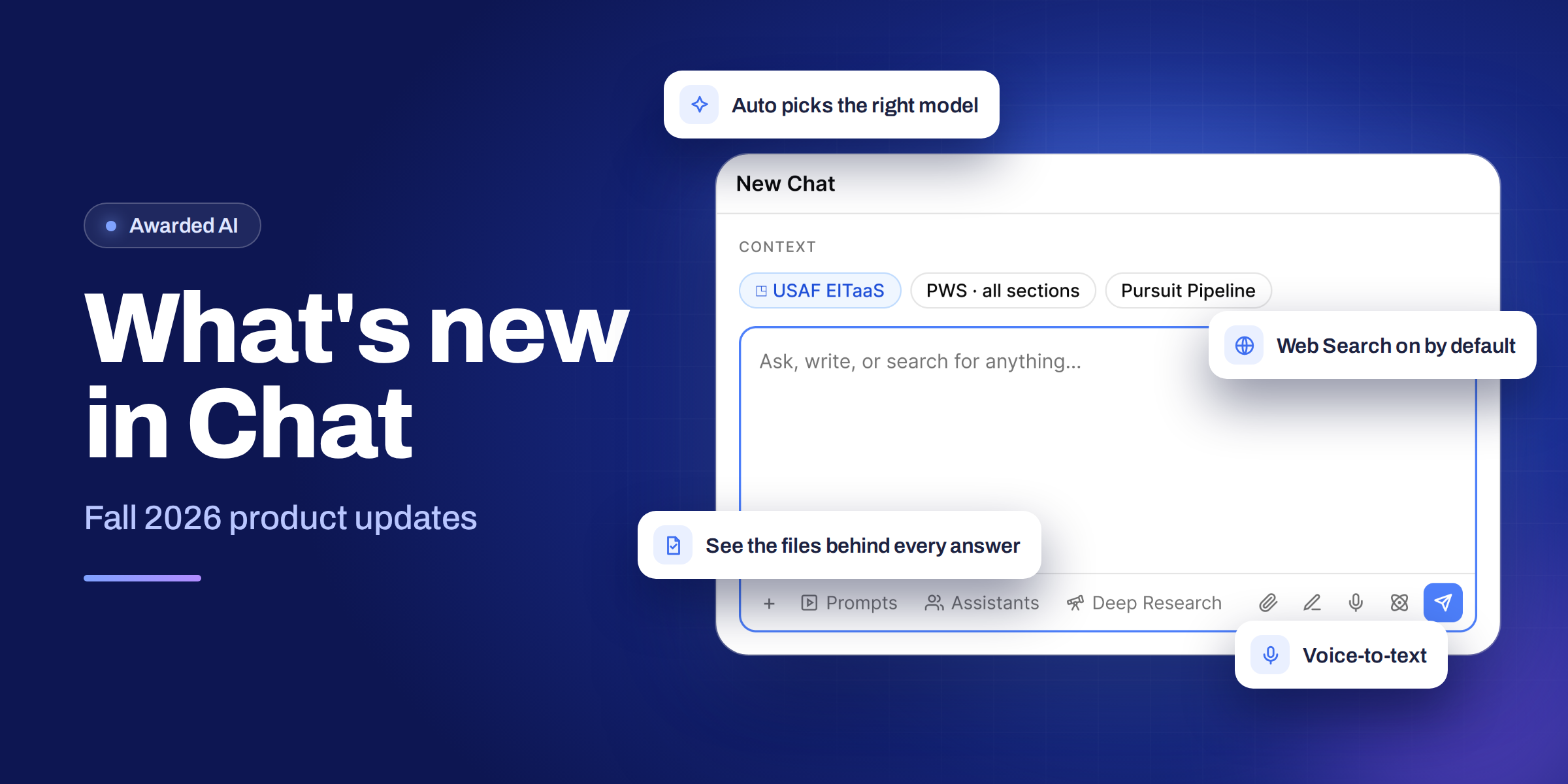
What's New in Awarded AI Chat: Fall 2026 Product Updates
Over the last few weeks, we shipped a steady run of small but mighty improvements to Chat in Awarded AI. Together, they change how it feels to do real capture and proposal work in Chat.
What's New in Awarded AI Chat: Fall 2026 Product Updates
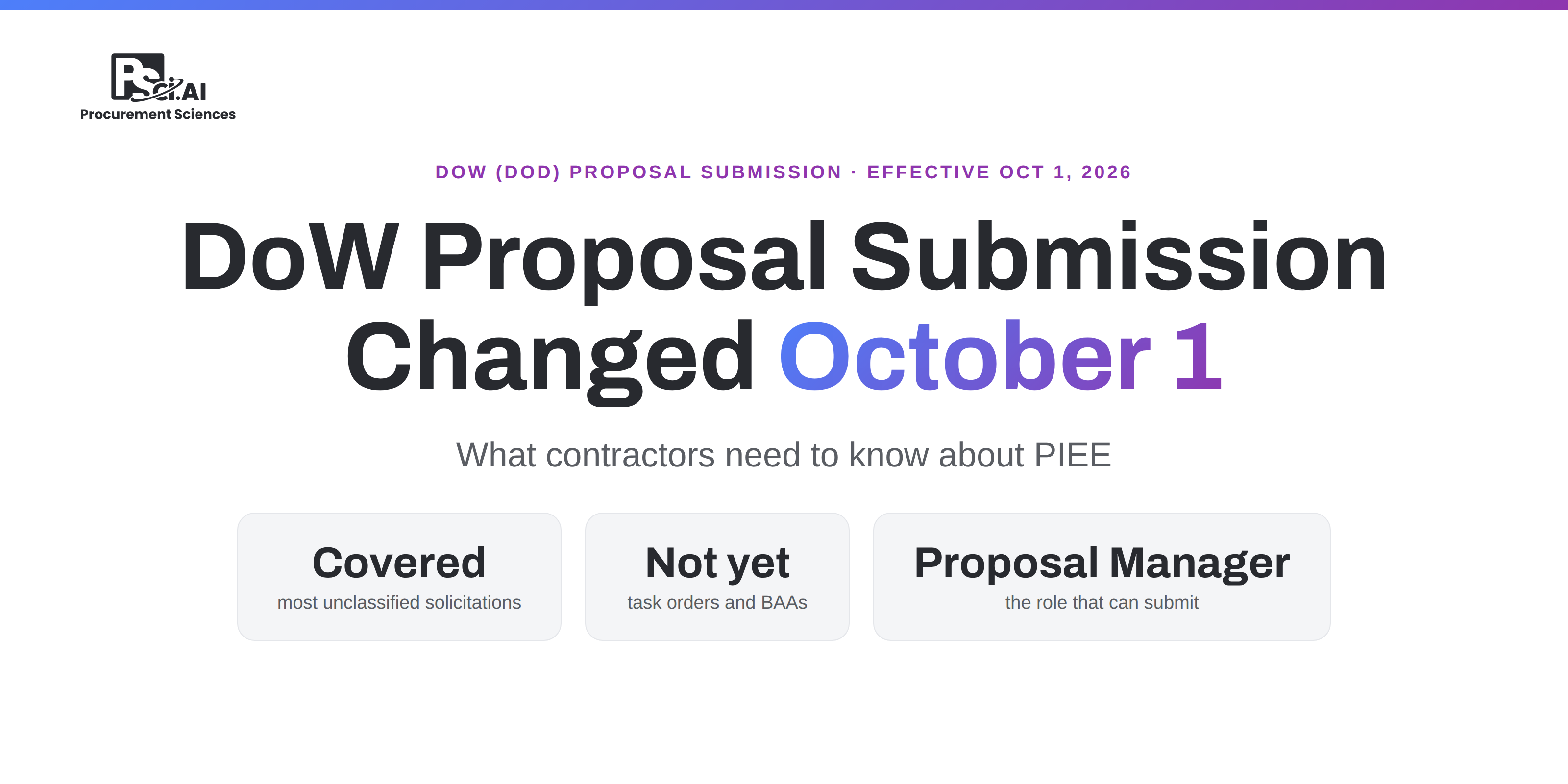
DoW Proposal Submission Changed October 1: What Contractors Need to Know About PIEE
As of October 1, 2026, Department of War (DoW) contracting officers must publish unclassified solicitations and receive offers through the PIEE Solicitation Module, unless an exception applies.
DoW Proposal Submission Changed October 1: What Contractors Need to Know About PIEE
.png)
What Is SEWP VI? A Guide to NASA's Next-Generation IT GWAC
NASA SEWP VI is the sixth generation of one of the federal government's oldest and largest IT acquisition vehicles, a Government-Wide Acquisition Contract (GWAC) that lets any federal agency buy commercial IT, communications, audio/visual, cloud, cybersecurity, and enterprise IT services without running its own competition.
What Is SEWP VI? A Guide to NASA's Next-Generation IT GWAC