
Claude for Government Contracting: Claude vs. Purpose-Built AI

Claude has become a widely used generative AI platform for research, writing, document analysis, coding, and complex reasoning. For government contractors, however, evaluating Claude involves more than asking what the model can do.
Teams also need to consider how Claude fits into government contracting workflows, which Claude environment they are using, what information they plan to process, and whether a general-purpose AI platform or a purpose-built GovCon platform better fits the work.
Those questions have become particularly important as Anthropic expands Claude for Government and its work across the U.S. public sector.
Here’s what government contractors should know.
What Is Claude?
Claude is Anthropic's family of AI models and applications designed for tasks including writing, research, analysis, coding, document processing, and increasingly agentic workflows.
Depending on the product and deployment, teams can use Claude to:
- Analyze and summarize documents
- Draft and revise content
- Conduct research and synthesize information
- Work with large amounts of context
- Analyze data and complex information
- Write and review code
- Connect Claude to other applications and data sources
- Build AI-powered workflows and agents
For a government contracting team, those capabilities can translate into useful applications such as researching an agency, summarizing a solicitation, brainstorming win themes, analyzing documents, or helping draft proposal content.
But Claude itself is not a government contracting workflow platform.
That distinction becomes important as organizations move from experimenting with AI to operationalizing it across BD, capture, and proposal teams.
Can Government Agencies and Contractors Use Claude?
Yes, but the answer depends heavily on which Claude environment is being used and what information is being processed.
Anthropic offers Claude for Government, a FedRAMP High-authorized version of its Claude application. Anthropic says it is available to U.S. federal, state, and local agencies and qualifying public-sector organizations, with additional deployment options available through government cloud environments.
Anthropic also offers specialized Claude Gov models for U.S. national-security customers operating in classified environments. These models have been adapted for applications such as intelligence analysis, operational support, threat assessment, and cybersecurity.
That means "using Claude for government" can refer to very different environments.
A user working with public information through a commercial Claude account is not in the same situation as an organization processing sensitive government information through an authorized government environment.
What About CUI and Sensitive Government Information?
This is where government contractors need to pay particularly close attention.
Federal requirements distinguish between using public AI applications with public or non-sensitive information and using AI services to process protected federal information.
Anthropic says Claude for Government operates in a FedRAMP High-authorized environment and can support CUI and FIPS 199 High Impact data. Anthropic also offers Claude through government cloud configurations with different authorization levels.
For contractors, the takeaway is not simply that "Claude is approved" or "Claude isn't approved."
The relevant questions are:
- Which Claude product or deployment are you using?
- What information will be entered or connected?
- What authorization level does the work require?
- What does the applicable contract require?
- What controls has your organization approved?
A commercial Claude account and Claude for Government should not be treated as interchangeable environments.
Claude's Government Policies Are Changing Too
The technical capabilities are only part of the story.
Anthropic has also changed how its Usage Policy applies to certain government customers. In 2026, Anthropic said it may negotiate tailored restrictions with selected government entities based on factors including their legal authorities, mission, safeguards, and oversight.
For example, Anthropic says certain government arrangements may permit legally authorized foreign-intelligence analysis while restrictions continue to apply to areas including disinformation campaigns, weapons, censorship, domestic surveillance, and malicious cyber operations.
Anthropic has also been involved in a dispute with the U.S. defense establishment over restrictions the company sought to retain around certain military and surveillance applications of Claude.
For government contractors, this creates an important distinction: Claude's availability, authorization, and acceptable use can depend on the customer, environment, contract, and mission.
Teams evaluating Claude should verify current requirements for their particular contract and deployment rather than relying on assumptions based on consumer Claude or older AI policies.
Claude is also introducing AI-generated content watermarking. Anthropic has begun applying invisible text watermarking to newer Claude models as part of its compliance with the EU AI Act. The watermark is designed to indicate the likelihood that Claude was involved in generating text without adding visible labels, hidden characters, or information identifying the user or organization. Anthropic is also rolling out detection capabilities to eligible organizations, with broader access planned over time.
Where Claude Can Help Government Contractors
Used in an appropriate environment, Claude can be valuable across a range of GovCon tasks.
Research and analysis
Teams can use Claude to synthesize documents, research topics, analyze large amounts of information, and explore complex questions.
Solicitation analysis
Claude can help users review lengthy solicitations, summarize requirements, identify themes, and interrogate uploaded documentation.
Drafting and editing
Proposal professionals can use Claude to generate first drafts, rewrite sections, summarize source material, brainstorm approaches, and refine existing content.
Knowledge work
Claude's large-context capabilities can make it useful for working across substantial document sets and extracting relevant information.
Coding and technical workflows
Claude's coding and agentic capabilities extend its usefulness beyond traditional chat and document generation into software development and automated workflows.
These are meaningful capabilities. But access to a capable AI model and having a system designed around the government contracting lifecycle are different things.
Claude vs. Purpose-Built AI for Government Contracting
The central difference is what the platform was designed to do.
Claude is a broad AI platform that can be applied across thousands of use cases.
Procurement Sciences is built specifically around government contracting workflows. Following the acquisition of HigherGov, the platform combines government market intelligence with AI-powered workflows across the contracting lifecycle.
HigherGov helps teams find and evaluate opportunities, understand agencies and markets, track recompetes, and identify potential partners. Awarded AI supports the capture, proposal, pricing, review, and delivery workflows that turn those opportunities into pursuits.
Claude can assist with many individual research, analysis, and writing tasks. Procurement Sciences is designed to connect the data, intelligence, and workflows government contractors use to find and win work.
For example, a GovCon team using a general-purpose AI assistant may need to develop its own processes around:
- Opportunity discovery and analysis
- Bid/no-bid evaluation
- Competitive research
- Capture strategy
- Requirement analysis
- Compliance workflows
- Proposal development
- Review and collaboration
- Reusing organizational knowledge across pursuits
A purpose-built platform can structure those activities directly into the workflow rather than requiring teams to design each process around a general AI assistant.
That doesn't necessarily make the two mutually exclusive.
For many organizations, horizontal AI applications and purpose-built GovCon AI can serve different purposes.
Claude vs. Procurement Sciences
The easiest way to think about the distinction is general AI capability vs. GovCon workflow specialization.
The relevant question therefore isn't simply: "Which AI is better?"
It's: "Are we looking for broad AI capabilities, or an AI platform already structured around how our GovCon team works?"
For many organizations, the answer may ultimately include both.
Claude Pricing and Evaluation Considerations
Claude pricing varies depending on how an organization accesses the models.
Commercial Claude plans, enterprise deployments, API usage, Claude for Government, and government cloud deployments can all have different pricing models.
For government contractors, cost comparisons should therefore account for more than subscription price.
Teams may also want to evaluate:
- Required deployment environment
- Model and API consumption
- Security and compliance requirements
- Integrations
- Internal development requirements
- Workflow configuration
- Governance and administration
- Training and adoption
- Ongoing maintenance
This is particularly important when comparing a general-purpose AI platform with a purpose-built application.
The cost of accessing an AI model and the cost of operationalizing AI across an organization are not necessarily the same thing.
Should Government Contractors Use Claude?
Claude can be a powerful part of a government contractor's AI strategy.
For general research, analysis, drafting, coding, and knowledge work, it offers increasingly sophisticated capabilities. Anthropic's expansion into government-specific environments also means Claude's government story is substantially different from what it was even a short time ago.
But organizations evaluating AI for government contracting should also consider how much workflow structure they want to build themselves.
General-purpose AI gives teams flexibility.
Purpose-built GovCon AI connects AI to the market intelligence, workflows, and processes teams use to pursue government opportunities.
For many organizations, the decision may not ultimately be Claude or Procurement Sciences. The more useful question is which workflows belong in a horizontal AI environment and which benefit from a platform purpose-built for government contracting.
Teams evaluating general-purpose AI may also want to see how AI for government contracting compares with ChatGPT.
Frequently Asked Questions
What is Claude for Government?
Claude for Government is Anthropic's government-focused Claude offering. Anthropic provides Claude in a FedRAMP High-authorized environment, with additional government cloud deployments available for different security requirements.
Can government contractors use Claude?
Yes, but the appropriate environment depends on the information being processed, contractual requirements, and the contractor's security obligations. Commercial Claude and government-authorized Claude environments should not be treated as interchangeable.
Can Claude be used with CUI?
Anthropic states that Claude for Government can support CUI in its FedRAMP High environment. Contractors should still verify that the specific deployment, configuration, contract, and organizational controls meet their requirements.
Is Claude FedRAMP authorized?
Claude for Government is available in a FedRAMP High-authorized environment. Other Claude deployments may have different authorization levels, so organizations should evaluate the specific environment they intend to use.
What can government contractors use Claude for?
Depending on the approved environment, Claude can support research, document analysis, summarization, drafting, coding, data analysis, and other knowledge-work tasks.
Is Claude built specifically for government contracting?
No. Claude has government-specific offerings, but it is a broad AI platform. Purpose-built GovCon platforms such as Procurement Sciences structure AI and market intelligence around opportunity discovery, BD, capture, proposal, pricing, and related government contracting workflows.
What are the best Claude AI alternatives for government contractors?
The right Claude AI alternative depends on the use case. Teams seeking another general-purpose AI assistant may compare Claude with ChatGPT or Microsoft Copilot. Teams looking specifically for government contracting workflows may instead evaluate purpose-built GovCon platforms that combine market intelligence with BD, capture, and proposal execution.
Is Claude or purpose-built GovCon AI better for proposal writing?
Claude can support drafting, editing, summarization, and document analysis. Purpose-built GovCon platforms add workflows and context designed specifically around government proposals, including requirements, compliance, capture strategy, organizational knowledge, and review processes. The appropriate approach depends on whether a team needs general writing assistance or broader proposal workflow support.
Does Claude watermark AI-generated content?
Yes. Anthropic has introduced invisible text watermarking for newer Claude models to support AI-generated content transparency requirements. The watermark does not visibly alter the text or identify the individual user, organization, or conversation.
Choosing the Right AI Approach for GovCon
AI adoption in government contracting is moving beyond simply giving employees access to a chatbot.
The next question is how AI fits into the workflows, information, security requirements, and operating processes that determine how teams actually pursue and win government business.
Claude offers increasingly sophisticated general-purpose AI capabilities and an expanding government footprint.
Procurement Sciences takes a different approach by combining HigherGov's government market intelligence with Awarded AI's structured workflows across BD, capture, proposals, pricing, and delivery.
See how Procurement Sciences connects market intelligence and AI across the GovCon lifecycle. Request a demo.
Click here to schedule a demo to get the full scoop on how our product actually works and discover how AI can transform your approach to government contracting.
Explore More Resources
How to Find IDIQ Contracts and Task Order Opportunities
Open IDIQ solicitations are posted on SAM.gov like any other contract opportunity. Task orders issued under IDIQs you already hold are a different problem entirely, since most never touch SAM.gov at all.
How to Find IDIQ Contracts and Task Order Opportunities

What Is an IDIQ Contract? A Guide for Government Contractors
Indefinite Delivery, Indefinite Quantity (IDIQ) is a federal contract vehicle that lets an agency order an unknown amount of supplies or services, within stated limits, over a fixed period of time, rather than committing to a fixed quantity up front.
What Is an IDIQ Contract? A Guide for Government Contractors
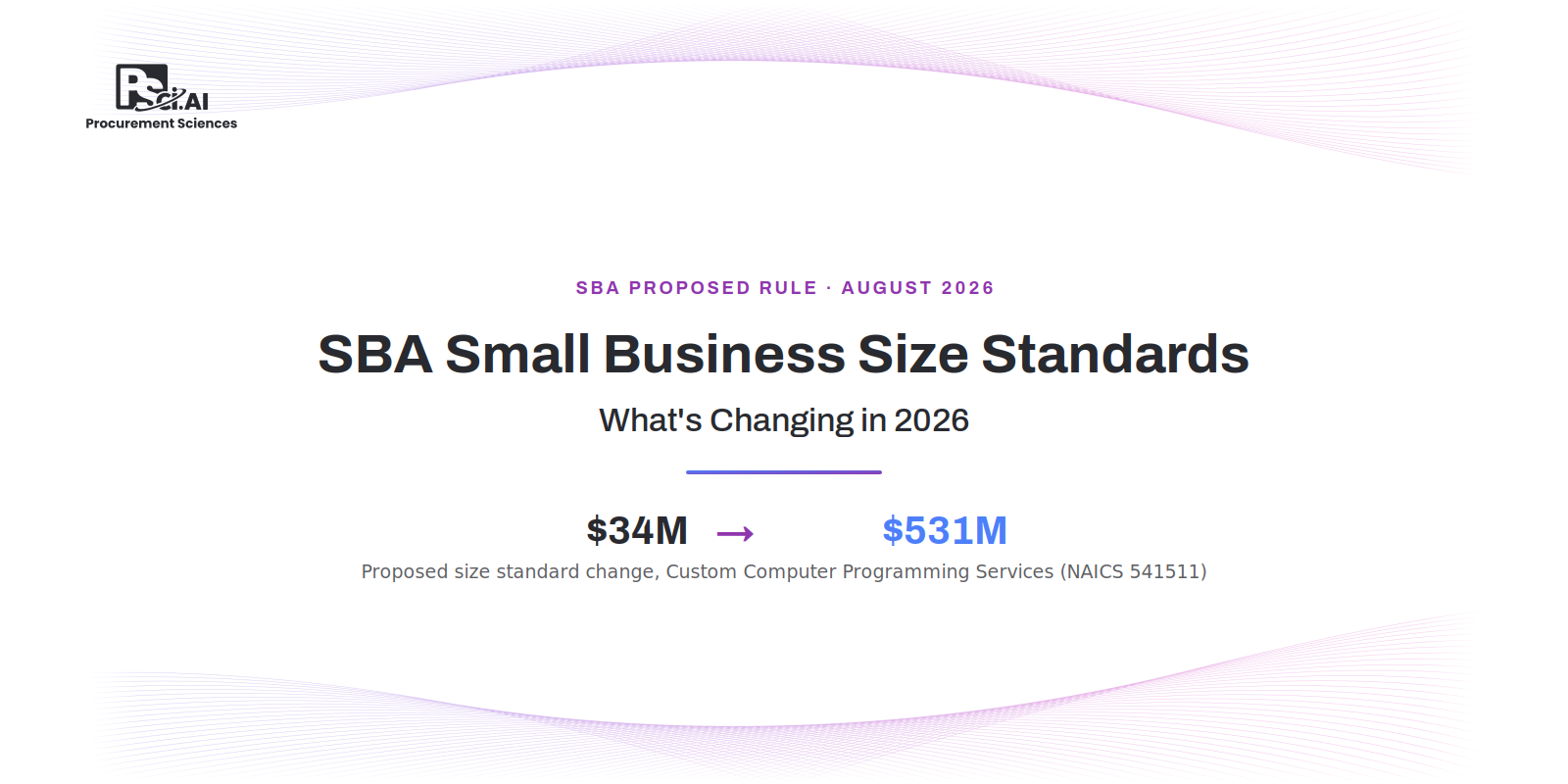
SBA Small Business Size Standards Are Changing: Here's What Government Contractors Need to Know
On August 20, 2026, the Small Business Administration (SBA) published a proposed rule that would rewrite its small business size standards, the thresholds that determine which companies qualify as "small" for federal contracting, SBA loans, and related programs.
SBA Small Business Size Standards Are Changing: Here's What Government Contractors Need to Know