
Webinar Recap: AI Is Changing Proposal Teams, How Teams Find, Evaluate, Partner, and Win Faster

Procurement Sciences recently presented at an APMP sponsored webinar on how artificial intelligence is transforming proposal teams: not just in the mechanics of writing, but across the entire BD lifecycle. The session was designed to help practitioners understand where AI stands today, what is coming in the next five years, and what concrete steps proposal professionals can take now to stay ahead.
Bruce Feldman, AI Platform Strategist at Procurement Sciences, led the presentation. With thirty years of GovCon BD experience spanning capture management, proposal management, and executive leadership, Bruce approaches AI from the practitioner's chair, not the engineer's. His framing throughout: skate to where the puck is going, not where it sits.
What Generative AI Actually Does and Why It Matters for Proposals
Bruce opened with a clarification that matters for anyone evaluating AI tools: the large language model, the engine that generates text, is only part of what makes a platform useful. The surrounding software environment, how information is conditioned before it reaches the model and how output is formatted when it comes back, is equally important. Both components together constitute the platform, and the quality of the surrounding software is often what separates a purpose-built GovCon tool from a general-purpose one.
What the platform does that is genuinely remarkable comes down to two things. First, it writes well. Grammatically correct, syntactically clean, no spelling errors. There is still work to do on tone and style, and AI-generated content can feel formulaic if it is not handled carefully. But the fact that it writes competently at all, and does so at speed, is significant. The blank page problem that slows every proposal process is largely solved.
Second, when the platform is well designed, it can ingest information from multiple sources, synthesize it, and produce coherent output. The quality of what goes in, what Bruce calls context, directly determines the quality of what comes out. Specific, relevant input yields specific, relevant output. Generic input yields generic output. That relationship is the core discipline of using AI effectively for proposals.
Where the Industry Stands: Three and a Half Years In
Generative AI became publicly viable around late 2022. In the roughly three and a half years since, more than eighty percent of government contractors have adopted it in some capacity. That penetration rate, measured by McKinsey, is faster than mobile phones, faster than the iPad, faster than the internet.
The efficiency gains are real. Procurement Sciences customers report anywhere from thirty to eighty percent reductions in time spent on labor-intensive, repetitive tasks. Compliance matrices that used to take days now take hours. First drafts that took a week can now be ready for human review in a fraction of the time. Revision cycles after red team are compressing. These are not marginal improvements.
Beyond speed, there is a quality dimension. AI can surface relevant past performance, identify capability gaps, and draw connections across a company's knowledge base that a human researcher might miss simply due to time constraints. The best informed team tends to win. AI expands what it is possible to know before a proposal ships.
There is also a workforce dimension that does not show up in efficiency metrics but matters to anyone who manages proposal teams: AI gives people time back. Burnout is a real and recurring cost in this industry. Tools that reduce the pressure of constant deadlines have genuine organizational value, even when that value is hard to quantify in a business case.
The AI Super Cycle and What It Means for Cost
The infrastructure buildout happening right now, data centers, chip capacity, electrical grid investment, connectivity, follows a recognized pattern. It took roughly two decades to build out the cell tower infrastructure that made mobile phones universally accessible. The AI equivalent is happening faster, but the underlying dynamic is the same: enormous capital investment today in anticipation of future demand. At some point, the bill comes due to the users.
Token costs, the unit cost of actual AI usage, are already catching teams off guard. Companies that did not model their usage carefully have found themselves well over budget. As AI becomes more deeply embedded in workflows and usage scales up, cost management becomes a genuine discipline rather than an afterthought.
The practical implication is not to slow down on AI adoption. It is to build cost governance into the process from the start, track usage at a meaningful level of granularity, and select platforms with the architectural flexibility to optimize cost as the model landscape continues to evolve.
Technologies Reshaping Proposals in the Next Five Years
Agents and agentic systems. An AI agent, in practical terms, is when the platform takes action on your behalf without you explicitly invoking it. A research request that automatically triggers a web search, retrieves relevant sources, and synthesizes them into the model's response is a simple example. Agents are already in widespread use; what is coming is greater sophistication. Agentic systems take this further: multiple models working in concert, each specialized for a different role, coordinated by an orchestrating model. One model drafts, another reviews, a third revises. The practical benefit is cost optimization: you use a higher-capability, higher-cost model for complex reasoning tasks and a lower-cost model for high-volume, repetitive ones.
Knowledge graphs. Gartner projected that seventy percent of leading generative AI implementations would incorporate knowledge graphs, and adoption is accelerating. The distinction matters for proposals: a standard database holds facts about entities; a knowledge graph holds the relationships between them. For capture and proposal work, that means connecting a contracting officer to their job history, connecting that history to the solicitations their previous office released, and connecting those patterns to how an evaluation board is likely to approach scoring. That relational layer makes the AI's outputs substantially more nuanced and significantly reduces hallucination.
Predictive analytics. P-win assessment, price-to-win estimation, forecast of evaluation criteria before an RFP drops: these are the questions capture and proposal teams have always grappled with, usually through judgment and experience rather than rigorous analysis. Predictive analytics tools, integrated with generative AI platforms, will make these estimates more defensible and more accurate. Bruce described a past boss who insisted every bid's P-win be reported as forty percent regardless of the real assessment. The tools coming will make that kind of institutional fiction harder to sustain, and the decisions better for it.
Performance monitoring. Right now, most AI platforms offer limited visibility into how the system is performing and where it is falling short. That is changing. Expect platforms to surface metrics on task completion times, error rates, rework costs, and system bottlenecks, with dashboards that let proposal managers and leadership make informed decisions about workflows, training, and platform configuration. Instrumentation of the AI platform itself is an underappreciated capability with significant downstream value.
Specific Use Cases for Proposal Teams
Library management. Curating a company's proposal knowledge base is chronically under-resourced. There is rarely time to go back through every proposal written, extract the strongest content, and organize it for easy retrieval. AI can automate much of that process: ingesting content, assessing relevance, extracting key passages, and depositing them in the right place in the knowledge base. Humans stay in the loop as reviewers and quality managers rather than doing the mechanical work themselves.
Proposal reviews. Color team reviews, particularly red teams, involve reconciling dozens of comment threads, identifying compliance gaps, and assessing whether the proposal is generating enough strengths to score well. AI can help at every stage: consolidating reviewer comments, flagging inconsistencies, checking compliance at the line level, and evaluating the proposal against anticipated evaluation criteria. The goal is not to remove human reviewers but to make their time more focused on judgment rather than mechanics.
Cost estimation and BOE development. As fixed-price contracting becomes the government's default, the ability to build rigorous, defensible Basis of Estimate documentation becomes more important. AI can help bridge the gap between a technical approach and a price, suggest cost estimating methodologies, model labor category trade-offs, and help teams understand what price point actually positions them to win given the evaluation methodology in play.
Mining company data. Every company has capabilities buried in proposals written two or three years ago, in CPARs that were never systematically reviewed, in program documentation that lives in a corner of SharePoint no one has opened recently. AI can surface relevant content using natural language search rather than clumsy keyword queries. It can find the past performance that best supports a current claim, even when the person who wrote it has left the company.
Adapting to AI-assisted government evaluation. The government is already using AI for compliance checking, and is actively piloting its use for evaluating non-cost factors: strengths, weaknesses, risks, and deficiencies. Bruce was candid that the specifics of which models and prompts agencies are using are unlikely to be disclosed anytime soon. But teams can use their own AI to analyze award debriefs, track how evaluation feedback is shifting over time, and adapt their approach to score better in an environment where the evaluator may not be entirely human.
Human in the Loop: Still the Right Default
Bruce returned to this point repeatedly throughout the session. Proposals are contractually binding documents. An AI-generated assertion that turns out to be inaccurate, a hallucinated citation in a protest, a commitment the company cannot keep: these carry real legal and reputational consequences. The Court of Federal Claims has already sanctioned companies for submitting AI-generated protests with fabricated legal citations. The GAO has documented its unhappiness with the same pattern.
The right posture is not to avoid AI. It is to keep humans accountable for the final content. AI drafts, researches, reviews, and flags. Humans decide what to use, what to change, what the strategy is, and what the company is willing to stand behind in a contractually binding submission. That division of responsibility is where the efficiency gains come from without the risk.
The Call to Action
Prepare for outcome-based thinking internally. The government is moving toward fixed-price, outcome-based contracting. Teams that start measuring what proposal tasks actually cost, and using AI to identify where those costs come from, will be better positioned both to manage their own operations and to write proposals that speak the government's language.
Prioritize user trust. Adoption stalls when people do not trust the output. That trust is built through transparency about what the AI is doing and where it is sourcing information, through training that builds real proficiency rather than superficial familiarity, and through platforms that invite verification rather than discouraging it.
Future-proof your platform selection. The technology is moving fast. A platform that cannot accommodate agents, agentic architectures, knowledge graphs, and predictive analytics in the next few years will leave teams with technical debt and a growing gap relative to competitors who chose more wisely. Ask vendors directly how they are planning for these capabilities before committing.
Let your people experiment. The teams pulling ahead are not the ones who implemented AI once and called it done. They have people whose job includes staying current with what is possible, testing new approaches, and bringing what works back into the organization. Building that culture of continuous learning is how you stay ahead of a market that is not slowing down.
Want to see how Procurement Sciences supports proposal teams across the full BD lifecycle? Book a demo to talk through your specific use cases.
Click here to schedule a demo to get the full scoop on how our product actually works and discover how AI can transform your approach to government contracting.
Explore More Resources
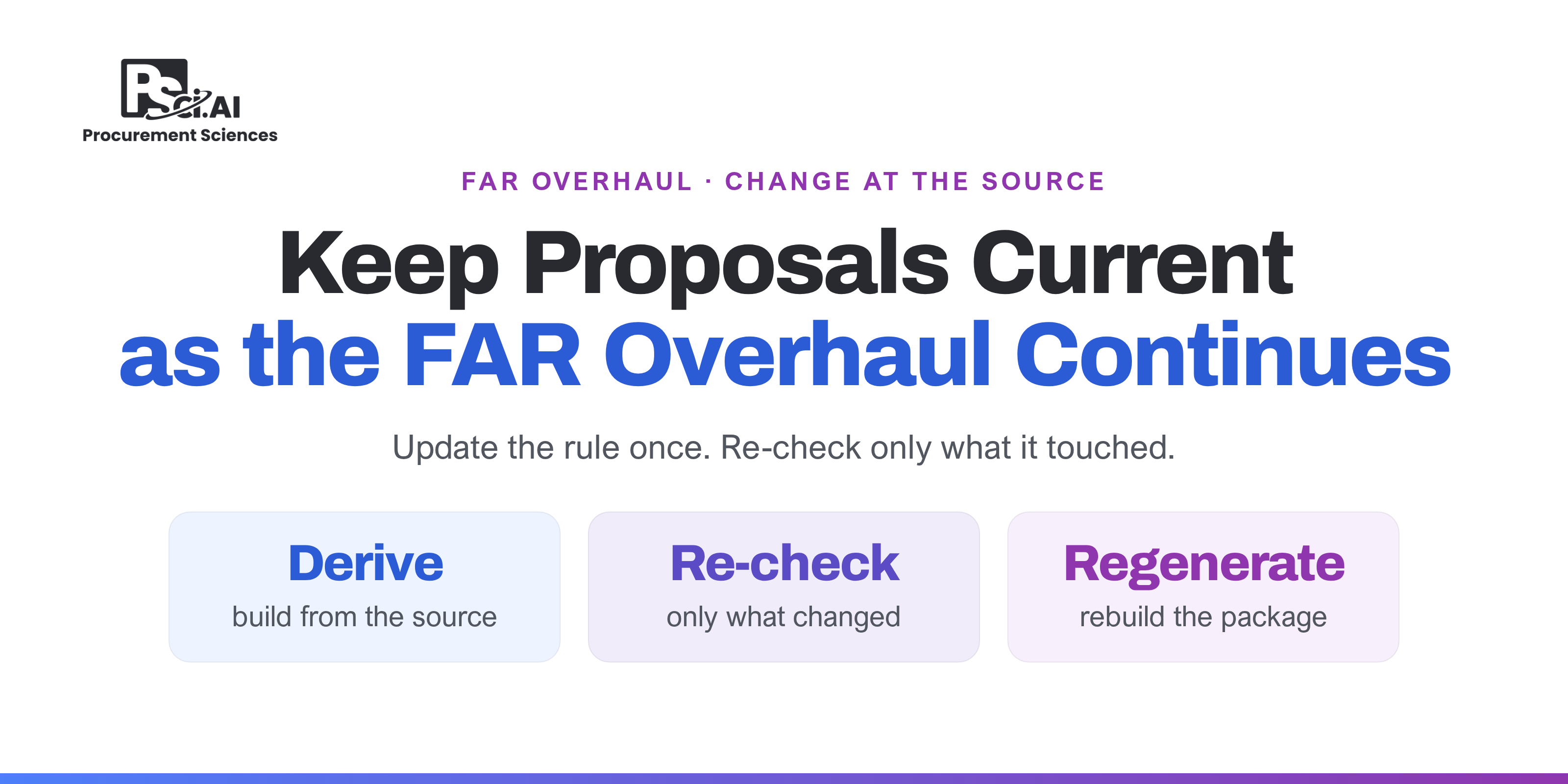
How to Keep Proposals Current as the FAR Overhaul Continues
The FAR overhaul means the rules governing your bid can change while you write it. The fastest way to keep up is to organize your proposal content so every item traces back to the rule it relies on. Update the rule once, and you know exactly what to re-check. We call this Change at the Source.
How to Keep Proposals Current as the FAR Overhaul Continues
Webinar Recap: Outgrowing Small Business, Using AI to Write and Win Like a Prime
Procurement Sciences recently joined APMP for a webinar on one of the most challenging transitions in government contracting: what happens when a small business outgrows its set-aside protections and has to compete in the full and open market against primes with ten times the resources.
Webinar Recap: Outgrowing Small Business, Using AI to Write and Win Like a Prime
Microsoft Copilot Alternatives for Government Contracting: What GovCon Teams Should Know
Microsoft Copilot has become a significant part of the enterprise AI landscape, bringing generative AI directly into applications many government contractors already use every day.
Microsoft Copilot Alternatives for Government Contracting: What GovCon Teams Should Know