
How to Find Government Contracts: 5 Ways AI Can Help You Focus on the Right Opportunities

Finding government contracts is not usually the hard part.
SAM.gov alone gives contractors access to active federal opportunities, with filters for factors such as NAICS codes, set-aside status and federal organization. Contractors can also monitor agency procurement forecasts for requirements that may be coming before a formal solicitation is released.
The harder question is: Which opportunities are actually worth pursuing?
A keyword match can tell you that an opportunity mentions cybersecurity, cloud migration or professional services. It cannot tell you whether your company has the right past performance, customer experience, contract access, staffing or competitive position to justify months of capture and proposal effort.
That is where AI can be more useful. Instead of simply helping teams find more government contracts, AI can help BD and Capture teams evaluate opportunities against the factors that make them a better fit for the company.
Here are five ways to use it.
1. Go beyond keyword searches and look for actual company fit
Keyword searches are a useful starting point, but they can create a noisy pipeline.
A contractor searching for “cloud modernization,” for example, may find dozens of opportunities containing the phrase. Some could be the wrong size. Others could require past performance your company does not have, a vehicle you cannot access or a socioeconomic status you do not hold.
Start by defining what a good-fit opportunity looks like for your organization.
That may include:
- Target agencies and buying offices
- NAICS and PSC codes
- Preferred contract sizes
- Set-aside eligibility
- Contract vehicles you can access
- Relevant capabilities
- Geographic requirements
- Past-performance requirements
- Known customer relationships
SAM.gov allows contractors to search federal opportunities by criteria including NAICS and set-aside status. The real opportunity for AI is to layer your company-specific qualification criteria onto that market data.
Instead of asking: Which opportunities mention our capabilities? Ask: Which opportunities match our capabilities, customers, contract profile and proven experience?
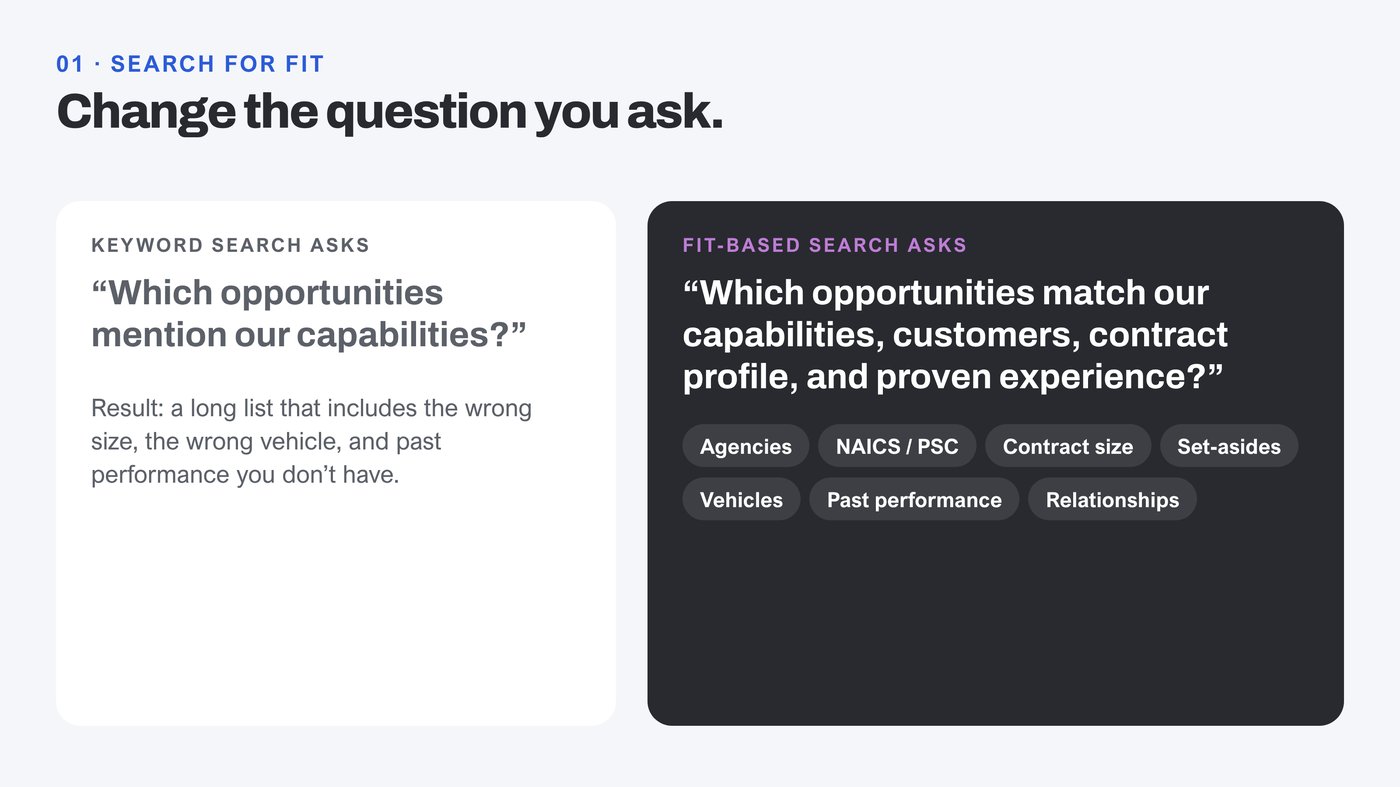
That produces a much more useful starting list.
2. Compare the requirement to work you have actually performed
An opportunity can sound perfect until you read the Performance Work Statement. That is why qualification should go beyond a solicitation title or a few matching terms.
For each potential pursuit, compare the actual scope of work against your company’s past performance.
Look for questions such as:
- Have we performed comparable work before?
- Was it at a similar scale?
- Have we supported this agency or mission area?
- Do we have relevant technical experience?
- Can we point to measurable outcomes?
- Would our past performance likely be considered relevant under the solicitation’s criteria?
AI can help teams review a requirement against a larger body of company knowledge much faster than manually opening old proposal folders one at a time.
But this is also where grounding matters. The goal is not to have an AI model decide that you are qualified because two documents use similar language. The goal is to use verified company information to surface relevant experience for a human Capture or BD leader to evaluate.
A pursuit becomes more interesting when the answer is not merely “we can do this,” but “we can show where we have done something meaningfully similar before.”
3. Research the incumbent and competitive landscape before committing resources
Finding the opportunity is only one part of qualification. Before moving a pursuit forward, ask what you know about the existing contract and competitive environment.
Historical federal award data can help answer questions such as:
- Who is the incumbent?
- How long have they held the work?
- What agency or contracting office bought it?
- What contract vehicle was used?
- How large has the award been?
- Was it competed?
- Was it set aside?
- Have there been modifications or follow-on awards?
- Which companies regularly win similar work?
Public contract award data is now searchable through SAM.gov, including filters for agencies, businesses, NAICS/PSC information, competition and set-aside type. SBA also recommends historical award information as a resource for contractors researching federal markets.
AI can help organize that research and surface patterns faster. But the important output is not simply an incumbent name.
It is a better Capture question: What would have to be true for us to win this work?
If the incumbent has held the requirement for years, has strong agency relationships and appears well positioned for the recompete, that does not automatically mean “no-bid.” It does mean you should understand the competitive challenge before committing proposal resources.
4. Find opportunities earlier than the solicitation
If your search process starts when an RFP appears, you may already be late.
Federal agencies publish procurement forecasts specifically to give industry earlier visibility into potential future requirements. Acquisition.gov maintains links to recurring forecasts across major federal agencies, and current federal acquisition guidance emphasizes forecasts as a way to increase transparency and help vendors monitor upcoming opportunities.
Early signals can also come from:
- Agency procurement forecasts
- Sources sought notices
- RFIs
- Pre-solicitation notices
- Industry days
- Expiring contracts and recompetes
- Budget and mission priorities
- Changes to acquisition strategy
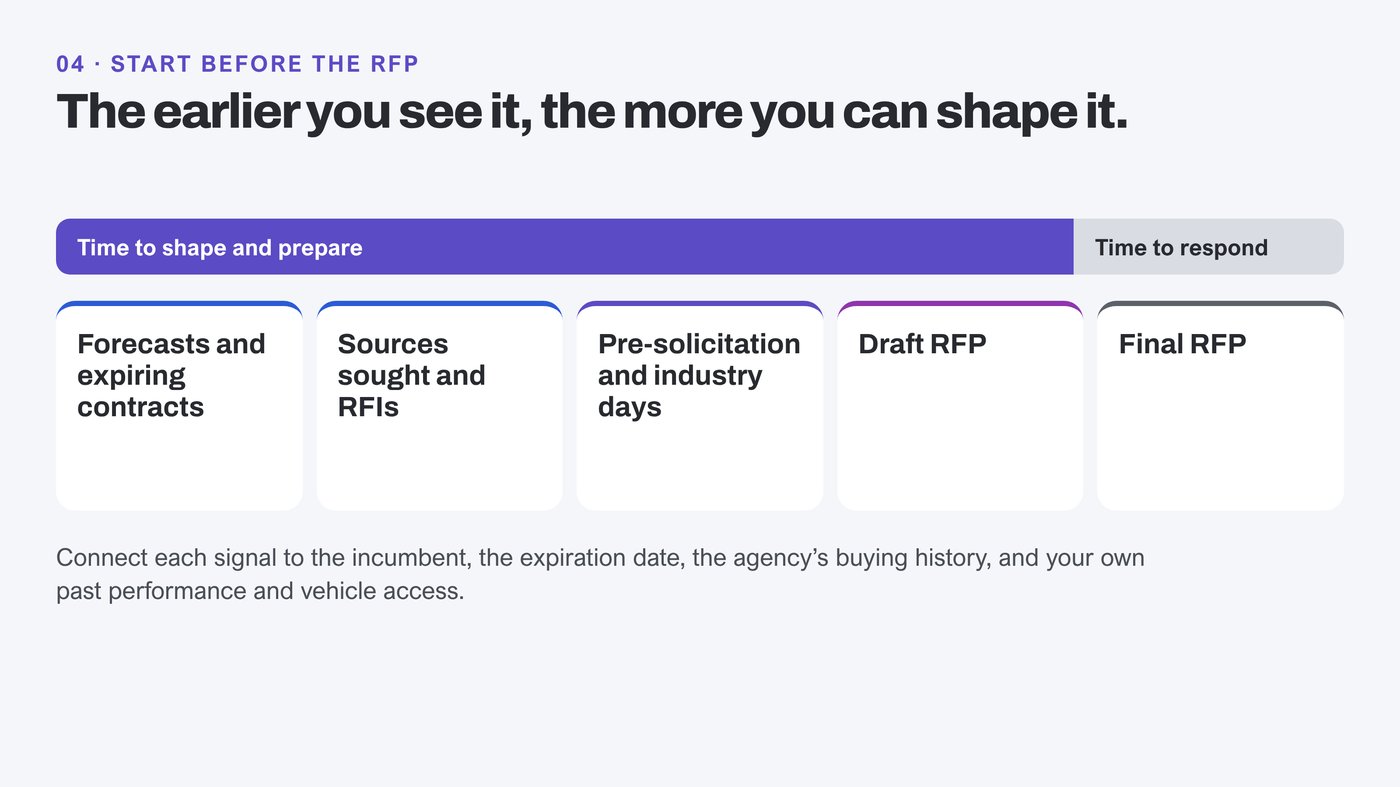
AI becomes useful when it helps teams connect those signals instead of reviewing them one by one.
For example, a forecasted requirement becomes more meaningful when you can also see:
- the incumbent contract,
- the expected expiration date,
- the agency’s buying history,
- your relevant past performance,
- your vehicle access,
- and any gaps you would need to close before competing.
That changes opportunity discovery from “here is an RFP we found” to “here is a potential pursuit we have time to shape and prepare for.”
5. Use explicit qualification criteria to create a shorter pipeline
More opportunities do not necessarily create a healthier pipeline. A pipeline filled with opportunities that your team cannot realistically win consumes Capture time, proposal resources and leadership attention.
The final step is therefore not discovery. It is prioritization. Create consistent bid/no-bid criteria and evaluate each opportunity against them.
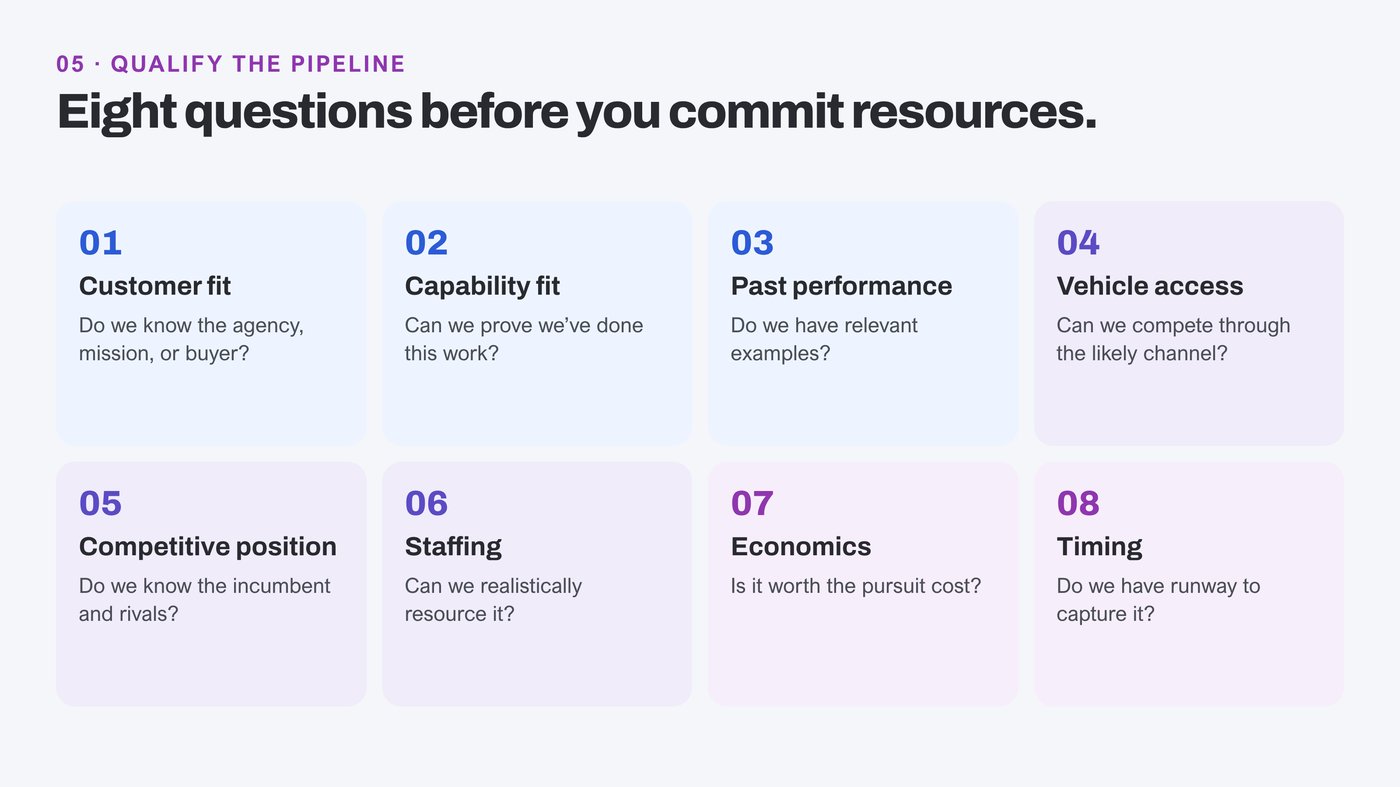
Those criteria might include:
- Customer fit: Do we know the agency, mission or buyer?
- Capability fit: Does the requirement align with work we can prove we have performed?
- Past performance: Do we have relevant examples?
- Vehicle access: Can we compete through the likely acquisition channel?
- Competitive position: Do we understand the incumbent and likely competitors?
- Staffing: Can we realistically resource the work?
- Economics: Is the potential contract attractive enough to justify the pursuit?
- Timing: Do we have enough runway to capture the opportunity properly?
AI can help assemble the information needed to answer those questions consistently. The final decision should still belong to the people responsible for the pursuit.
The goal is not an automated “yes” or “no.” It is a pipeline where the reason for pursuing an opportunity is explicit and evidence-based.
Finding more contracts isn’t the goal
There are more sources of federal opportunity information available to GovCon teams than ever.
SAM.gov provides current procurement notices and award data. Agencies publish forecasts. Historical contract information can reveal incumbent and buying patterns. Market intelligence platforms can bring those signals together.
The competitive advantage comes from what happens next.
The strongest BD teams do not ask: How many opportunities did we find?
They ask: Which opportunities deserve our time?
That is the role AI can play in government contract discovery: connecting market intelligence with company-specific context so teams can move from a large universe of possibilities to a smaller set of qualified pursuits.
Procurement Sciences brings those workflows together through Market Intelligence by HigherGov for opportunity discovery and federal market research and Awarded AI for opportunity qualification and downstream Capture and proposal workflows. The goal is not simply to surface more opportunities. It is to help teams understand which ones fit and move the right pursuits forward.
See how Procurement Sciences helps GovCon teams find and qualify the right opportunities →
Frequently Asked Questions
Where can I find government contracts?
SAM.gov is the federal government’s centralized source for contract opportunities. Contractors can search procurement notices and filter opportunities by criteria such as NAICS code, set-aside status and federal organization. Agencies also publish procurement forecasts that can provide earlier visibility into planned acquisitions.
Can I search SAM.gov for free?
Yes. Anyone can search contract opportunities on SAM.gov without an account. Creating an account adds functionality such as saving searches and following opportunities. An active SAM.gov entity registration is required to bid on federal contract opportunities.
How can AI help find government contracts?
AI can help contractors analyze larger volumes of opportunity and market data, compare requirements with company capabilities and past performance, research historical awards and incumbents, and apply consistent qualification criteria to potential pursuits.
AI is most useful when it works with reliable market and company information rather than simply generating recommendations from a solicitation title or keyword match.
How do I know if a government contract is a good fit for my company?
Look beyond whether your capabilities appear in the solicitation. Evaluate customer fit, relevant past performance, contract size, vehicle access, staffing, competitive position, economics and the amount of capture runway available.
A good qualification process should make the reason for pursuing the contract clear before major proposal resources are committed.
How can I find government contracts before the RFP is released?
Monitor agency procurement forecasts, sources sought notices, RFIs, pre-solicitation activity, industry engagement and expiring contracts. Acquisition.gov maintains links to federal agency procurement forecasts, which can help contractors identify potential opportunities earlier in the acquisition lifecycle.
Click here to schedule a demo to get the full scoop on how our product actually works and discover how AI can transform your approach to government contracting.
Explore More Resources
October 2026 Vulnerability Wave: How Procurement Sciences Responded
Starting in October 2026, the software industry began one of the most intense runs of security disclosures in its history. More than 17,000 new vulnerabilities were reported, about 4% of every vulnerability on record. In response, we moved quickly: we checked every issue against the systems we actually run and applied the updates that mattered.
October 2026 Vulnerability Wave: How Procurement Sciences Responded

Webinar Recap: AI Builds a FY28 Forecast to Guide Your FY27 Planning
Procurement Sciences recently joined GovConWire and Executive Mosaic for a session on a planning problem that every government contracting team faces and few solve well: how do you decide where to invest capture and proposal resources this fiscal year to win contracts that will not even be competed until next fiscal year?
Webinar Recap: AI Builds a FY28 Forecast to Guide Your FY27 Planning
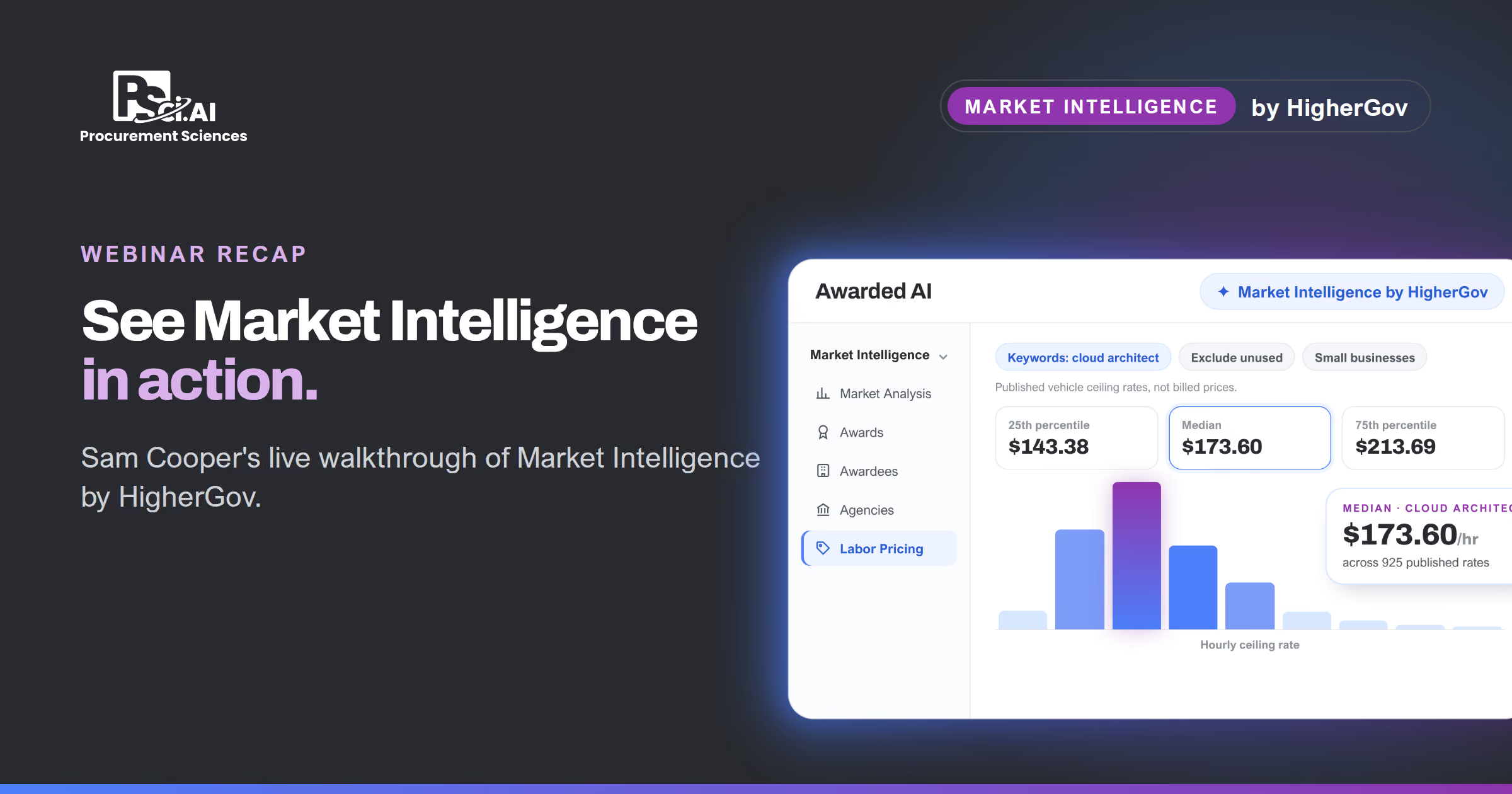
Webinar Recap: Product Spotlight, Market Intelligence by HigherGov Inside Awarded AI
Procurement Sciences recently hosted a product spotlight session on Market Intelligence by HigherGov, the newly integrated data layer now available inside Awarded AI. Sam Cooper, Director of Solutions Consulting, walked through what the integration means in practice, why it matters for the BD lifecycle, and demonstrated it live.
Webinar Recap: Product Spotlight, Market Intelligence by HigherGov Inside Awarded AI