
Webinar Recap: AI Builds a FY28 Forecast to Guide Your FY27 Planning


Procurement Sciences recently joined GovConWire and Executive Mosaic for a session on a planning problem that every government contracting team faces and few solve well: how do you decide where to invest capture and proposal resources this fiscal year to win contracts that will not even be competed until next fiscal year?
Bruce Feldman, AI Platform Strategist at Procurement Sciences, led the session. With more than thirty-five years of government contracting BD experience across capture, proposal management, and executive leadership, Bruce approached the topic as a practitioner. He did not just describe a method. He ran it, using AI to build a real FY28 forecast from the public opportunity data, and walked through what came out.
Why FY27 Is the Year to Plan for FY28
The government fiscal year does not line up neatly with the way most companies plan. Contracting officers are making acquisition decisions for FY28 right now, in the early months of FY27. And the timeline for winning a competitive award runs backward from there.
Bruce laid out the math. For a full and open competition, you might need sixty to ninety days for proposal evaluation, sixty days for proposal preparation, and another thirty to sixty days or more between draft RFP and final RFP. Add the capture work that should precede all of that, and the conclusion is unavoidable: if you want to bid and win effectively in FY28, your work starts in FY27.
For the largest opportunities, the runway is longer. Anything at the billion-dollar scale and above demands capture that begins one to two years or more before the draft RFP appears. A team that waits for the solicitation is already behind.
The Real Constraint Is No Longer Labor
Public opportunity data is available to the entire contracting community. Anyone with a SAM.gov registration can access it. The advantage goes to the team that can aggregate, analyze, and act on it faster and more intelligently than competitors.
Bruce described a maturity model for how companies handle that data. At the lowest level, work is ad hoc: one or two people doing whatever seems best that day. At the middle levels, teams use opportunity aggregators and filters but still spend most of their hours sorting, clicking through links, reading notices, and retyping data into a CRM. At the highest level, AI is integrated directly into the BD platform, has access to the opportunity data, and applies the company's own strategy, account plan, and qualification criteria to filter and rank leads.
The shift at that top level is significant. When AI does the sorting, the limiting factor stops being the labor of a BD practitioner reading everything. It becomes leadership attention: how many opportunities does your leadership have the time and appetite to evaluate and decide on? That is where the constraint should be. Hours that used to go into raw data handling move into the work that actually improves decisions: customer engagement, market intelligence, early P-win estimation, and win strategy.
A related point from systems engineering that Bruce emphasized: every time you re-key, port, or migrate information between systems, you create inefficiency and risk. Each manual handoff is a place where data leaks and errors enter the process. A redesigned workflow keeps the data in one environment.
Building the Forecast: Six Kinds of Signal
A good forecast does not rely on a single source.
Agency forecasts. These advance notices tell industry that something is coming, often before any formal acquisition activity. They do not always match what appears on SAM.gov. Discrepancies between the two should be identified and resolved, and AI can help reconcile them.
Budget documents. The Congressional Budget Justification books show how funding is actually being directed. If an agency advertises an opportunity in an area where Congress has not directed funding, that is worth knowing before you invest.
Formal notices. RFIs, sources sought notices, and similar preliminary announcements. Bruce noted that the revolutionary FAR overhaul gives contracting officers more discretion here. The government is not obligated to publish a sources sought, and may gather the same information other ways. Understanding how a specific customer tends to operate matters.
Expiring contracts. Contract end dates and option periods help you back into likely recompete timing. But the most common outcome is that the government exercises its options, so end dates alone are an incomplete signal.
Informal intelligence. Industry day conversations, discussions with competitors and prospective teammates, and direct dialogue with government personnel never appear in a public record. AI cannot gather this. Your capture managers and BD people have to, and the information needs to be entered into the system with attribution: who said it, when, and exactly what was meant.
Your own company data. Strategy, account plans, past performance, CPARS ratings, current contracts, and growth targets. The AI needs this to tell you what fits, not just what exists.
Fusing these sources is what produces insight a single portal cannot. A contract in an aggregator may show option periods running through 2031, suggesting nothing will happen soon, while an agency forecast signals an early follow-on. The AI can surface that conflict. A human decides what to do with it.
The Five Qualification Questions
Once opportunities are in the forecast, qualification comes down to five questions.
Is it real? Forecasts and expected recompetes do not always materialize. Establishing that an opportunity is actually going to happen comes first.
Does it fit? Does the work align with your account plan, strategy, and bid criteria? Chasing shiny objects is expensive. Capture is an investment of time and money, and focus matters.
Can we win? Do you have the qualifications and capability to score well in an evaluation? If not, what would it take to close the gap?
Can we perform? This goes beyond staffing. For anything more complex than pure staffing, you need confidence that you can deliver on the commitments your proposal will make. A termination or a fixed-price overrun is the cost of getting this wrong.
Is it worth it? Does the financial case make sense? Some opportunities are big swings meant to move the needle. Others are about holding a foothold through a recompete. Both are legitimate, but the decision should be deliberate.
AI can assemble evidence for each of these questions across market data, company data, and informal intelligence. The key requirement is traceability. Every claim in a gate review should link back to its source. If someone asks where an assertion came from, you should be able to point to it.
Where AI Needs a Guardrail
Bruce was direct that AI is not perfect, and the two things it does best, working fast and writing well, are also what make its errors easy to miss. Fluent writing is not the same as accurate writing.
Hallucinations, misinterpreted experience requirements, and missed compliance details are all risks. The mitigation is verification built into the process: restrict the AI to your company data and the government data you have gathered, require citations, and make sure a human reviews and owns the decision. Rankings and fit scores should come only from sources you can audit, not from information the AI pulled from somewhere you cannot see.
The final judgment stays with people. AI enables the work. It does not replace the strategic thinking, relationship knowledge, or accountability that go into deciding where to invest.
Why the Data Needs to Live Inside the Boundary
For teams handling Controlled Unclassified Information, there is a practical architecture point. If your opportunity aggregator and your AI platform are separate, you either pass data across an API, which may not give complete access to the source data, or you pierce the FedRAMP boundary to reach outside data, which is not acceptable in a CUI environment.
The cleaner design keeps everything inside: the opportunity data, your CUI-level company documents, and the AI that works across both. That allows the fusion of public and proprietary data in an environment that is compliant by construction.
What Process Redesign Looks Like
AI can do a lot on top of your existing process. Bruce argued it works even better when you redesign parts of the process around it. A few examples.
An early P-win and a case against. The early P-win should never be treated as final, but it should be part of the gate. AI can also draft the argument for why you should not bid, including the opportunity cost. That gives decision makers both sides.
Automated deferral monitoring. When you defer an opportunity, you do not drop it. Agents can watch for signals that change the picture and resurface it. A set-aside designation shifts to full and open. You win a seat on a GWAC that gives you access to delivery orders you previously ruled out. The government extends a contract and pushes a recompete into the next fiscal year. The team that notices these changes first has an advantage because everyone reacts to the same notice.
Lessons from past stops. If you have previously started capture or a proposal and decided to stop, what did you learn? That history can inform the next qualification decision, if you build the information flow to make it accessible.
The FY28 Experiment: 12,000 Records to a Working Pipeline
The most concrete part of the session was Bruce's own demonstration. He built an FY28 forecast, mostly from SAM.gov plus other sources, limited to opportunities valued at $10 million or more to keep the analysis manageable.
He started with more than 12,000 records. AI filtered them to roughly 3,500 possible competitive opportunities, a reduction of about 70 percent, before applying any company-specific criteria. The filters removed things that would not interest a bidder looking for competitive work:
- Completion contracts where the work is done and no follow-on is expected
- Sole source and FFRDC-related notices
- Task orders on an existing single-award IDIQ, where the follow-on will likely stay with the same vehicle
- Multiple-award contracts, consolidated so that twenty awardees ending is treated as one opportunity rather than twenty
- Records with no evidence of a recompete
He then correlated the results with agency forecasts to establish confidence levels. Where the forecast and the opportunity data agreed, he had higher confidence that the opportunity was real and on schedule.
What the Forecast Showed
A few findings stood out.
- Value is concentrated. About half of the total value sits in roughly 35 competitions out of the 3,500. The billion-dollar-scale opportunities tilt the whole picture.
- Vehicle access is a gate. About half of the competitions are task orders or multiple-award vehicles. Without a seat on the vehicle, as a prime or a sub, you are locked out.
- Q4 timing risk. About a third of the contracts end in the fourth quarter of FY28, when the government is typically moving fastest to obligate funds. That raises the question of whether those actions slip into FY29, which may be worth discussing with the contracting officer.
- Set-asides matter. Close to 40 percent carry a set-aside designation. Large businesses should be thinking about which small and socioeconomic companies would make strong subcontractors. That is a different qualification question, focused on whether the partner knows how to win.
- Thin competition is common. About 24 percent of the competitions received only one offer last time. The usual explanation is an entrenched incumbent. That prompts a decision: engage the competition advocate, challenge the incumbent, or pass.
Bruce also made a point about P-win. An opportunity with twenty potential bidders does not mean a 5 percent chance. Of those twenty, only a few have actually done capture, engaged the customer repeatedly, and made the right investments. The relevant question is not how many might bid but whether yours will be one of the few high-quality offers.
Try It Yourself
- Pull opportunities you qualified a year ago, look at which you won and lost, and ask what the qualification process could have caught earlier.
- Pick one meaningful lead as a pilot (not a must-win, and not a trivial task order) and have AI help assess it against the five questions. Compare the result to a recent gate package built manually. Is the AI more thorough? Is the traceability better?
- For a bigger test, give the AI a block of opportunities, apply a methodology like the one above, and compare the result to your hand-built list. Where they differ, ask why.
The core idea: AI reads what filters cannot. It can go below the metadata into attachments and text, apply your company data, and return a ranked fit. And the quality of the evidence becomes part of the gate. Leadership gets to make decisions based on traceable data rather than instinct alone.
Watch the full webinar recording to learn more.
Want to see how Procurement Sciences supports opportunity identification, qualification, and capture with AI built for government contracting? Book a demo at procurementsciences.com.
Click here to schedule a demo to get the full scoop on how our product actually works and discover how AI can transform your approach to government contracting.
Explore More Resources
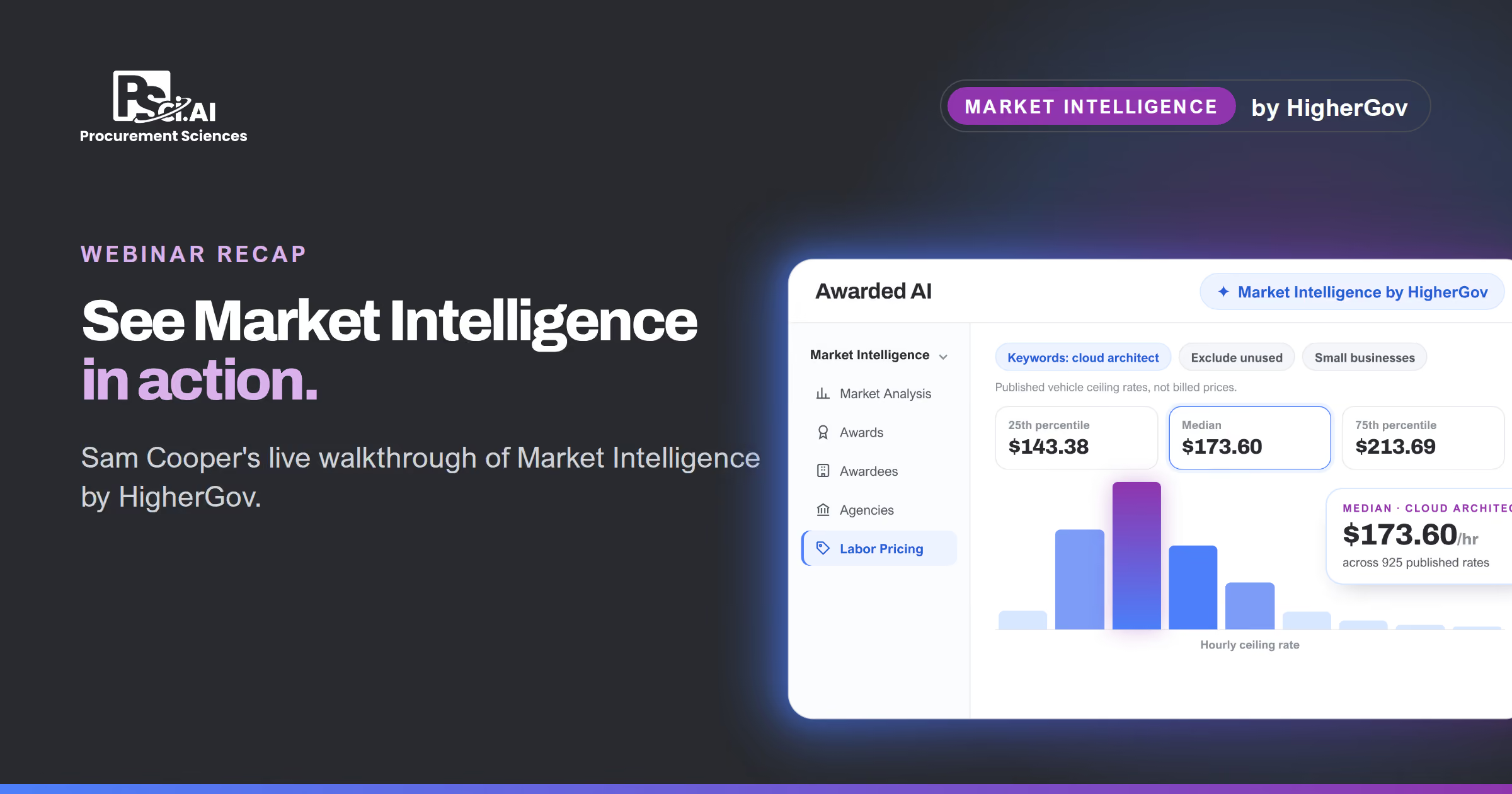
Webinar Recap: Product Spotlight, Market Intelligence by HigherGov Inside Awarded AI
Procurement Sciences recently hosted a product spotlight session on Market Intelligence by HigherGov, the newly integrated data layer now available inside Awarded AI. Sam Cooper, Director of Solutions Consulting, walked through what the integration means in practice, why it matters for the BD lifecycle, and demonstrated it live.
Webinar Recap: Product Spotlight, Market Intelligence by HigherGov Inside Awarded AI
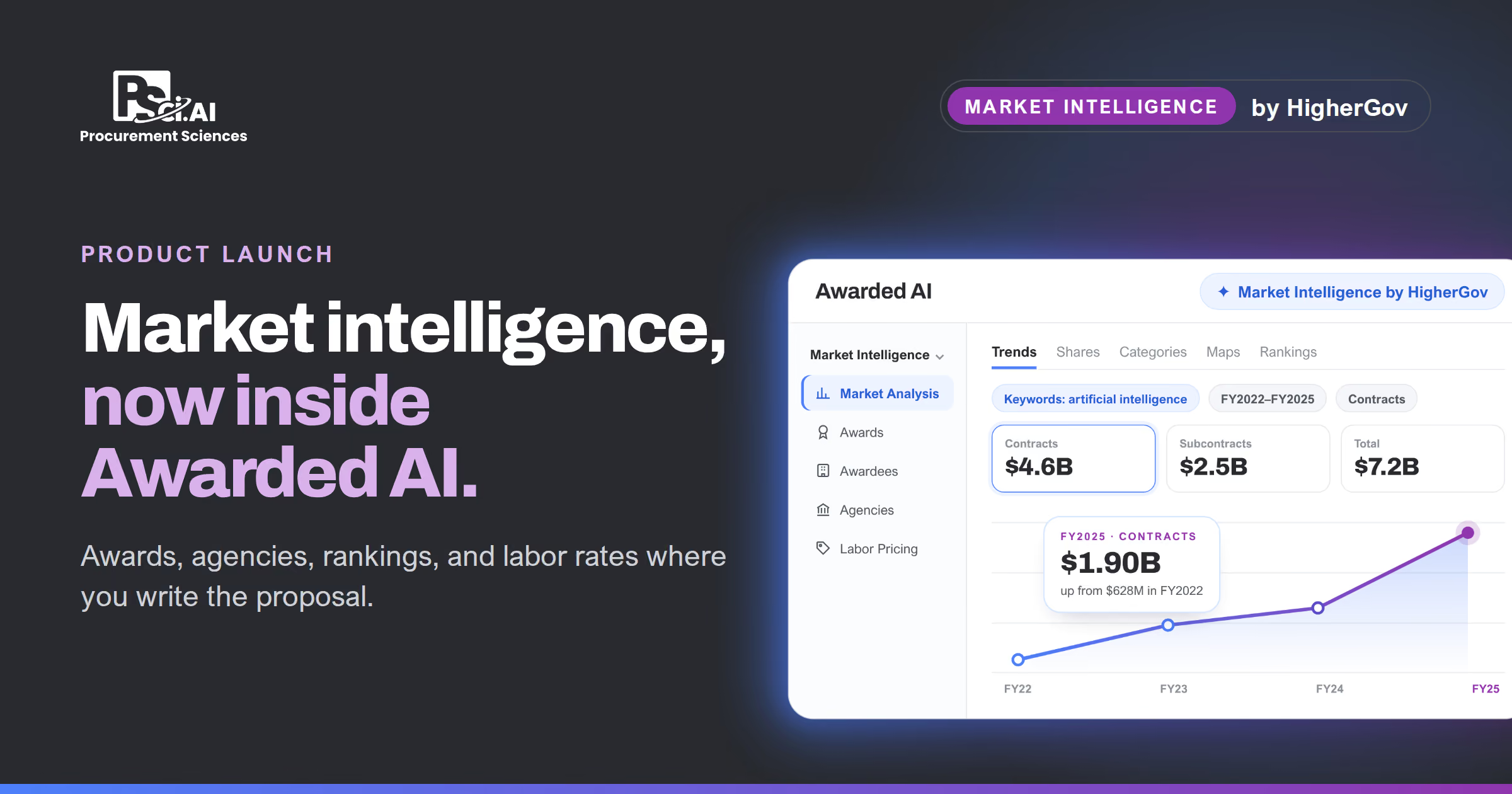
Introducing Market Intelligence by HigherGov: Know the Market Before You Bid
Today we're launching Market Intelligence by HigherGov, which brings HigherGov's federal market data directly inside Awarded AI. The research behind every bid now lives in the same secure platform where you capture and write.
Introducing Market Intelligence by HigherGov: Know the Market Before You Bid
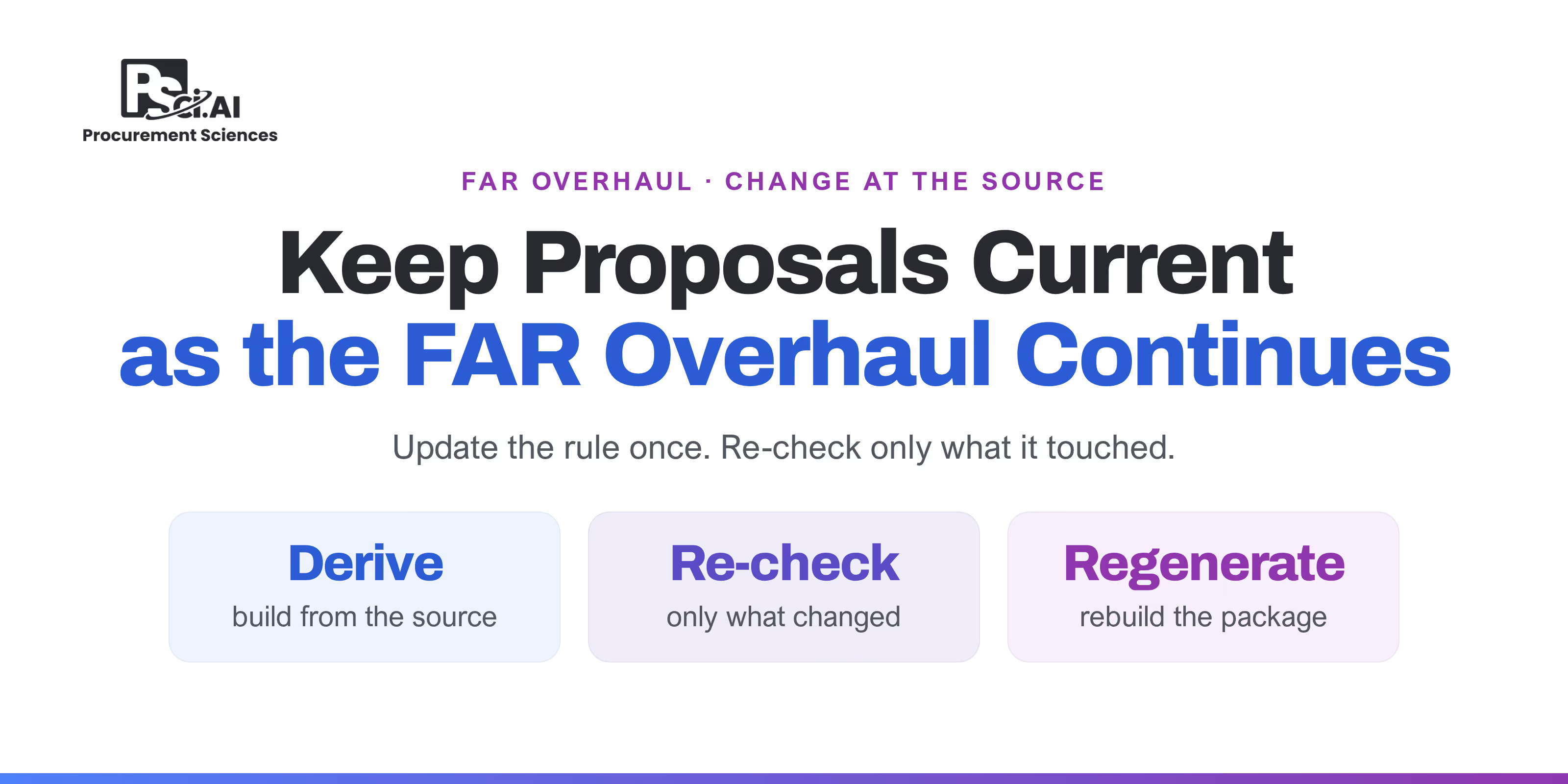
How to Keep Proposals Current as the FAR Overhaul Continues
The FAR overhaul means the rules governing your bid can change while you write it. The fastest way to keep up is to organize your proposal content so every item traces back to the rule it relies on. Update the rule once, and you know exactly what to re-check. We call this Change at the Source.
How to Keep Proposals Current as the FAR Overhaul Continues