
October 2026 Vulnerability Wave: How ProcurementSciences Responded

Was Awarded AI affected by October’s vulnerability wave? We have found no evidence of any attack on, or compromise of, Awarded AI or your data. Here is what happened, what we checked and fixed, and how we kept customers informed.
Starting in October 2026, the software industry began one of the most intense runs of security disclosures in its history. More than 17,000 new vulnerabilities were reported, about 4% of every vulnerability on record. In response, we moved quickly: we checked every issue against the systems we actually run and applied the updates that mattered.
What Happened in October 2026?
Security researchers and software makers find and fix weaknesses in widely used software all the time. That's healthy, and it's how the internet gets safer. Usually these fixes arrive at a steady pace. In October 2026, the pace increased:
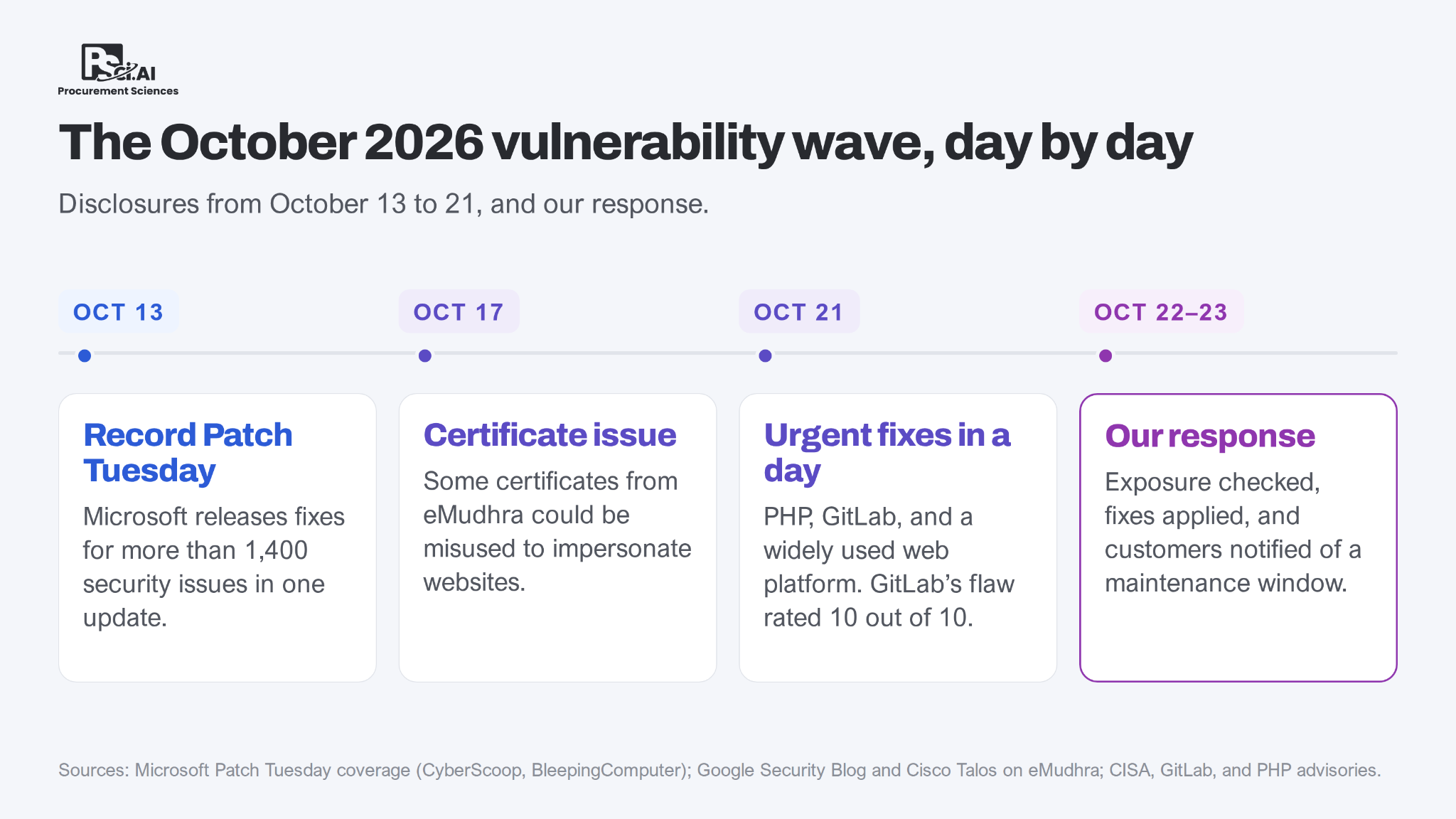
- A record "Patch Tuesday." On October 13, Microsoft released fixes for more than 1,400 security issues (“Patch Tuesday” is Microsoft’s monthly release of security fixes). It was the largest monthly release in the company's history.
- A problem with digital certificates. On October 17, researchers found that some certificates from eMudhra, a trusted certificate issuer (an organization browsers trust to vouch that a website is real), could be misused to impersonate legitimate websites. Certificates are part of what makes the padlock in your browser mean something. Browsers blocked the affected certificates quickly, but every company still had to update the list of trusted issuers inside its own systems.
- A wave of critical fixes in one day. On October 21, PHP, GitLab and the maintainers of a widely used web application platform all released urgent security updates. PHP is a programming language used by a large share of the world's websites. GitLab is a popular tool for managing software code. The GitLab flaw received the highest possible severity rating, 10 out of 10 (the top of the scale security teams use to rank how serious a flaw is). The U.S. Cybersecurity and Infrastructure Security Agency (CISA) urged organizations that couldn't patch PHP right away to take those systems offline.
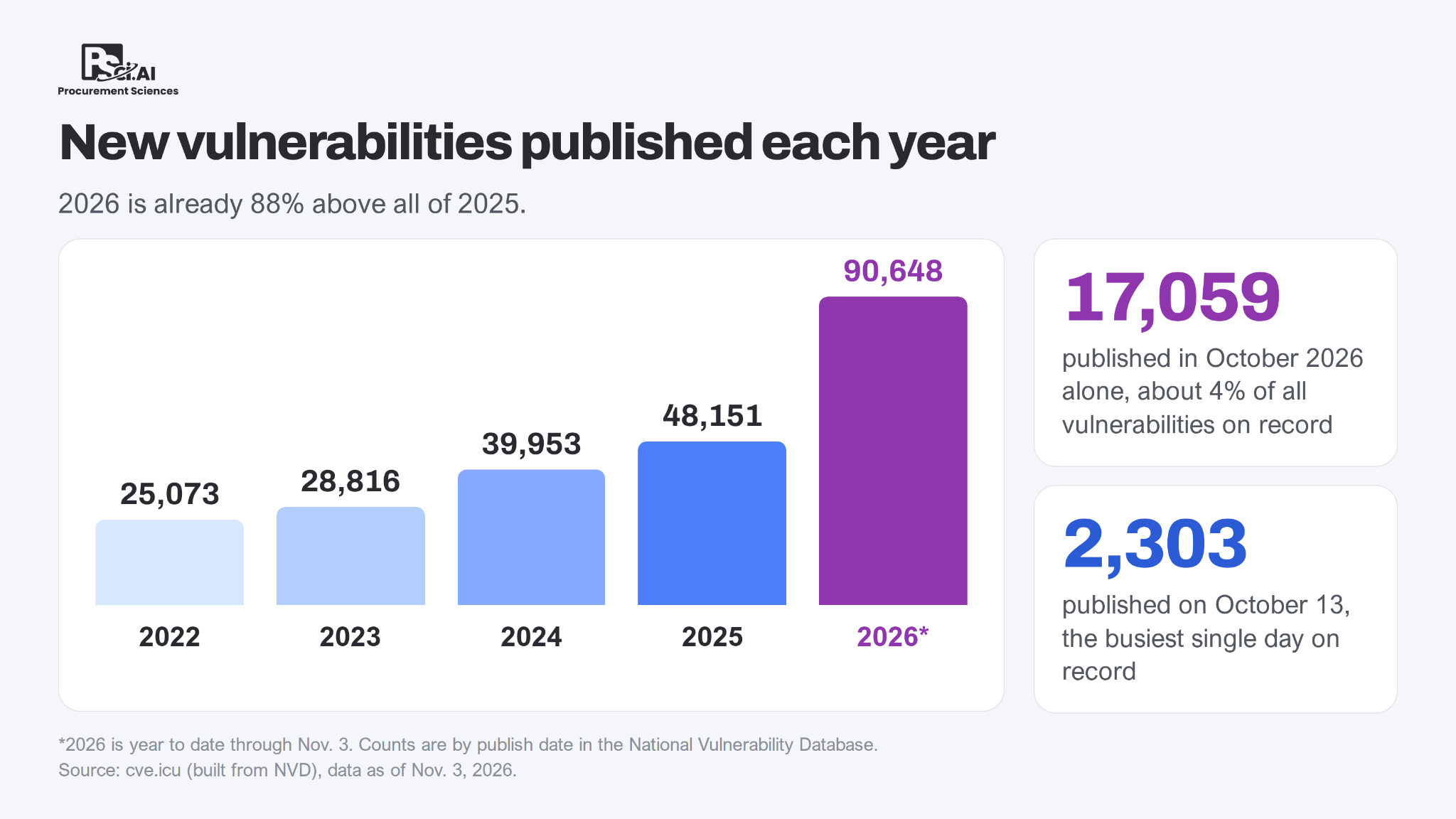
The bigger picture: new vulnerabilities are being published faster than ever. October 2026 was the largest month on record, with more than 17,000 new vulnerabilities published worldwide, about 4% of the roughly 400,000 publicly catalogued vulnerabilities on record. The climb has been steady all year: monthly totals have risen every month since January, from about 4,300. So far in 2026, more than 90,000 have been published, more than double the same point last year and 88% above 2025’s full-year total of about 48,000. (Source: cve.icu, which tracks the public CVE catalog.)
When news like this breaks, we ask two questions: Are we affected? and How do we close any gap quickly and safely?
How Did Procurement Sciences Respond?
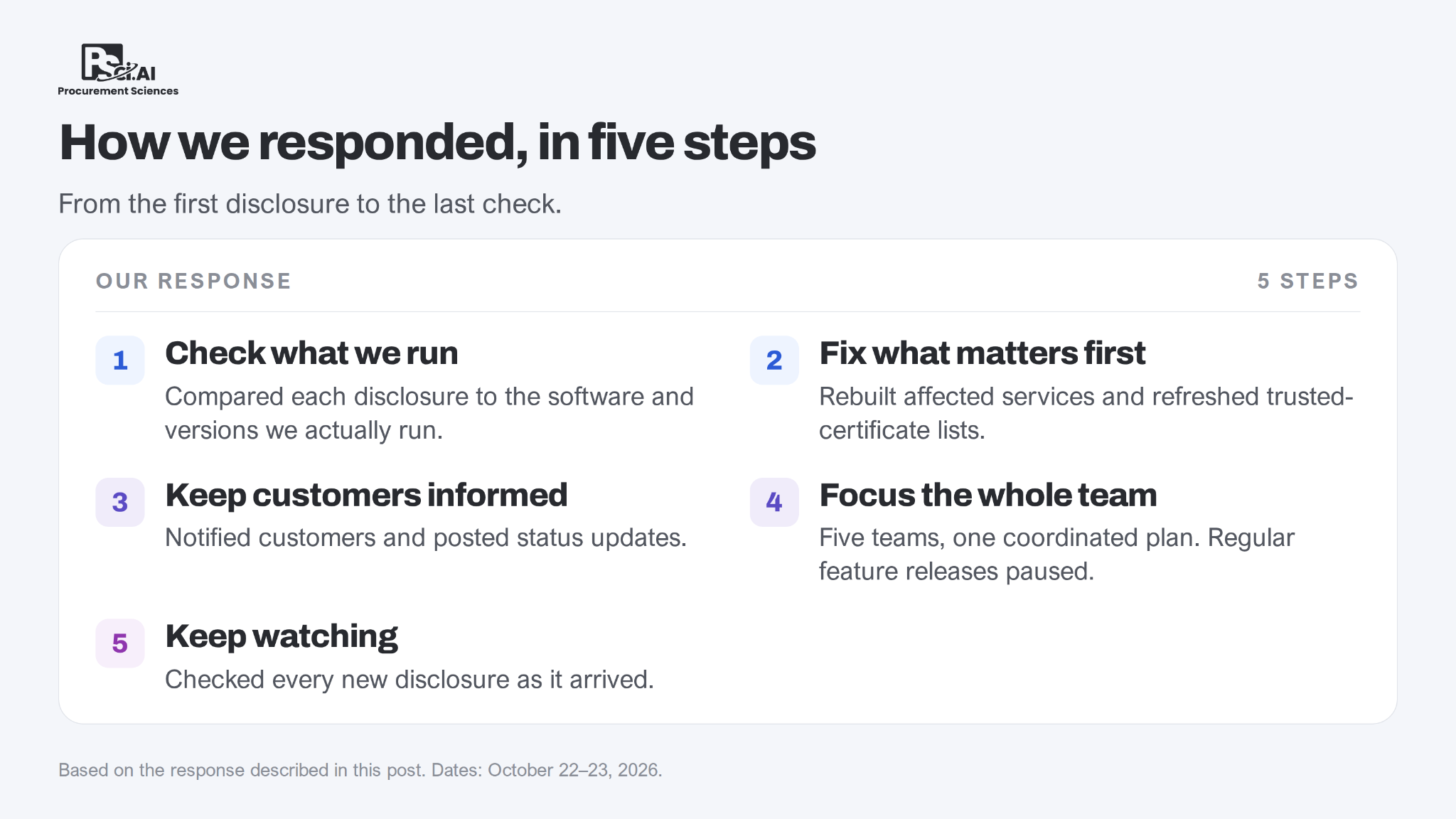
We checked our real exposure first. Before we changed anything, we compared each disclosure against the software and versions we actually run. That told us where to focus:
- PHP and GitLab: no exposure. Neither critical flaw affected our platform.
- Microsoft's record release: limited impact. Most of these fixes don't apply to how our platform is built, and the relevant updates went through our normal patching process.
- The certificate issue and the web application platform update: our main focus. Both applied to us, so that's where we put our effort.
We fixed what mattered, fast. Our audit of our cloud environment found about 8,100 containers (the packaged pieces our software runs in) that needed an updated list of trusted certificate issuers. Our engineers rebuilt the affected services, applied the patched software versions and refreshed certificate lists across our environment. Our first fix was complete less than four hours after our response formally kicked off.
We kept customers informed. With fixes this important available, we didn't want to wait for a quiet weekend. So on October 22 we notified customers of a security maintenance window (a scheduled period for updates), posted updates on our status page, and continued the work through October 23.
We focused the whole team. Engineers from five product and infrastructure teams worked from one coordinated plan, and every fix was tracked to completion. We temporarily paused regular feature releases so security work came first.
We kept watching. As more disclosures arrived during the month, we checked each one against what we run. In several cases, including a critical issue in a popular AI software component, we confirmed we weren't affected and moved on.
Why did the response succeed so rapidly?
Speed comes from preparation. A few long-standing choices paid off this month:
- We know what we run. Because we keep an up-to-date inventory of our software, we could answer "are we affected?" quickly and with confidence.
- We build on hardened foundations. Much of our platform runs on minimal, security-focused building blocks (designed to have fewer weak points) that get updated quickly when issues are found. For many fixes, we only had to redeploy, not re-engineer.
- Security is everyone's job. Our security, infrastructure and product teams work together every day, so pulling together under pressure came naturally.
October 2026 by the Numbers
Industry numbers and our response:
What has happened since October?
The pace hasn't let up. In the first 18 days of November, more than 10,000 new vulnerabilities were published, slightly ahead of October's record pace and almost five times the same stretch last year. November 10 was the second-busiest day on record, and 2026 has now passed 100,000 for the year. Our approach is the same as it was in October. We check each new disclosure against what we run, fix what applies to us first, and patch fast. We still have found no evidence of any attack on, or compromise of, Awarded AI or your data.
Our commitment to you
Weeks like this are what a security program is for. We find out fast, assess honestly, fix what matters first and keep you informed. Your data is secure, and our team continues to monitor our environment closely. We have found no evidence of any attack on or compromise of your data, and our team continues to monitor our environment closely.
If you have questions about this work or our security program, reach out to your customer success manager or our support team. You can also read about our security and compliance program or visit our Trust Center. We're always happy to talk.
Thank you for trusting us with your work.
Frequently asked questions
Was Awarded AI affected by the October 2026 vulnerabilities?
We found no evidence of any attack on, or compromise of, Awarded AI or customer data. Two of the disclosures, a certificate issue and a web application platform update, applied to us, and we fixed both. The PHP and GitLab flaws did not affect our platform.
What is a vulnerability?
A vulnerability is a weakness in software that someone could misuse. Researchers and software makers publish them in a public catalog so everyone can fix them. A published vulnerability is a to-do list item for security teams, and it is a different thing from an attack.
What is Patch Tuesday?
Patch Tuesday is Microsoft’s monthly release of security fixes, on the second Tuesday of each month. October 13, 2026 brought the largest release in the company’s history, with more than 1,400 fixes.
What is a certificate issuer, and why did the eMudhra issue matter?
Browsers and software trust certificate issuers to vouch that a website is real. When some certificates from eMudhra could be misused to impersonate websites, browsers blocked them and companies updated their trusted-issuer lists.
How does Procurement Sciences handle security vulnerabilities?
We keep an up-to-date inventory of the software we run, compare each disclosure against it, fix what applies first, notify customers when work affects them, and keep checking new disclosures. Learn more on our security page and Trust Center.
What security certifications does Awarded AI have?
Our security page lists SOC 2 Type 2, and FedRAMP Moderate Authorization.
Sources
- CyberScoop, Microsoft Patch Tuesday, October 2026: the record release.
- Google Security Blog, Cisco Talos, and Red Hat advisory RHSB-2026-012: the eMudhra certificate issue.
- CISA alert on critical PHP vulnerabilities: the guidance to take unpatched PHP systems offline.
- GitLab 19.5.1 patch release: the 10 out of 10 severity rating.
- cve.icu, built from the National Vulnerability Database: vulnerability counts by publish date, data as of November 3, 2026.
John Bullough VP of Security, Compliance & Infrastructure (CISO), ProcurementSciences
Click here to schedule a demo to get the full scoop on how our product actually works and discover how AI can transform your approach to government contracting.
Explore More Resources

Webinar Recap: AI Builds a FY28 Forecast to Guide Your FY27 Planning
Procurement Sciences recently joined GovConWire and Executive Mosaic for a session on a planning problem that every government contracting team faces and few solve well: how do you decide where to invest capture and proposal resources this fiscal year to win contracts that will not even be competed until next fiscal year?
Webinar Recap: AI Builds a FY28 Forecast to Guide Your FY27 Planning
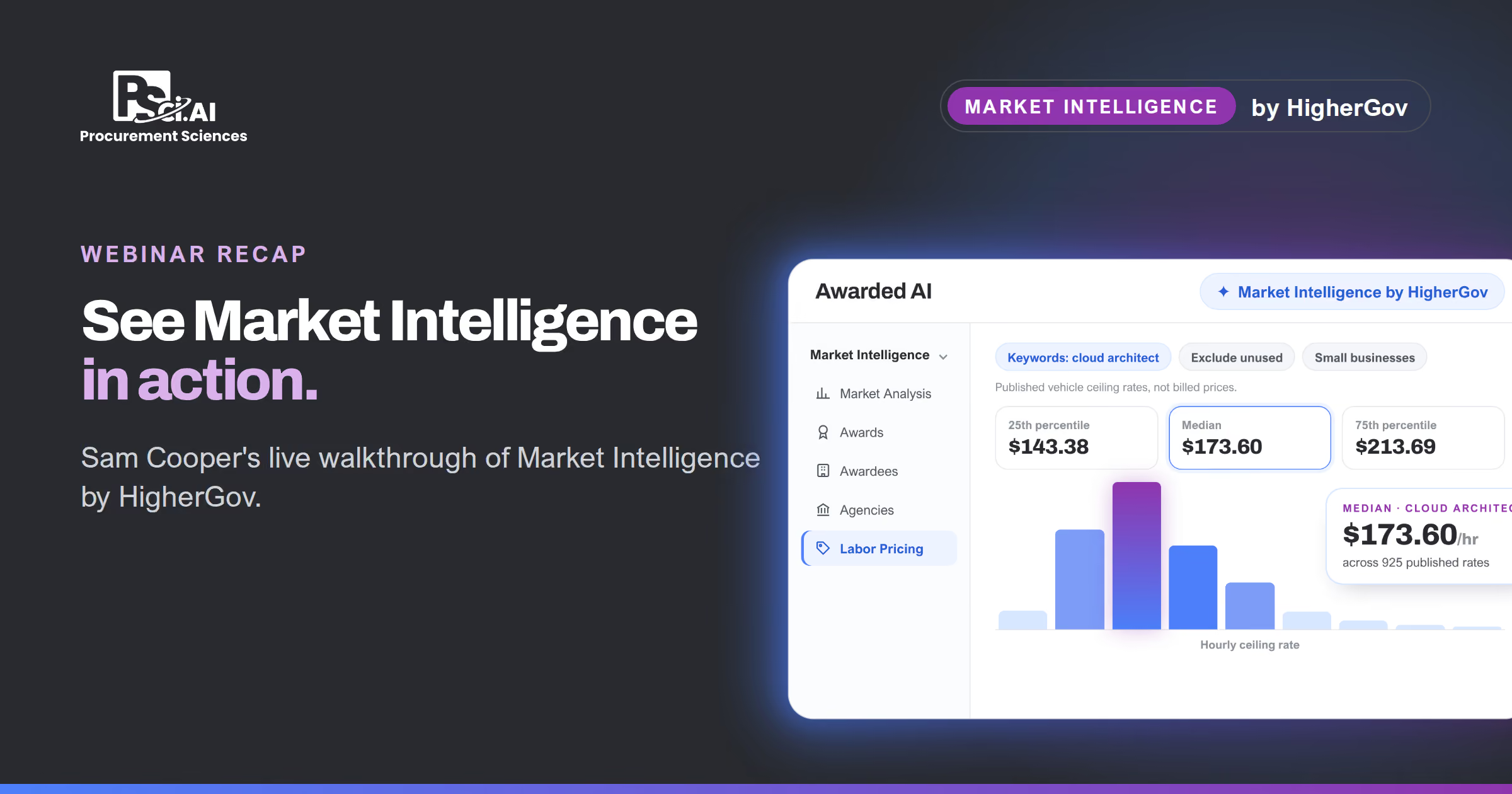
Webinar Recap: Product Spotlight, Market Intelligence by HigherGov Inside Awarded AI
Procurement Sciences recently hosted a product spotlight session on Market Intelligence by HigherGov, the newly integrated data layer now available inside Awarded AI. Sam Cooper, Director of Solutions Consulting, walked through what the integration means in practice, why it matters for the BD lifecycle, and demonstrated it live.
Webinar Recap: Product Spotlight, Market Intelligence by HigherGov Inside Awarded AI
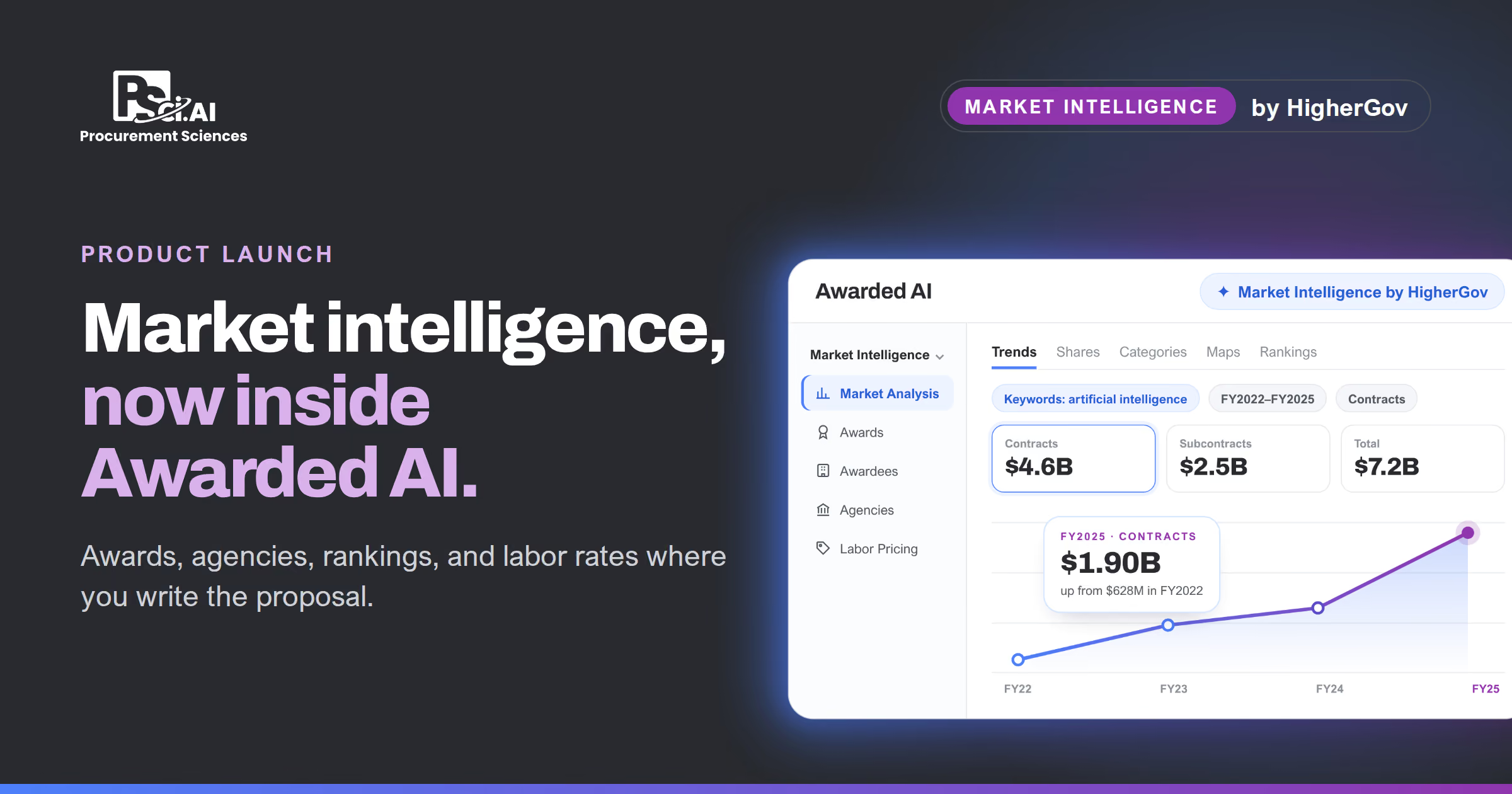
Introducing Market Intelligence by HigherGov: Know the Market Before You Bid
Today we're launching Market Intelligence by HigherGov, which brings HigherGov's federal market data directly inside Awarded AI. The research behind every bid now lives in the same secure platform where you capture and write.
Introducing Market Intelligence by HigherGov: Know the Market Before You Bid