
Webinar Recap: From Gut Feel to Outcomes, AI-Driven Capture Management That Wins

Procurement Sciences recently joined Jennifer Shouse and Associates for a webinar on one of the most important shifts happening in government contracting right now: the move away from intuition-led capture toward data-driven decision making, and how AI is making that shift not just possible but practical.
Sam Cooper, Senior Solutions Engineer at Procurement Sciences, led the session. Sam works directly with thousands of GovCon professionals on AI adoption across the BD lifecycle, and he brought a frank, practitioner-focused perspective to why gut feel alone is no longer enough, and what teams can actually do about it today.
Here's what came out of the conversation.
Why Gut Feel Is Losing Ground
For a long time, GovCon business development ran on executive intuition. Former government decision makers who crossed into industry, or practitioners who had spent decades learning how procurement works, held real competitive advantages. They knew the agencies. They knew the players. They had the relationships.
That still matters. But the environment is changing in ways that make intuition alone insufficient.
Competition is intensifying. More companies are bidding on more opportunities. New players with innovative capabilities are entering the federal market regularly. Pipelines are more complex, drawing from more sources than a single agency forecast ever captured. And acquisition itself is shifting, with OTA obligations growing 712% over the past decade, CSOs moving faster than traditional procurement vehicles, and the FAR undergoing its most significant overhaul in years.
The result is a data problem. There is more information available than any team can realistically process, coming from more places than ever, moving faster than before. Teams that rely primarily on relationships and instinct are increasingly at risk of missing deals, chasing the wrong ones, or getting caught late in a pursuit by something they should have seen at the start.
The answer isn't to abandon judgment. It's to give judgment better inputs.
What AI Actually Changes About Capture
The core shift AI enables in capture management is the ability to navigate data at scale, quickly, across the full lifecycle of an opportunity.
At the top of the funnel, that means finding opportunities from sources that would be impractical to monitor manually, tracking budget trends, identifying market segments with spending momentum, and surfacing recompetes before they're widely visible. Sam pointed to a specific feature in Procurement Sciences' platform: a vulnerable recompetes indicator that flags contracts where the incumbent is at risk, giving teams early visibility into opportunities worth pursuing before the crowd shows up.
It also means understanding the competitive landscape in real time. Sam shared an example from a customer tracking a small IDIQ with four prime awardees approaching recompete. The challenge was figuring out which subcontractors had been winning consistently across the vehicle, since those subs were likely to put in prime bids on the next iteration. Manually tallying task orders and award data across the full IDIQ would have taken days. The AI answered the question in seconds, because the underlying data was already there.
That kind of capability, fast access to deep competitive intelligence, is what changes what's possible in early stage capture.
Qualifying More Objectively
One of the most valuable things AI brings to qualification is something that's hard to generate internally: an outside perspective.
Capture managers are advocates by nature. You find an opportunity, build a relationship, do the work to understand the customer, and you want to pursue it. That's the job. But it also means rose-colored glasses are an occupational hazard. Red flags get rationalized. Weak fits get called close enough.
AI, when it's backed by real data and designed to be critical rather than confirmatory, can surface what you might not want to hear. Sam noted that one of the things customers consistently value about Awarded AI is that it doesn't function as a yes machine. It's designed to give an objective read, flag gaps, and challenge assumptions, not to validate whatever the user is hoping to hear.
That objectivity is particularly useful at the gate review stage, where the decision to continue investing in a pursuit needs to be grounded in something more than optimism. The AI can run a full analysis, map your capabilities against requirements, assess the competitive position, identify risks and missing pieces, and surface all of it quickly so the human making the decision has a complete picture rather than a partial one.
Challenging Bias in PWIN
P-win is another area where AI adds meaningful value, and where the limitation of purely quantitative frameworks becomes clear.
A rigid PWIN calculator gives you a number. It's a useful framework, but it can box you in: lock you into a score that doesn't account for intangibles and doesn't flex as new information comes in. AI can work within the same framework while also incorporating context that a spreadsheet can't hold, market trends, competitive signals, the customer's historical behavior, the relationships in play. It brings the gut feel into the equation alongside the data rather than treating them as separate inputs.
The result is a more honest PWIN that actually supports the decision you're trying to make: whether to keep investing, whether to no-bid early, whether to adjust strategy. Sam was direct about this: one of the clearest efficiency gains from AI in capture isn't that you bid more. It's that you no-bid smarter and earlier, before significant resources are already committed to a pursuit that data would have told you to walk away from.
Teaming: Finding the Right Partners Faster
Teaming is a use case Sam returned to several times, because it sits at the intersection of two common problems.
For smaller businesses without an established network, finding the right teaming partners often means showing up to events and hoping to meet the right people. There's not a lot of strategy behind it. For larger businesses, the problem is often the opposite: too many potential partners, too much to track, and no easy way to match capabilities to a specific opportunity's requirements.
AI addresses both sides. On the discovery side, it can go out and find teaming partners with relevant capabilities, set-aside qualifications, and agency experience that align with a specific pursuit. It can build action plans and surface contact information. On the management side, it can maintain a living capabilities matrix against the requirements of a PWS and automatically surface the most relevant partners when a new opportunity comes in.
Procurement Sciences recently acquired HigherGov specifically to deepen the data layer available to the AI, including a teaming partner finder that matches directly on capabilities and set-asides. The idea is that the AI shouldn't just be a writing tool. It should know the market well enough to point you toward the right partners before you've spent time searching.
Let the AI Carry the Busy Work
The overarching framework Sam offered for anyone getting started with AI in capture is this: let the AI carry the busy work, and keep your judgment where it matters most.
The busy work is anything that is time consuming, repetitive, and data dependent but doesn't actually require human strategic thinking. Research. Tracking. Data collection. Going line by line through a PWS to map requirements. Pulling competitive intelligence. Drafting RFI responses. Building compliance matrices. Running gate review analysis. All of it is necessary. None of it needs to be done manually anymore.
What should stay with the human is everything that actually drives whether you win: the underlying capture strategy, the win themes, the decision about whether and how to pursue, the relationship with the customer, the judgment calls that no amount of data can fully automate. The AI can help brainstorm, surface options, and pressure-test thinking. But the strategic direction has to come from the team.
Sam framed it as the difference between human in the loop and human in the lead. The loop framing suggests the human is one part of a process the AI is running. The lead framing puts the human in control of the process, with AI doing the heavy lifting underneath. That distinction matters for how teams actually build their workflows.
One More Thing: The Buyer Is Using AI Too
Sam closed with a point that's easy to overlook in conversations about AI adoption on the industry side: the government is using AI as well.
Federal agencies have access to tools like ChatGPT and Claude. They're using AI for market research, capability identification, and increasingly for proposal evaluation. The specifics vary agency to agency, but the trend is consistent and accelerating.
This changes the calculus for capture and proposal strategy. If evaluators are using AI to review submissions, teams that understand how that process works, and that use AI on their side to optimize for it, will have an advantage. It's not about gaming the system. It's about being aware of how the entire acquisition environment is changing and positioning accordingly.
Where to Start
Sam's advice for teams that haven't fully adopted AI yet was consistent with what practitioners in earlier conversations have said: start specific, start where it hurts most.
What is your team spending time on every week that is genuinely below your pay grade? What research gets done manually that could be automated? What analysis gets skipped because there isn't time, even though it would make the decision better? Start there. Get comfortable with the tool, build repeatable prompts, and expand from there.
The teams that are pulling ahead in this market aren't doing everything with AI at once. They found a few use cases that actually moved the needle and built disciplined workflows around them. That's still the right entry point.
Want to see how Procurement Sciences supports AI-driven capture from pipeline through award? Book a demo to talk through your specific use cases.
Click here to schedule a demo to get the full scoop on how our product actually works and discover how AI can transform your approach to government contracting.
Explore More Resources

What Is an IDIQ Contract? A Guide for Government Contractors
Indefinite Delivery, Indefinite Quantity (IDIQ) is a federal contract vehicle that lets an agency order an unknown amount of supplies or services, within stated limits, over a fixed period of time, rather than committing to a fixed quantity up front.
What Is an IDIQ Contract? A Guide for Government Contractors
SBA Small Business Size Standards Are Changing: Here's What Government Contractors Need to Know
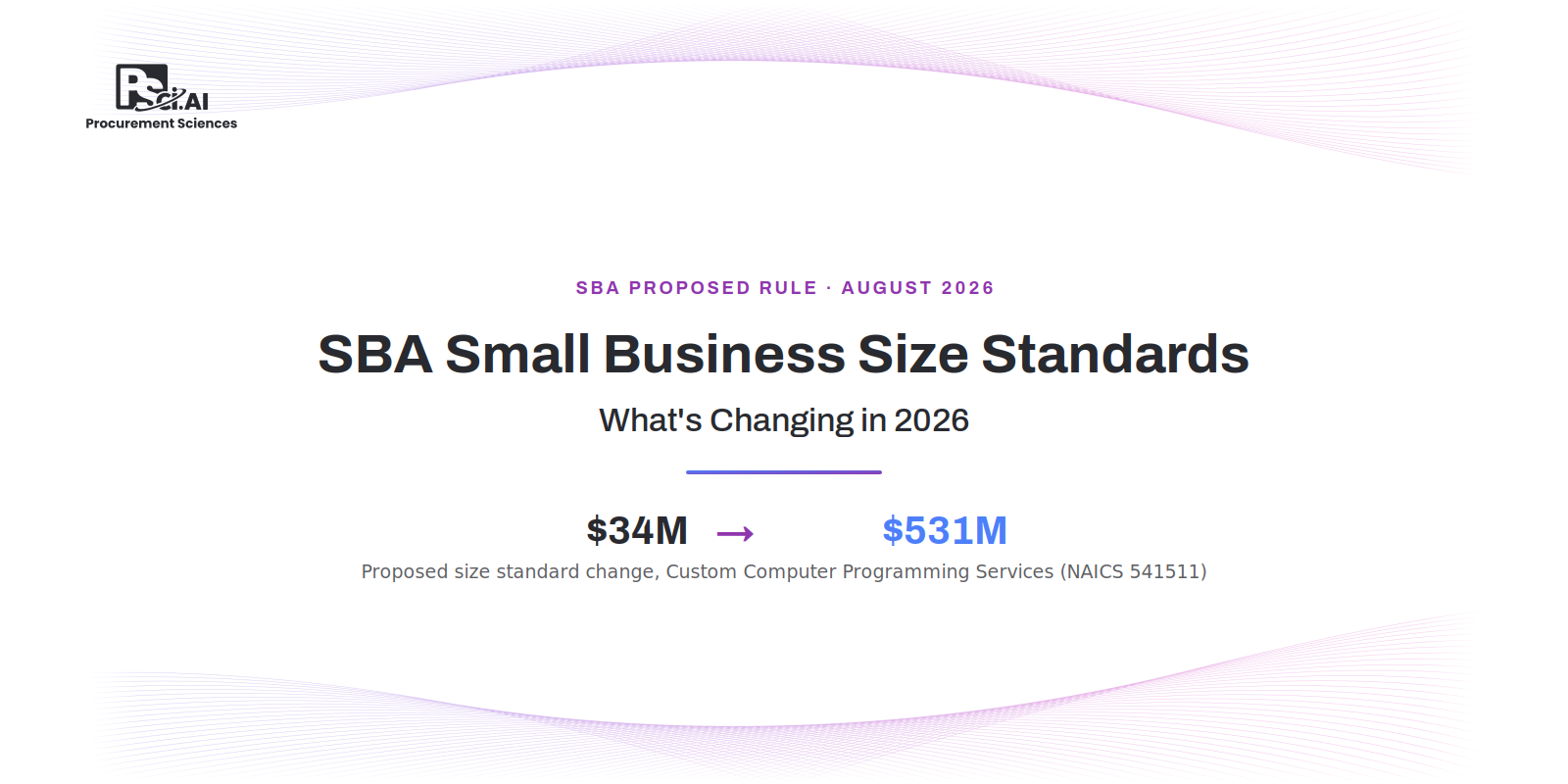
On August 20, 2026, the Small Business Administration (SBA) published a proposed rule that would rewrite its small business size standards, the thresholds that determine which companies qualify as "small" for federal contracting, SBA loans, and related programs.
SBA Small Business Size Standards Are Changing: Here's What Government Contractors Need to Know
Procurement Sciences AI Named a High Performer in G2's Fall 2026 Government Procurement Grid®
We're proud to share that Procurement Sciences AI has been named a High Performer in G2's Fall 2026 Grid® Report for Government Procurement Software.
Procurement Sciences AI Named a High Performer in G2's Fall 2026 Government Procurement Grid®