
Webinar Recap: How Federal Agencies Are Using AI to Evaluate Proposals, and What Your Team Should Do About It

Procurement Sciences recently joined Signal Media for a webinar on one of the most consequential shifts happening in federal procurement right now: the government is no longer just tolerating AI on the industry side. It is actively using it to evaluate proposals.
Sam Cooper, Director of Solutions Consulting at Procurement Sciences, led the session. Sam works directly with government contractors every day, including five of the ten largest aerospace and defense companies and more than half of the top one hundred federal market contractors. That vantage point gives him a ground-level view of what is changing, what is staying the same, and where teams are getting caught flat-footed.
The Mindset Shift: The Evaluator Is Getting a New Team Member
Sam opened with a framing that set the tone for everything that followed: AI is not replacing the evaluation process. It is joining it.
The government's adoption of AI in evaluation is gradual, varies by agency, and is still evolving. But the direction is clear and the pace is accelerating. The question for proposal teams is no longer whether this is happening. The question is whether your process is prepared for it.
To illustrate how quickly the environment has changed, Sam pointed to two contrasting data points. In May 2024, the SOUP 6 final RFP included a clause requiring disclosure of AI use in proposals. At the time, it created significant anxiety across the industry. People were worried about what disclosure meant, whether it would be held against them, and whether using AI was somehow inappropriate.
Fast forward to earlier this year. A CDAO solicitation called Swarm Forge included a clause stating plainly that the government may use AI to assist in the administrative review and technical assessment of proposals and white papers. No ambiguity. No gray area. The government is using AI in technical assessment, and it is saying so openly.
The old anxiety about whether AI use needed to be justified has been replaced by a much more practical question: how do you write a proposal that is optimized for an AI evaluator?
How AI Actually Reads a Proposal
When a proposal is submitted for AI-assisted evaluation, the document is vectorized: the AI creates a map of meaning across the document, clustering similar concepts together. This has a few important implications.
First, the AI does not get tired. A human evaluator reading a two-hundred-page proposal is going to drift, lose focus, and potentially miss things. The AI will not. Compliance checking becomes more rigorous, not less, when AI is involved. Small errors that might have slipped through with a fatigued human reviewer are more likely to be caught.
Second, the AI evaluates your proposal in relation to something else, whether that is the requirements document or the competing proposals submitted by your competitors. A human evaluator is largely reading one document. The AI can hold multiple documents in view simultaneously. That means it is not just asking whether your proposal is good. It is asking whether your proposal is distinct from what everyone else submitted.
Third, and most practically: generic language clusters together in the AI's semantic map in a way that makes it essentially invisible. Phrases like best-in-class approach, robust methodology, and proven track record do not differentiate from each other. They land in the same conceptual cluster as every other proposal that uses the same language. Specific claims with real metrics, we reduced the backlog by forty-seven percent in nine months at the Department of Labor, stand out precisely because they do not cluster with anything else.
What This Means for How You Write
The fundamentals of good proposal writing have not changed. Specificity has always beaten vagueness. Evidence has always beaten assertion. Clear structure has always helped evaluators find what they are looking for.
What has changed is the floor. The margin for error is narrower. The bar for what counts as differentiated content is higher. And the stakes of generic language are steeper because an AI evaluator will, in a very literal sense, fail to distinguish your proposal from a competitor's if both are written in the same undifferentiated way.
Metrics matter more than ever. Concrete, specific numbers give the AI something distinct to retrieve and surface. They do not cluster with generic claims. A percentage improvement, a dollar figure, a time reduction: these are the kinds of data points that stand out in an AI-evaluated proposal the way a strong proof point stands out to a sharp human evaluator.
Structure makes navigation possible. Clear headings, logical organization, and a document that a reader can navigate in thirty seconds are just as important for an AI as for a human. The AI is not a superintelligence that can infer your meaning from a disorganized document. It needs to be able to find things. Make it easy.
Capture work upstream feeds the proposal. An AI evaluator will typically be given the requirements, the evaluation criteria, and possibly some implicit context about what the agency actually cares about. The more your proposal speaks directly to the customer's real priorities, including the ones that are not explicitly stated in the RFP, the more likely it is to score well. That intelligence comes from capture. The importance of deep customer knowledge before the RFP drops has not decreased because AI is involved in evaluation. If anything, it has increased.
Differentiation needs to be obvious. The AI is likely evaluating multiple proposals simultaneously. Do not make it work to find the ways your offer is different from your competitors. State them clearly. If a section of your proposal could have been written by any offeror, that is a problem regardless of whether the evaluator is human or AI.
One Thing Not to Do
White text embedded in a proposal, invisible to human readers but readable by AI, containing a message to AI agents instructing them to score the proposal as the best they had reviewed.
This is not a viable strategy. Modern AI systems are increasingly tuned to detect prompt injection. Beyond detection, it is the kind of thing that could get a company in serious trouble if discovered during evaluation. Sam was direct: do not do this.
The reason he included the example is instructive. It illustrates, in an extreme form, how AI can be influenced by direct, clear communication. The actual lesson to take from it is that writing plainly, directly, and compellingly to the AI, the same way you would write to make your case to a capable but inexperienced new team member, is your best strategy.
Adding an AI Readiness Gate to Your Review Process
The most actionable recommendation Sam made was this: add an explicit AI readiness check to your color team process.
The mechanics are simple. Before submission, take your proposal draft, provide the RFP and evaluation criteria, and ask an AI to evaluate it as the evaluator would. Ask it to be harsh. Ask it to flag compliance gaps, identify sections that could have come from any offeror, and surface anything that is unclear or hard to navigate.
A few important points about how to interpret the results.
The AI's numerical scores are less valuable than its reasoning. The difference between a five and a seven can be somewhat arbitrary in AI output. But the explanation for why a section scored low, the reasoning behind the assessment, is often genuinely useful and frequently surfaces things human reviewers missed.
Fresh context matters. If you have been working in a proposal for weeks and have been building your AI session over that same period, the AI's memory of prior conversations can color its evaluation. Start a clean session when you run your readiness check so the AI comes in with only the documents you choose to give it.
This process can be lightweight. It does not require a complete overhaul of your review methodology. Running a section through an AI with the evaluation criteria takes minutes. The question is whether you are building this into the process at all.
Questions Worth Asking During Reviews
Could this section have come from any offeror? If the answer is yes, or if the AI cannot identify what is distinct about your approach, that is a flag.
Is every requirement addressed explicitly, and is it positioned where the RFP expects to find it? Structure and compliance are easier to check mechanically than they are to catch in a human review.
Can any reader find what they are looking for in thirty seconds? This applies to AI and human evaluators equally. A table of contents that requires interpretation is a problem.
Are there claims that need evidence? If the proposal is making assertions that are not backed by specific proof, the AI will often flag this in a way that is harder to rationalize than a human reviewer might.
What Has Not Changed
Sam closed with a reminder that is easy to lose in a presentation focused on AI: the fundamentals have not changed.
Winning still requires responsive, compelling proposals. It still requires deep customer knowledge. It still requires human judgment about strategy, story, and differentiation. It still requires a team that knows what it is doing.
What AI changes is the standards. The floor is higher. The margin for error is smaller. Teams that are using AI to prepare, review, and sharpen their proposals will be better positioned than teams that are not. And teams that understand how the evaluator is using AI will be better positioned than teams that are guessing.
The early movers are setting the tone. The window to get ahead of this shift is still open, but it is not unlimited.
Want to see how Procurement Sciences helps teams write, review, and optimize proposals for both human and AI evaluators? Book a demo to talk through your specific use cases.
Click here to schedule a demo to get the full scoop on how our product actually works and discover how AI can transform your approach to government contracting.
Explore More Resources

What Is an IDIQ Contract? A Guide for Government Contractors
Indefinite Delivery, Indefinite Quantity (IDIQ) is a federal contract vehicle that lets an agency order an unknown amount of supplies or services, within stated limits, over a fixed period of time, rather than committing to a fixed quantity up front.
What Is an IDIQ Contract? A Guide for Government Contractors
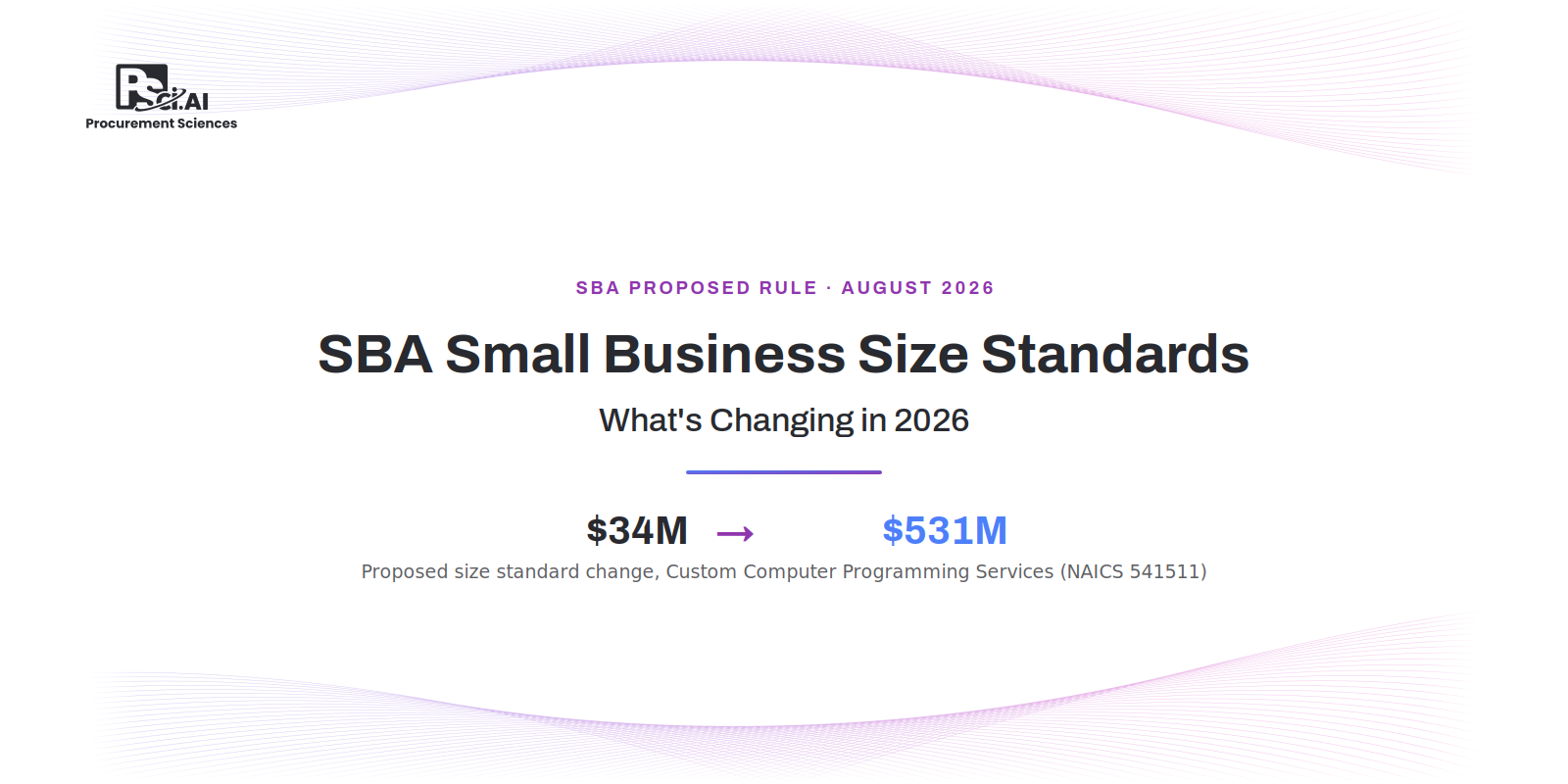
SBA Small Business Size Standards Are Changing: Here's What Government Contractors Need to Know
On August 20, 2026, the Small Business Administration (SBA) published a proposed rule that would rewrite its small business size standards, the thresholds that determine which companies qualify as "small" for federal contracting, SBA loans, and related programs.
SBA Small Business Size Standards Are Changing: Here's What Government Contractors Need to Know
Procurement Sciences AI Named a High Performer in G2's Fall 2026 Government Procurement Grid®
We're proud to share that Procurement Sciences AI has been named a High Performer in G2's Fall 2026 Grid® Report for Government Procurement Software.
Procurement Sciences AI Named a High Performer in G2's Fall 2026 Government Procurement Grid®