
Government Contracts for Bid: Find Opportunities That Fit Your Criteria

.png)
Thousands of government contracts for bid are active at any given time across federal, state, and local agencies. Most are publicly posted on platforms like SAM.gov.
The problem isn’t finding opportunities. It’s finding the right ones.
Broad searches return hundreds of results, many of which don’t align with your capabilities, past performance, or bandwidth. Teams end up spending hours reviewing solicitations that were never a realistic fit, draining time and bid and proposal (B&P) resources.
This guide shows how to narrow the field quickly. We’ll cover where to find opportunities, how to filter them using NAICS and PSC codes, and how to apply a fast bid/no-bid screen so your team can focus on contracts it’s actually positioned to win.
Key Takeaways
- Government contracts for bid are publicly posted solicitations (RFPs, IFBs, RFQs) where agencies invite businesses to compete for work, with SAM.gov as the primary federal source.
- Effective discovery starts with targeted search strategies using NAICS codes, PSC codes, and saved alerts, rather than broad keyword searches that return hundreds of irrelevant results.
- A structured bid/no-bid process prevents wasted effort by assessing capability alignment, competitive landscape, and compliance requirements before committing proposal resources.
- Understanding solicitation formats helps contractors quickly identify evaluation criteria and determine whether price or technical approach will drive the award.
- AI-powered tools reduce time spent on discovery and qualification by surfacing relevant contracts and automating initial fit assessments.
What Qualifies as a Government Contract for Bid
Government contracts for bid are formal solicitations where federal government agencies, as well as state and local entities, publicly announce procurement needs for goods, services, or construction and invite qualified businesses to submit proposals or quotes.
These opportunities span federal civilian agencies, the Department of Defense (DoD), and state and local governments, each with its own posting systems and requirements.
To submit a bid, organizations must have an active SAM.gov registration and a Unique Entity ID (UEI).
Where to Find Available Government Contracts Online
Opportunity discovery only works if your coverage is consistent. Contractors who rely on a single source or check sporadically are more likely to miss relevant bids or find them too late.
While SAM.gov has the largest catalog of federal opportunities, it’s not the only source for government contracts for bid. Maintaining a regular review cadence across multiple platforms helps ensure you’re seeing the right solicitations early enough to act.
SAM.gov Contract Opportunities
SAM.gov is the official government website for federal contracting opportunities. All federal agencies use the platform to post solicitations above the micro-purchase threshold, which is $15,000 for most purchases. Higher thresholds apply for contingency operations and defense support.
Any entity with an active SAM.gov account and a UEI can access and explore available opportunities. In addition to active postings, SAM.gov includes historical award data that contractors can use for competitive intelligence.
The platform offers a straightforward search interface. Users can search by keywords and apply filters such as:
- Specific federal organizations
- NAICS codes
- Set-asides
- Place of performance
- Response deadlines
As the largest source of federal opportunities, SAM.gov is indispensable for government contractors (GovCons). Its scale also creates competition, so strong filtering and early identification are critical to standing out.
Agency-Specific Procurement Pages
Some agencies manage procurement through their own portals, either in addition to or separate from SAM.gov. Relying on SAM.gov alone can mean missing opportunities that are posted or previewed elsewhere.
Examples include:
- GSA eBuy: A restricted platform for General Services Administration (GSA) Schedule holders
- NASA SEWP: A centralized procurement vehicle for IT, communications, and AV across federal agencies
- Agency forecast pages: Used to identify upcoming requirements before they are formally posted on SAM.gov
State and Local Bid Portals
SAM.gov covers federal contracts, not state and local opportunities. Contractors targeting those markets need to use separate platforms such as BidNet, PublicPurchase, and state-specific portals.
While these sources may offer fewer opportunities depending on your target regions, they often attract less traffic and therefore less competition.
Once you identify the portals relevant to your business, take two steps: review each platform for current bid opportunities, and enable any available notification tools for specific contract types. Not every portal offers alerts, but using them where available helps ensure you don’t miss new postings.
Building a Focused Search Strategy
Because of how government procurement platforms are structured, most contractors end up wasting time and resources on unfocused searches. Broad keyword queries on SAM.gov and similar platforms often return hundreds of results, many of which aren’t applicable.
Some can be ruled out quickly from the title or preview. Many cannot, requiring time-consuming manual review to determine whether an opportunity is a real fit.
A more disciplined search strategy built around classification codes and automated alerts helps narrow the field, allowing teams to focus on contracts that align with their capabilities and priorities.
NAICS and PSC Code Targeting
Start narrowing your search using industry and product classifications that match the work you perform. Two code systems are central to this approach:
- NAICS (North American Industry Classification System) codes identify the industry category a contract falls under.
- PSC (Product Service Codes) classify the specific goods or services the government is purchasing.
Compared to broad keyword searches, filtering by NAICS and PSC codes produces a smaller, more relevant set of results.
Begin with the NAICS codes that best reflect your core capabilities, and use them as primary filters on SAM.gov and other sources. Then layer in PSC codes to further refine results to the types of work your team is best positioned to deliver.
Saved Searches and Email Alerts
SAM.gov and many third-party platforms allow you to save search criteria so you don’t have to re-enter filters each time you log in. You can also set up daily or weekly email alerts for new opportunities that match those criteria.
When configured correctly, alerts give you immediate visibility into new postings, extending your response window and improving your ability to build a competitive bid.
Quick tip: Where possible, create multiple saved searches with different filter combinations. Agencies don’t always categorize requirements consistently, and layering searches helps capture opportunities that might otherwise be missed.
Quick Bid/No-Bid Evaluation Checklist
Even with improved discovery, many GovCons still lose time by building proposals for poor-fit opportunities.
Not every solicitation deserves a response. Pursuing the wrong bids drains time and B&P resources that could be focused on contracts you’re more likely to win.
Structured evaluation criteria help filter out weak fits early. Experienced contractors rely on bid/no-bid checklists they can apply quickly, before committing meaningful effort to capture or proposal development. AI decisioning tools can support this process by helping teams assess fit and prioritize opportunities more efficiently.
If you don’t have a bid/no-bid process in place, the following three-step checklist provides a practical starting point.
Capability Alignment
Your first filter is capability. Confirm that your team has the technical skills, required certifications, and relevant past performance to execute the work.
IT contractors aren’t winning agriculture contracts, and vice versa.
Ask:
- Do we have relevant past performance within the last 3–5 years?
- Can we meet any required certifications or clearances?
- Do we have, or can we quickly secure, the personnel needed?
Be selective. For every long-shot win, there are far more bids that lead to wasted B&P costs.
Competitive Landscape Signals
Competitive landscape signals help you assess factors beyond capability that can influence a win.
- Incumbent contractors: Incumbents have a built-in advantage. Be realistic about whether you can displace them.
- Historical awards: If an agency consistently selects contractors significantly larger or smaller than your firm, the opportunity may not align with your positioning.
- Set-aside designations: These opportunities are limited to specific groups, such as small businesses, veteran-owned, or women-owned firms. If you qualify, this can improve your odds. If not, it’s an immediate no-bid decision.
Consider two similar opportunities: one is a small business set-aside with an entrenched incumbent, and the other is an unrestricted, full-and-open competition. The scope may be similar, but the likelihood of winning is not.
SAM.gov provides contract award data that can help you evaluate these dynamics and estimate realistic win probability.
Compliance Window and Submission Effort
Response deadlines and proposal complexity vary widely. Both should be assessed before deciding whether to bid, based on your team’s bandwidth and ability to deliver a competitive response.
For example, an opportunity may be a strong fit but require a 100-page technical proposal with a response deadline in a few days. Without existing capture work, a highly resourced team, or support from an AI-powered proposal tool, that effort is unlikely to be feasible.
If an opportunity passes the rest of your bid/no-bid criteria, take a deeper look at the required effort and compare it against your current workload before committing.
Understanding Common Solicitation Formats
Solicitations come in several formats, and understanding the differences between them helps contractors quickly determine how bids will be evaluated and where to focus their efforts.
Quick tip: The format of a solicitation typically signals how agencies will weigh price versus technical approach in making an award decision.
RFP vs. IFB vs. RFQ
Requests for Proposal (RFPs) are the most complex of the three. Responding to an RFP requires detailed technical descriptions of how you’ll approach the work. Agencies typically evaluate RFPs on a best-value basis, meaning they consider both price and non-price factors to determine the overall benefit.
Invitations for Bid (IFBs) award contracts to the lowest responsive, responsible bidder through a sealed bidding process. These are common for construction and commodity purchases.
Requests for Quotation (RFQs) are generally used for commercial items with defined specifications, where price is the primary evaluation factor.
Understanding the format allows contractors to allocate proposal effort appropriately. Misreading it can lead to overinvesting in technical detail where it’s not valued or pursuing price-driven work where you aren’t competitive.
Sources Sought and RFI
Sources Sought notices are pre-solicitation market research used by agencies to identify potential vendors before issuing a formal request.
Requests for Information (RFIs) serve a similar purpose, allowing agencies to gather input on requirements, pricing structures, and technical approaches.
Neither guarantees a future contract award. However, both can create indirect advantages:
- Input from Sources Sought responses or RFIs may shape how agencies define requirements, influencing the direction of an upcoming solicitation.
- These responses also put your team’s capabilities in front of agency stakeholders, strengthening your position ahead of a formal award decision.
Use AI to Surface the Best Fits Faster
Manual opportunity discovery and qualification take time, often at the expense of capture strategy and proposal development.
For years, that tradeoff was unavoidable.
AI-powered tools are changing that. GovCon-specific AI can automate filtering by matching solicitation requirements against your capabilities, past performance, and strategic priorities.
These tools can also parse dense solicitation documents to extract key requirements, evaluation criteria, and compliance needs much faster than manual review. The result is a more scalable approach to opportunity discovery and qualification without adding headcount.
Procurement Sciences’ Awarded AI platform is purpose-built for government contractors. It automates core workflows, including opportunity discovery and bid/no-bid evaluation, allowing your team to focus on the work most likely to result in wins.
Move Faster on the Right Bids With Awarded AI
Finding government contracts for bid is only the first step. Consistent wins come from qualifying the right opportunities early, focusing effort where it matters, and executing strong capture and proposal strategies across the contract lifecycle.
Procurement Sciences’ Awarded AI platform supports that process end to end. It helps teams identify relevant opportunities, evaluate bid/no-bid decisions faster, and manage proposal workflows with greater precision. Built specifically for GovCon, it reflects the realities of DoD, civilian, and state and local contracting, allowing teams to operate with more focus and less wasted effort.
Book a demo to evaluate Awarded AI against your current opportunity pipeline to see how it improves speed, consistency, and win probability.
FAQs
What registration do I need before I can bid on federal contracts?
You must register in SAM.gov and obtain a Unique Entity ID (UEI), which replaced the DUNS number in 2022. Registration is free and must be renewed annually to maintain eligibility.
How long does SAM.gov registration approval usually take?
Initial SAM.gov registration typically takes 7–10 business days for domestic entities, though it can take longer if additional validation is required. Start the process well before you plan to submit your first proposal.
Can I search for civilian contracts separately from defense contracts?
Yes. SAM.gov allows you to filter by agency, so you can focus on civilian agencies or specifically target DoD opportunities based on your capabilities and clearance status.
Do I need a paid subscription to view government contract opportunities?
No. SAM.gov is free to use and provides full access to federal solicitations. Some third-party aggregators and bid-matching services charge subscription fees for features like alerts and competitive intelligence.
How can AI help if each solicitation is formatted differently?
AI tools trained on government contracting can parse varied solicitation formats to extract requirements, evaluation criteria, and compliance needs. This allows your team to assess fit quickly without manually reviewing each document.
Click here to schedule a demo to get the full scoop on how our product actually works and discover how AI can transform your approach to government contracting.
Explore More Resources
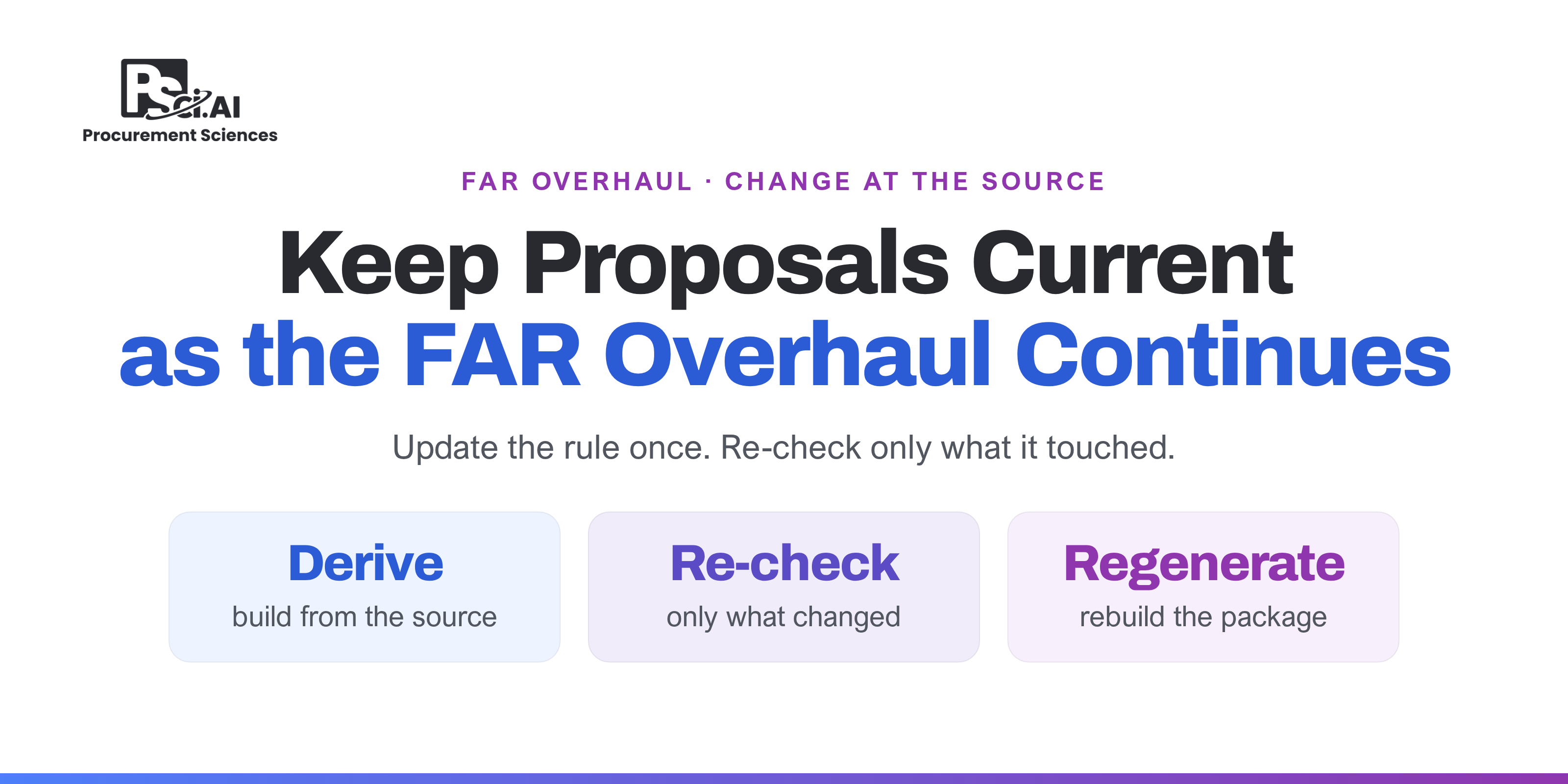
How to Keep Proposals Current as the FAR Overhaul Continues
The FAR overhaul means the rules governing your bid can change while you write it. The fastest way to keep up is to organize your proposal content so every item traces back to the rule it relies on. Update the rule once, and you know exactly what to re-check. We call this Change at the Source.
How to Keep Proposals Current as the FAR Overhaul Continues
Webinar Recap: Outgrowing Small Business, Using AI to Write and Win Like a Prime
Procurement Sciences recently joined APMP for a webinar on one of the most challenging transitions in government contracting: what happens when a small business outgrows its set-aside protections and has to compete in the full and open market against primes with ten times the resources.
Webinar Recap: Outgrowing Small Business, Using AI to Write and Win Like a Prime
Microsoft Copilot Alternatives for Government Contracting: What GovCon Teams Should Know
Microsoft Copilot has become a significant part of the enterprise AI landscape, bringing generative AI directly into applications many government contractors already use every day.
Microsoft Copilot Alternatives for Government Contracting: What GovCon Teams Should Know