
5 Best RFP Automation Platforms

.png)
Government contractors face a unique set of additional hurdles that contractors in the broader marketplace don’t have to worry about. High proposal volumes with short submission windows, strict FAR/DFARS compliance, GovCon-specific terminology and writing style, and limited SME bandwidth all add complexity that general-market RFP tools don’t tend to handle well.
Request for proposal (RFP) automation software uses artificial intelligence and workflow tools to analyze RFP requirements, generate response drafts, manage content libraries, and coordinate team collaboration. Using RFP automation tools, teams can reduce the manual effort required to move a request for proposal from discovery through submission, reducing days of work to just hours.
Below, we’ll break down exactly what RFP automation software does, show you how to evaluate platforms for the unique needs of GovCon, and share five tools that outperform the rest for complex government bids.
Key Takeaways
- RFP automation software replaces fragmented workflows of spreadsheets, email chains, and disconnected documents by centralizing requirements, drafts, tasks, and collaboration in a single platform.
- The best RFP response automation software for government contractors goes beyond generic AI drafting to parse compliance requirements, generate matrices, and structure SME assignments around evaluation criteria.
- AI-powered RFP tools accelerate early-stage work by generating first drafts, summarizing dense solicitation language, and surfacing reusable content from past proposals.
- Testing any RFP tool against a real, recent solicitation reveals workflow fit and requirement-handling accuracy that demos and feature lists cannot show.
Why Teams Turn to RFP Automation Software
Most proposal teams handle RFP response using a collection of software tools that weren’t built for it. Word documents, shared drives, email threads, and spreadsheets for assignments may be great general-market tools, but they don’t fit the contours of RFP/RFI workflows.
Data ends up fragmented across tools, creating a level of coordination overhead where project managers and proposal writers spend time wrangling files and details instead of focusing on content quality, review rigor, and win strategy.
There’s also the problem of scale. As proposal volume increases, time-consuming document management and manual processes built on scattered tools get stretched to the breaking point. Bottlenecks that were frustrating but manageable become barriers to growth and limitations on quality.
Teams also have to contend with the version chaos that comes from working over email and shared drives, where multiple iterations of a file create confusion. With no definitive source of truth, team members could spend hours working in the wrong version of a file, leading to lost changes and last-minute reconciliation.
Last, copy-paste compliance risk is higher. It’s no secret that some portions of government RFPs use similar, near-boilerplate language. Still, it’s important to tweak reused content based on specific requirements, and it’s harder to spot copy-paste mistakes when using software that doesn’t know how to look for them.
How RFP Automation Tools Address GovCon Challenges
RFP response software addresses the shortcomings of general office software, bringing centralized version control, contracting-specific workflows, and review tools into a single interface. Additionally, RFP response tools that are purpose-built for government contracts add nuanced capabilities that general-market RFP software (and certainly office suites) lack.
In essence, GovCon-specific RFP automation tools speak the language of GovCon. They’re built to handle FAR/DFARS language, evaluation criteria structures, and multi-stakeholder workflows. They can also take apart a dense solicitation document, breaking it down into structured workflows and understandable chunks so that teams don’t have to do this detailed interpretation work manually.
By taking on this detailed analysis work, GovCon RFP automation tools lighten the administrative load, enabling capture and proposal teams to focus on strategy, win themes, and review quality.
RFP automation tools can also enable structured SME tasking and tracking. Within the software, you can assign discrete tasks with context and deadlines, improving SME response quality and speed. Instead of rounds of follow-up emails, teams gain real-time progress visibility.
The role of AI in RFP automation
RFP automation tools increasingly employ AI throughout their platforms. AI can parse a dense solicitation into a compliance matrix, pulling out requirements and mapping them to response sections. It can even generate those matrices automatically and populate some using an existing content library based on previous proposals.
Highly skilled humans can spend hours manually reading and still miss some requirements. AI, while imperfect, can parse in seconds to minutes and thoroughly extract all requirements.
Evaluation Criteria for RFP Response Automation Software
Software review articles like this almost all contain long lists of generic features, maybe some pros and cons. The problem is, feature lists and splashy website demos aren’t enough. They don’t tell you whether the solution is a real GovCon fit or a general-market product that will inevitably create more work for your teams.
Instead, GovCons need explicit evaluation criteria grounded in actual solicitations and firm attributes:
- Proposal volume: Can a solution handle your current and future proposal volumes?
- Security constraints: Can it handle the security constraints you work under?
- Workflow maturity/scale: Is the solution undersized or over-featured for your firm’s scale and maturity?
Where possible, the best evaluation you can execute is running an old solicitation through various RFP response automation software options to see how they handle real-world conditions.
Security and deployment options
If your team handles CUI, ITAR, or other sensitive data, you’ll need an application that has the appropriate security posture and deployment flexibility.
For example, some teams must operate their tech stack on-premise or in a private cloud deployment to meet contract requirements. Other certifications, such as SOC 2 Type 2 and, increasingly, Cybersecurity Maturity Model Certification (CMMC), may also appear in contract requirements.
Caution: As you evaluate options using real proposal content, verify a tool’s security posture before uploading proposal content to it.
FAR and DFARS compliance support
GovCons pursuing federal contracts typically have to comply with the Federal Acquisition Regulation (FAR). Defense-related and adjacent contractors also need to consider a platform’s compliance with the Defense Supplement (DFARS).
Solutions built for GovCon can flag compliance requirements and support traceability throughout the proposal lifecycle. Compared to generic AI platforms, models trained on GovCon data generally reduce rework for proposal writers and SMEs.
As you evaluate compliance support, look at whether a platform supports compliance across both matrix generation and requirement-to-response traceability.
Analytics for decisions
GovCon business development teams have plenty of opportunities, but many RFPs won’t be strong fits for the organization’s specialties and size. Teams spend significant resources working through a high volume of opportunities to find the ones that are really worth pursuing.
Advanced RFP automation platforms help here as well, supporting bid/no-bid decisions with analytics. These tools can analyze opportunities at scale, identifying opportunities your organization is well-suited to win based on your data and historic performance. By using AI for analytics-based prioritization, GovCons can focus their capture team resources on the opportunities they are most likely to win.
To identify valuable capabilities here, look for tools that can produce win probability signals, resource requirements, and competitive positioning inputs. Make sure to validate these claims and abilities during evaluation, as analytic depth varies widely from platform to platform.
5 Best RFP Automation Platforms
Government contractors evaluating RFP automation software have a range of options, from generic proposal tools to purpose-built GovCon-specific automation solutions. We’ve curated five of the strongest options here.
We assessed each solution based on GovCon workflow fit rather than general proposal automation features. Specifically, we based our analysis on three areas that matter most to GovCons: compliance handling, AI accuracy, and workflow integration.
Awarded AI by Procurement Sciences
Awarded AI is purpose-built for the entire government contracting lifecycle by former government contractors who saw the need for a solution that addressed every stage in a cohesive platform, from opportunity discovery through post-award performance.
Procurement Sciences’ solution isn’t a general-market or generic AI tool. Instead, Awarded AI is trained on GovCon-specific data so it can more effectively interpret proposals and more naturally draft high-quality language that looks and sounds right for GovCon.
Awarded AI is FedRAMP Moderate Authorized and supports FAR/DFARS compliance, evaluation criteria mapping, and color team reviews. The platform also offers secure deployment options, starting with a single-tenant architecture (dedicated storage resources so data is never commingled).
Deploy Awarded AI in the cloud configuration that best suits your organization and contract requirements:
- Azure Commercial Cloud for strong security controls without federal cloud mandates
- Azure Government Cloud for FedRAMP High, CUI, and GCC High compatibility
- Customer-managed private cloud for complete control, strict data residency, or air gapping
Key features:
- AI-powered requirement parsing and compliance matrix generation
- Structured SME task assignment with deadline tracking
- Content library management with version control
- Win rate analytics and pWin decision support
- Color team review workflow integration
- Secure deployment options for CUI and ITAR environments
Loopio
Loopio is an established player in general-market RFP response software. The platform has strong content library management and AI proposal creation tools that pull tightly from approved content, keeping proposals accurate and on-target (so long as that library content is robust and accurate itself).
Strengths of the Loopio platform include tools for structured team workflows, SME recommendations, and automated library maintenance. Large teams with high proposal volumes and low variability often find Loopio an effective choice.
Be aware that because of Loopio’s dependence on library content and lack of GovCon-specific capabilities, teams with small or limited past content they can use to seed a content library may get less value out of Loopio.
Key features:
- AI portal automation for common RFP formats
- Content library with duplicate and stale content flagging
- Smart SME recommendation and routing
- Collaboration tools for distributed teams
Responsive
Responsive (formerly RFPIO) is an enterprise-focused platform that supports workflow automation and strategic reporting for sales teams and proposal teams managing complex RFP ecosystems. Billed as a strategic response management platform, Responsive has a slightly different focus and is not tailored to GovCon.
Strengths of the platform include portal imports/exports, handling varied document formats, and streamlining an organization-wide knowledge base. It’s a strong choice for teams that need a focus on collaboration, approvals, and governance.
That said, Responsive is not an AI-native platform, so its AI-assisted capabilities may be less developed or embedded. Teams with established manual RFP processes or specific restrictions on AI use may find this a positive, while others may see it as a drawback.
Key features:
- Workflow automation with milestone tracking
- Portal import/export for complex formats
- Strategic analytics and reporting
- Integration with CRM and collaboration tools
AutoRFP.ai
AutoRFP.ai is all about speed. It’s quick to implement (around 24 hours) and even quicker to generate responses. As an AI-native platform, generative AI is the core architecture here.
The platform excels at drafting responses quickly with semantic search through your own content library, bringing down response time without sacrificing accuracy. AutoRFP states its responses remain accurate, insightful, and on-brand.
Multilingual support is an attractive feature for multinational companies (44+ languages supported) and points to the platform’s broad business focus. It’s easy to use and lightning-fast, but GovCon teams should use real solicitations to evaluate how it handles GovCon-specific language and compliance requirements.
Key features:
- Generative AI drafting with confidence scores
- Semantic search across content libraries
- Real-time collaboration tools
- 24-hour implementation timeline
DeepRFP
DeepRFP is an AI-driven suite that supports both B2G/GovCon and B2B proposal response processes. GovCon-focused functionality includes bid/no-bid analyzers and compliance checks. Built with the needs of proposal writers in mind, DeepRFP provides focus where some other platforms opt for breadth.
DeepRFP uses a unique modular approach with different specialized AI agents taking care of various proposal tasks, rather than funneling everything into a single centralized workflow. The biggest question for GovCon teams is where those modules fit into existing workflows and governance.
Key features:
- Proposal Writer for rapid draft generation
- RFP Analyzer for bid/no-bid decision support
- Proposal Reviewer for compliance checking
- Compliance matrix generation
When to Invest in RFP Automation Tools
GovCons need to consider when, not just whether to automate.
On the one hand, if your processes aren’t mature enough to have clear, consistent workflows, or you don’t have time or buy-in, then investing in RFP automation tools could create an unacceptable level of disruption and might not deliver enough improvement.
On the other, once your team hits crisis mode, reshaping your processes around a new RFP automation tool may seem entirely out of reach.
The right moment to invest is in between those two points, when your current processes are mature and stable but creating measurable friction.
Signals your current stack is failing
What does that measurable friction look like? It might look like processes that are working well enough but can’t scale. Or it could look like proposal managers who spend more time chasing details and wrangling versions than reviewing polished proposals.
Signs your tech stack is starting to crack under pressure include:
- Missing deadlines consistently
- Failing to find strong opportunities early enough
- Finding version conflicts during final review (or post-submission)
- Encountering strife with SMEs (disengagement or refusal)
- Losing more qualified opportunities (declining win rates)
If you’re seeing these signs of friction or declining performance, then you’re likely ready for RFP automation software.
Readiness checklist
Still not sure if you’re ready? Use this quick checklist.
- Do you have past proposals and approved content to seed a content library?
- Can you identify specific workflow bottlenecks that automation would address?
- Is leadership committed to adoption and willing to adjust existing processes?
- Do you have a recent RFP you can use to test platforms against real requirements?
“No” answers here point to content governance, workflow definition, or ownership gaps you need to close before pursuing automation.
Accelerate Government Proposal Success With Awarded AI
Government contractors have numerous options for RFP automation, but not every solution fully addresses GovCon needs. With significant GovCon experience throughout the organization, Procurement Sciences understands what GovCons need their proposal automation software to do.
That’s why Awarded AI is built for government contractors who need more than generic RFP automation. Procurement Science’s solution delivers:
- Tuned systems for accurate win probability signals
- GovCon-trained AI that gets the language right the first time
- Compliance-first workflows that keep RFP responses on track
- Secure deployment options that support a wide range of organizational and contract requirements
Of course, the best way to see if a RFP platform is the right fit is to test it with a real solicitation, so you can validate requirement parsing accuracy, workflow fit, and draft usefulness for yourself.
See how Awarded AI can accelerate your success: Book your demo now.
FAQs
What does RFP response automation software replace?
It replaces the fragmented combination of Word documents, spreadsheets, email chains, and shared drives that most proposal teams use to manage RFP responses, centralizing requirements, drafts, tasks, and collaboration in one platform.
How is AI RFP software different from generic writing tools?
AI RFP tools are built around proposal workflows and compliance needs, pulling from approved content and interpreting solicitation language instead of generating generic text that requires heavy rework.
Does RFP automation software eliminate the need for subject-matter experts?
No. SMEs remain essential for technical accuracy and win strategy, while the software reduces administrative burden with structured tasks, draft starting points, and clearer context.
Can ChatGPT write an RFP response?
ChatGPT can generate text, but it lacks the compliance traceability, content library governance, and workflow controls required for government proposals. Purpose-built RFP tools are designed to align drafts to solicitation requirements and approved language.
What is RFP automation?
RFP automation uses AI and workflow tools to analyze solicitation requirements, generate response drafts, manage reusable content, and coordinate team collaboration, reducing the manual effort of proposal development from days to hours.
Click here to schedule a demo to get the full scoop on how our product actually works and discover how AI can transform your approach to government contracting.
Explore More Resources
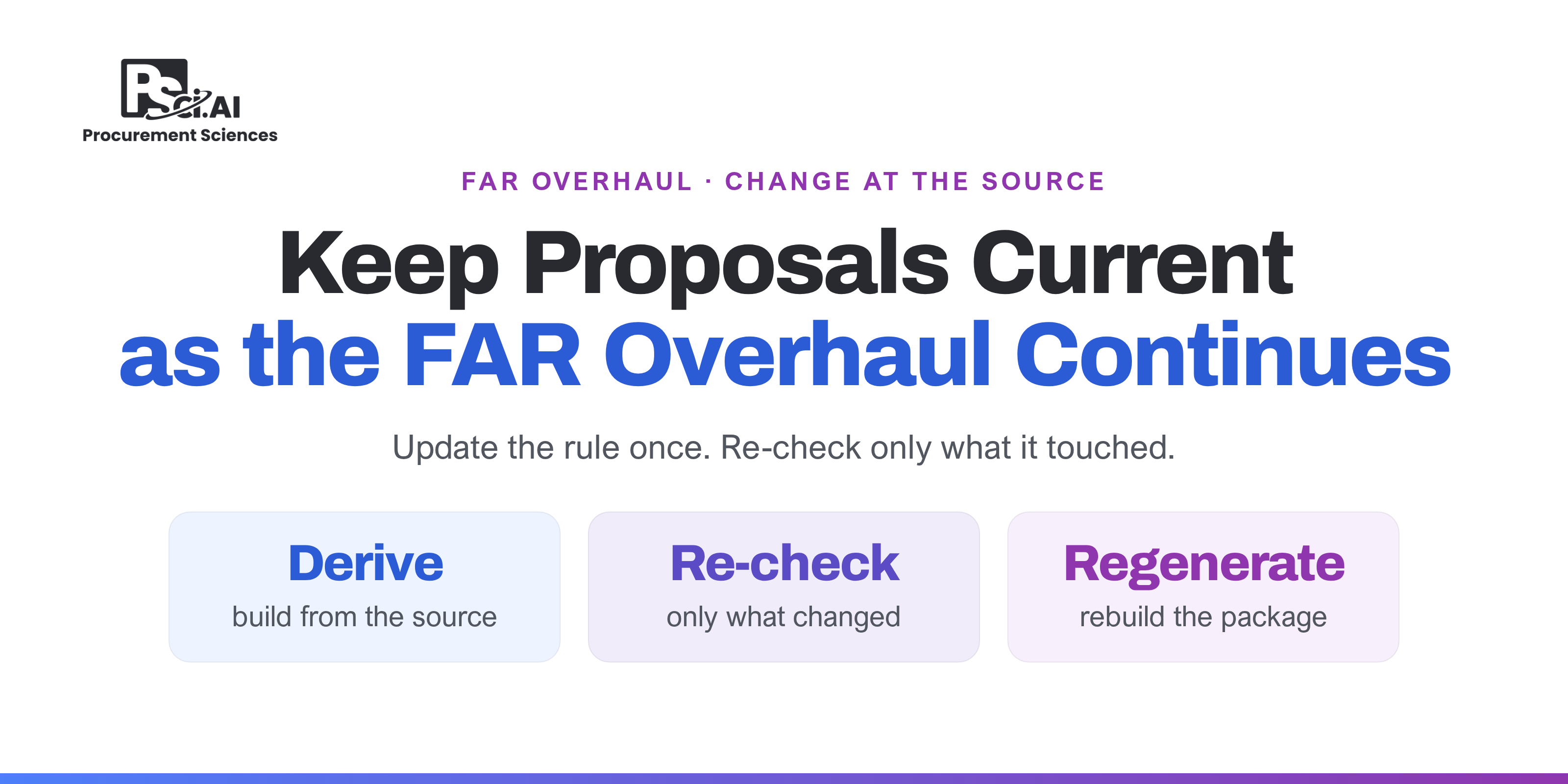
How to Keep Proposals Current as the FAR Overhaul Continues
The FAR overhaul means the rules governing your bid can change while you write it. The fastest way to keep up is to organize your proposal content so every item traces back to the rule it relies on. Update the rule once, and you know exactly what to re-check. We call this Change at the Source.
How to Keep Proposals Current as the FAR Overhaul Continues

Webinar Recap: Outgrowing Small Business, Using AI to Write and Win Like a Prime
Procurement Sciences recently joined APMP for a webinar on one of the most challenging transitions in government contracting: what happens when a small business outgrows its set-aside protections and has to compete in the full and open market against primes with ten times the resources.
Webinar Recap: Outgrowing Small Business, Using AI to Write and Win Like a Prime

Microsoft Copilot Alternatives for Government Contracting: What GovCon Teams Should Know
Microsoft Copilot has become a significant part of the enterprise AI landscape, bringing generative AI directly into applications many government contractors already use every day.
Microsoft Copilot Alternatives for Government Contracting: What GovCon Teams Should Know