
Best Responsive Alternatives and Competitors for Proposal Teams


Responsive (formerly RFPIO) is a proposal and response management platform designed to help teams complete RFPs, manage content libraries, and streamline collaboration across response workflows.
As teams evaluate Responsive competitors, alternatives, and pricing, many begin looking beyond proposal management tools to find platforms that better support capture strategy, opportunity evaluation, and proposal execution—especially in government contracting environments.
In this guide, we’ll break down the top Responsive alternatives, how they compare, and what to look for when choosing the right platform.
Responsive alternatives generally fall into two categories: proposal management platforms focused on response workflows, and platforms designed to support the full government contracting lifecycle. Understanding this distinction is key when evaluating which solution best fits your team.
Key Takeaways:
- Many teams outgrow response-focused tools as proposal complexity and compliance requirements increase.
- Proposal platforms vary significantly in how well they support structured workflows beyond answer reuse.
- Compliance, content governance, and visibility become increasingly critical as proposal volume scales.
- Evaluating platforms against a real request for proposal (RFP) exposes workflow gaps that demos often overlook.
- Platforms built for full proposal lifecycles reduce manual coordination and review bottlenecks.
Why Teams Look for Alternatives to Responsive
Responsive offers useful features for content management and document creation, particularly for reusing existing answers across proposals. But high-stakes government proposals require more than answer reuse.
When the RFP process involves strict compliance standards and multi-stage reviews, response management alone isn't enough.
Responsive primarily supports one part of the proposal workflow: building a content library and generating first drafts from existing content. It doesn't help teams identify RFP opportunities, break down RFP requirements, or manage compliance across the full proposal lifecycle. Tailoring reused content to highly specific government requirements can still require significant manual effort.
As proposal volume increases, these gaps become more visible. Large enterprises managing dozens of concurrent bids often need structured workflow automation, clearer task ownership, and stronger compliance controls. For high-volume government contractors, Responsive's scope may not support the operational demands required to scale.
What To Consider When Evaluating Responsive Alternatives
Your proposal management software will become part of your daily workflow, so it needs to fit how your team actually works. The right platform should streamline your most challenging tasks, not introduce new friction or coordination gaps.
Not all response automation platforms are built for highly regulated industries or high-volume environments. When comparing Responsive alternatives for government contracting, focus on how well each tool supports structured workflows, compliance requirements, and cross-team collaboration.
Proposal Workflow and Depth Structure
Your proposal software needs to support the complexity of your current workflow. Government RFPs often include detailed and specific requirements, and a generic template won't be enough. You need an AI-powered tool that can assess each individual RFP and generate tailored proposal responses. It should also support structured review and approval cycles.
RFP search functions are valuable for teams managing complex pipelines. They reduce time spent navigating government databases and allow teams to focus on proposal strategy.
As your business scales, centralizing your workflow in one platform becomes increasingly important. A single system reduces platform switching and helps prevent duplicate or conflicting documents. It also improves consistency and visibility across active proposals.
Compliance Support and Content Governance
Strict government compliance standards require more than basic document storage. When evaluating proposal management software, prioritize platforms with built-in compliance controls that reduce risk and oversight gaps.
Look for these key compliance features:
- Strict user permissions: Role-based access controls limit proposal visibility to qualified team members and reduce the risk of unauthorized changes.
- Auditability: Your software should generate a clear audit trail to prepare for future government reviews. The Defense Contract Audit Agency audits 2,465 contractors in a typical year.
- Controlled reuse: When reusing content from past proposals, your tool should help you remove outdated references to agencies, projects, or deadlines to prevent compliance issues.
- Cybersecurity features: Built-in security protections are essential for safeguarding sensitive government information and meeting requirements such as CMMC.
Without these controls, teams often rely on manual compliance checks for every submission. This slows execution and increases operational risk, especially in regulated environments.
Collaboration and Scalability
Government contracting proposals often involve multiple contributors. A primary author may structure the submission, while SMEs provide input for technical or specialized sections.
Strong proposal platforms include built-in collaboration features that allow teams to work within a shared environment. Look for tools that support task assignment, role clarity, and visibility into individual contributions. This improves accountability and reduces bottlenecks as proposal volume and team size increase.
Top Responsive Alternatives for Proposal Teams
If Responsive isn't the right fit for your team, several proposal management software platforms offer deeper workflow and compliance support. Below are the top Responsive alternatives, ranked by their suitability for government contractors.
For a broader overview, see AI tools for government contracting.
1. Procurement Sciences
Procurement Sciences is a purpose-built platform for government contracting teams that need support across the full lifecycle—from opportunity evaluation through capture strategy and proposal execution.
Unlike proposal management tools like Responsive, which focus on response workflows and content reuse, Procurement Sciences supports how teams evaluate opportunities, develop strategies, and execute proposals across the full lifecycle.
Beyond proposal generation, the platform supports the broader proposal lifecycle. Bid search features help identify new opportunities, and AI-driven review tools assist with compliance and quality checks before submission.
A centralized dashboard provides full visibility into your contract pipeline and active proposals. Documentation is maintained throughout the process to support continuity if a bid moves forward.
Key features:
- AI-assisted drafting trained on government terminology and proposal structures
- Compliance-aware content reuse and centralized libraries
- Workflow automation across capture, proposal, SME review, and final delivery
- Security and auditability designed for regulated environments
Best for:
Government contractors and proposal teams that want to move beyond proposal management and improve capture strategy and proposal execution.
2. Loopio
Loopio is an RFP tool focused on response management. It integrates with your existing tech stack to help teams build and maintain a centralized content library. Its AI pulls from that library to assist with proposal drafting, and built-in checklists help ensure key tasks are completed.
The platform is known for its ease of use and straightforward interface, making it accessible for teams prioritizing efficiency in response creation.
Key features:
- Centralized content library built on existing documents
- Collaboration tools and project tracking for response teams
- RFP and questionnaire insights
Best for:
Teams focused primarily on reusing existing content rather than managing full proposal workflows.
Many teams also compare Loopio alternatives when evaluating proposal management tools.
3. QorusDocs
QorusDocs is a proposal automation tool with deep integration across Microsoft 365 and SharePoint. Within Microsoft applications, teams can use its AI agents to review bid opportunities, pull from a centralized knowledge base, and draft proposals. The platform also supports PowerPoint, Excel, and other proposal formats.
If your team already operates within a Microsoft-based document workflow, QorusDocs can accelerate repetitive tasks and standardize output. However, it doesn't include compliance controls tailored to government contracting, so review and oversight processes may need to be managed separately.
Key features:
- Microsoft Word-native proposal creation
- Template-based document automation
- SharePoint integration
Best for:
Teams that rely heavily on Microsoft tools and have established proposal formats in place.
4. Proposify
Proposify is a platform focused on creating visually polished proposals and branded documents. It includes a drag-and-drop editor and AI-powered document management to help organize tasks and content. Teams can pull assets from existing libraries and add e-signatures, video, and other multimedia elements to their proposals.
For organizations prioritizing presentation and brand consistency, Proposify can streamline document creation. However, it doesn't include compliance or security controls designed for government contracting.
Key features:
- Proposal templates and document creation
- E-signature and document tracking
- Sales-oriented workflow management
Best for:
Sales teams that create visually driven proposals and branded materials that don't require government-specific compliance support.
How To Find Out Which Responsive Alternative Fits Your Proposal Process
The most effective way to evaluate Responsive alternatives is to test them using a real proposal. Demo videos and presentations highlight features, but they don't reflect how a platform performs within your actual workflows.
When testing proposal tools, keep the following considerations in mind.
Match Tools to Proposal Complexity
When evaluating each platform, assess whether it supports the complexity of your actual workflows. Consider your team structure, compliance requirements, and review processes, and identify the capabilities needed at each stage.
Start by breaking your proposal process into clear phases. Then map each tool's features to those phases. The more stages a platform can support, the more effectively it will align with your operations.
Generative AI features are only one factor in this decision. While they can accelerate drafting, long-term fit depends on how well the platform supports your workflow structure and compliance requirements.
Consider Long-Term Scalability
When selecting a proposal platform, consider how your business will grow over time. If the system isn't scalable, it may limit your ability to pursue additional opportunities and could require replacement sooner than expected.
As proposal volume increases, coordination becomes more complex. More submissions mean more contributors, tighter timelines, and greater oversight. A scalable platform should have the capacity for additional team members and increased proposal volume without disrupting existing workflows.
It should also adapt as your processes evolve and accommodate a growing content library without creating version confusion or governance challenges.
What Makes Procurement Sciences a Strong Responsive Alternative
Procurement Sciences is built specifically for government contractors that require structured workflow support and compliance alignment. Its design reflects the operational demands of government proposal teams, not just response management.
The following capabilities distinguish Procurement Sciences in regulated, high-volume environments.
Built for Full Proposal Workflows, Not Just Responses
Procurement Sciences' AI tools are designed to support more than basic RFP response reuse. The system helps generate proposal drafts tailored to each RFP and aligned with your organization's structure and requirements.
The proposal solution supports workflow from opportunity discovery through submission. Teams can search for RFPs, collaborate on active proposals, and manage compliance reviews within the same platform. The centralized dashboard allows task assignment and progress tracking to maintain visibility across submissions.
Designed for Compliance-Heavy Environments
Compliance violations can seriously affect your business, so they're a key consideration for government contractors. Procurement Sciences is built to support FAR and CMMC requirements, helping teams maintain compliance and prepare for audits. The Federal Acquisition Regulation is undergoing a comprehensive overhaul, increasing the importance of staying aligned with evolving standards.
Procurement Sciences includes strict data privacy and cybersecurity features. Your data is isolated in an environment suitable for sensitive government information and is never used to train AI models. The platform also provides advanced permissions and audit trails that give teams greater transparency and control over proposal work.
Built-in compliance review features further support governance during the proposal generation process.
Responsive vs Alternatives: Key Differences
When comparing Responsive to alternatives, the primary differences often include:
- Proposal and response management vs full lifecycle workflow platforms
- Content libraries vs structured capture and proposal workflows
- Response efficiency vs strategy-driven execution
Responsive is designed to help teams respond to RFPs more efficiently, while alternatives may focus more on how teams plan, evaluate, and execute opportunities from start to finish.
Choose a Proposal Platform That Fits How Your Team Works
Responsive is a widely used RFP tool, but it may not support the full operational demands of government proposal teams. The most effective way to evaluate alternatives is to test them against a real proposal and assess how well they handle workflow complexity, compliance requirements, and collaboration.
Procurement Sciences is designed to support structured proposal execution in regulated environments. From opportunity discovery through submission and review, the platform aligns workflow, compliance, and visibility in a single system. This approach helps government contractors manage higher proposal volume without sacrificing oversight or consistency.
Request a demo to see how Procurement Sciences compares to Responsive in real workflows.
FAQs
Why Do Teams Look For Alternatives To Response Management Tools?
As proposals grow in size and regulatory complexity, teams often need more structured workflows, clearer visibility, and stronger compliance controls than response management tools provide.
What's the Difference Between Response Management and Proposal Management?
Response management focuses on storing and reusing answers. Proposal management supports the broader process, including drafting, structured review cycles, compliance oversight, and submission coordination.
Do All Providers Support Government Proposal Requirements?
No. Many platforms are designed for commercial sales teams and may require additional manual processes to meet government compliance and security standards.
How Should Teams Evaluate Proposal Platforms Effectively?
Testing platforms against a real RFP reveals how well they support workflow structure, collaboration, and compliance under real conditions.
Click here to schedule a demo to get the full scoop on how our product actually works and discover how AI can transform your approach to government contracting.
Explore More Resources
.png)
Webinar Recap: Product Spotlight, Market Intelligence by HigherGov Inside Awarded AI
Procurement Sciences recently hosted a product spotlight session on Market Intelligence by HigherGov, the newly integrated data layer now available inside Awarded AI. Sam Cooper, Director of Solutions Consulting, walked through what the integration means in practice, why it matters for the BD lifecycle, and demonstrated it live.
Webinar Recap: Product Spotlight, Market Intelligence by HigherGov Inside Awarded AI
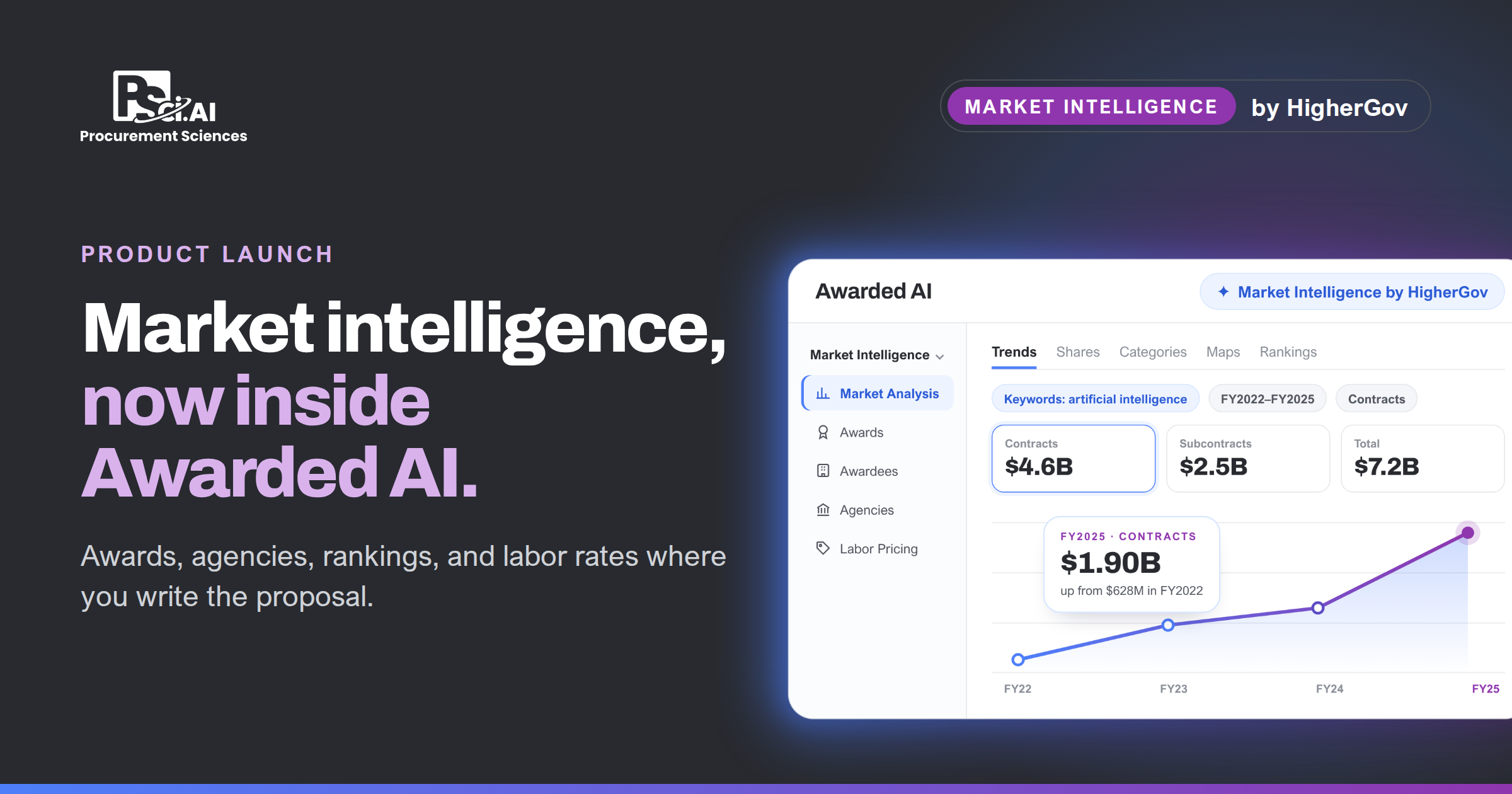
Introducing Market Intelligence by HigherGov: Know the Market Before You Bid
Today we're launching Market Intelligence by HigherGov, which brings HigherGov's federal market data directly inside Awarded AI. The research behind every bid now lives in the same secure platform where you capture and write.
Introducing Market Intelligence by HigherGov: Know the Market Before You Bid
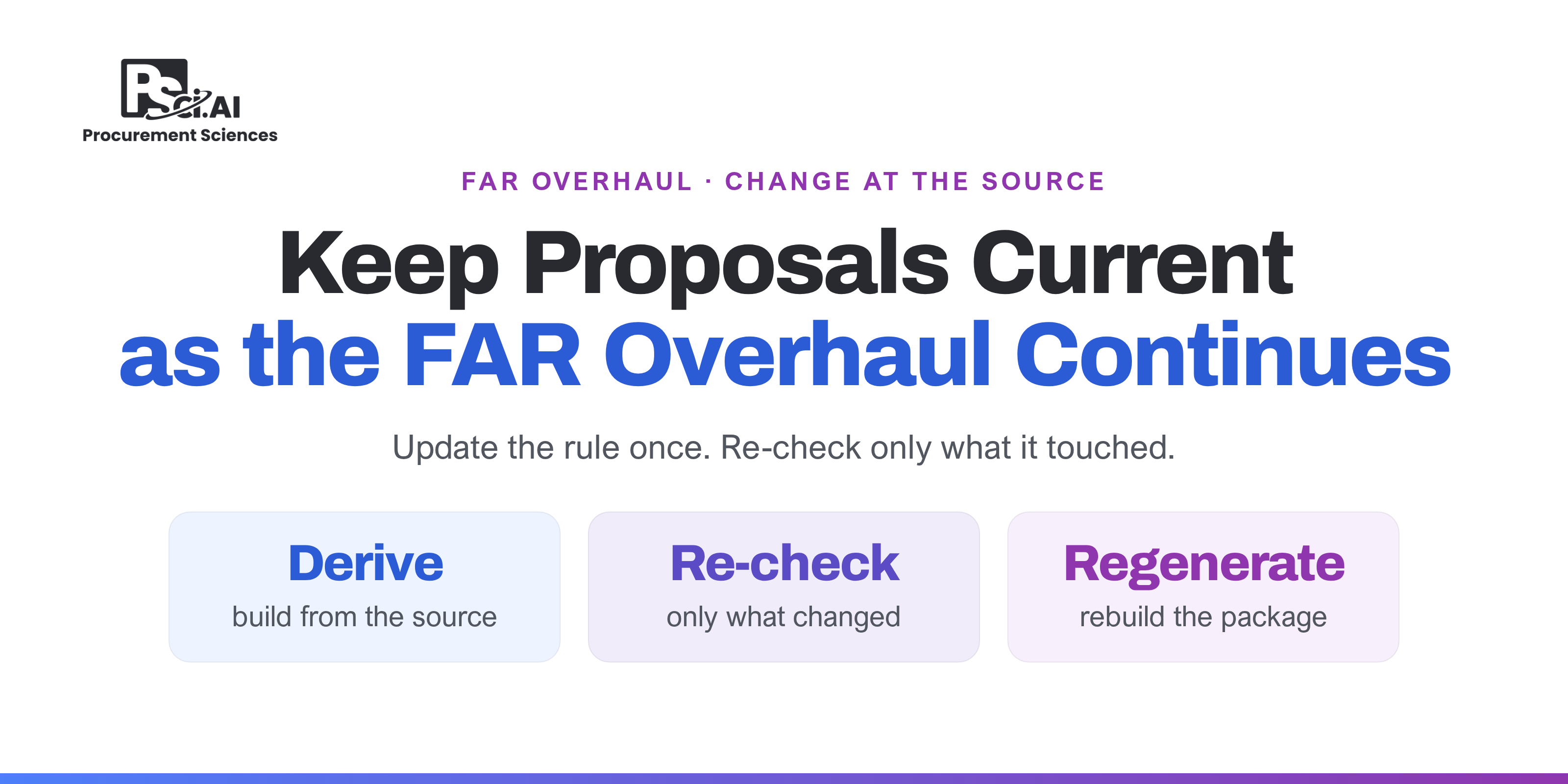
How to Keep Proposals Current as the FAR Overhaul Continues
The FAR overhaul means the rules governing your bid can change while you write it. The fastest way to keep up is to organize your proposal content so every item traces back to the rule it relies on. Update the rule once, and you know exactly what to re-check. We call this Change at the Source.
How to Keep Proposals Current as the FAR Overhaul Continues