
How to Find IDIQ Contracts and Task Order Opportunities

Open IDIQ solicitations are posted on SAM.gov like any other contract opportunity. Task orders issued under IDIQs you already hold are a different problem entirely, since most never touch SAM.gov at all. They move through GSA eBuy, agency-specific ordering portals, or direct notices to a closed pool of existing vehicle holders. Finding one requires a different search than finding the other.
If you've read our guide on what an IDIQ contract is, you already know that winning the base vehicle only earns you eligibility, not revenue. This piece covers the practical side: where the two kinds of opportunities actually live, and how to build a search that catches both.
Two Different Searches, Not One
Most contractors treat "finding IDIQ opportunities" as a single search problem. It's actually two:
- Finding a new IDIQ or GWAC to bid on. This is a competition anyone can enter, and it's publicly posted like a normal solicitation.
- Finding task orders under a vehicle you already hold. This is a closed competition among existing holders, and it often isn't public at all.
Confusing the two is the single biggest reason contractors say they "can't find anything" on a vehicle they hold. They're searching SAM.gov for task orders that were never posted there.
Where Open IDIQ Solicitations Live
The base award, the actual multi-year IDIQ or GWAC competition, follows normal federal posting rules. Under FAR 5.2, agencies must post solicitations above the simplified acquisition threshold (currently $350,000, raised from $250,000 as of October 1, 2025) to SAM.gov, along with sources-sought notices and pre-solicitation synopses that often surface months before the formal RFP drops.
Practical search habits that catch these early:
- Set saved searches on SAM.gov filtered by NAICS code and set-aside type, not just keyword.
- Watch for sources-sought and RFI notices specifically. Agencies use these to gauge industry interest before writing the real solicitation, and responding to one puts you on the radar before competitors even see the RFP.
- Check agency procurement forecasts. Acquisition.gov maintains a list of links to each agency's recurring procurement forecast page. Coverage and format vary wildly by agency, some are genuinely useful spreadsheets, others are barely maintained, but a forecast hit can give you a year of lead time on a vehicle recompete.
Where Task Order Opportunities Actually Live
Once you're on a multiple-award vehicle, the individual task orders (or delivery orders, for supplies) rarely get a public SAM.gov posting. Instead:
- GSA eBuy is where agencies issue RFQs and RFPs against GSA Multiple Award Schedules and several GWACs, including Alliant, Polaris, and VETS. Unlike SAM.gov, eBuy is restricted: you only see opportunities that match the Special Item Numbers (SINs) or vehicle categories you actually hold. If you're not seeing task orders you'd expect, check whether you're registered under the right SIN, not whether eBuy is broken.
- Agency-specific ordering portals run parallel systems for their own vehicles. The Navy's SeaPort-NxG, Army CHESS for IT hardware and software, and NASA SEWP all issue task orders through their own platforms rather than SAM.gov or eBuy.
- Unison Marketplace aggregates ordering across several GWACs and schedules (GSA Schedules, NASA SEWP, DHS FirstSource, and others) into a single login for contracting officers, which means a task order might route through Unison rather than the vehicle's native portal. It's worth registering as a vendor there if you hold any of the vehicles it covers.
- Direct notice from the contracting officer. For smaller or more specialized IDIQs, especially agency-unique ones, the fair opportunity notice may simply be an email sent to the pool of holders. There's no central system to monitor. The only defense is staying visible to the program office and asking to be added to notification lists when you're onboarded to the vehicle.
Under FAR 16.505(b)(1), agencies must give every multiple-award holder a fair opportunity to compete for orders above the micro-purchase threshold ($15,000), but "fair opportunity" doesn't mean "publicly posted." It means every current holder gets a shot, not that the outside world sees the notice.
Use Award History to Find the Pattern Before the Next Order Drops
FPDS and USASpending.gov won't show you an open opportunity, but they will show you where task orders have already gone, which is often more useful for planning. Every task order eventually gets reported against its parent IDV (Indefinite Delivery Vehicle) number. Pulling that history tells you:
- Which buying offices actually use the vehicle, versus which ones just have access to it
- Which contractors have won past orders, and roughly how often
- The typical dollar range of orders on that vehicle, which tells you whether it's worth the pursuit cost
This is capture research, not opportunity-hunting, but it's what separates a contractor who wins task orders from one who just holds a vehicle and waits. A vehicle with ten holders and no order history in two years isn't worth watching closely. One with a buying office issuing orders every quarter is.
Building a Search That Actually Covers Both
Given how fragmented this is, a manual process usually looks like: SAM.gov saved searches, a login to eBuy, logins to two or three agency-specific portals if you hold DoD or NASA vehicles, a recurring check of a handful of agency forecast pages, and a spreadsheet somewhere trying to track which vehicles you're even eligible to see orders on. It works, but it doesn't scale past a handful of vehicles, and it's easy to miss a 10-day response window buried in a portal nobody checked that week.
This is the specific problem market intelligence platforms exist to solve. Our HigherGov platform indexes vehicle holders, award history by parent IDV, and opportunity data across these fragmented systems in one searchable place, so the question "has anyone ordered against this vehicle recently, and who won" takes a search instead of a week of manual pulls. Procurement Sciences' Intelligence platform builds on that data to help BD and capture teams prioritize which vehicles are actually worth the pursuit, rather than treating every IDIQ you're eligible for as equally worth watching.
Frequently Asked Questions
Are task orders posted on SAM.gov?
Rarely. SAM.gov is the primary posting system for the base IDIQ or GWAC competition itself, but individual task orders under an existing vehicle are usually issued through GSA eBuy, an agency-specific portal, or direct notice to existing holders, not through SAM.gov.
What is GSA eBuy, and can anyone use it?
GSA eBuy is where agencies issue RFQs and RFPs against GSA Multiple Award Schedules and several GWACs. Access is restricted to vendors who hold the relevant Schedule contract, SIN, or GWAC seat, it isn't open to the general contractor community the way SAM.gov is.
Can I bid on a task order if I don't hold the underlying IDIQ?
Generally no, not as a prime. Task order competitions under a multiple-award IDIQ are limited to existing holders under fair opportunity rules. If you don't hold the vehicle, your path in is usually teaming as a subcontractor with a company that does.
How do I find task order opportunities as a potential subcontractor?
Since you won't see the fair opportunity notice directly, the practical approach is building relationships with prime holders on vehicles relevant to your capabilities before a specific task order is on the table, and using award history (FPDS, USASpending, or our HigherGov platform) to identify which primes are actually winning orders on a given vehicle.
What's the fastest way to track opportunities across multiple vehicles at once?
Manually, it means separate logins to SAM.gov, eBuy, and any agency-specific portals tied to vehicles you hold, plus periodic forecast checks. A market intelligence platform that indexes award history and opportunity data across these systems in one place removes most of that manual overhead.
Related Reading
- What Is an IDIQ Contract? A Guide for Government Contractors, the pillar guide this piece builds on.
Stop Checking Five Portals a Week
Every vehicle you hold adds another system to monitor and another way to miss a response window. Procurement Sciences' Intelligence platform surfaces award history and opportunity signals across the vehicles you're tracking in one place, built on data from our HigherGov platform.
Procurement Sciences is the AI platform for government contractors. Our platform supports business development, capture, proposal, and delivery teams across the full GovCon lifecycle. Request a Demo to learn more.
Click here to schedule a demo to get the full scoop on how our product actually works and discover how AI can transform your approach to government contracting.
Explore More Resources

What Is an IDIQ Contract? A Guide for Government Contractors
Indefinite Delivery, Indefinite Quantity (IDIQ) is a federal contract vehicle that lets an agency order an unknown amount of supplies or services, within stated limits, over a fixed period of time, rather than committing to a fixed quantity up front.
What Is an IDIQ Contract? A Guide for Government Contractors
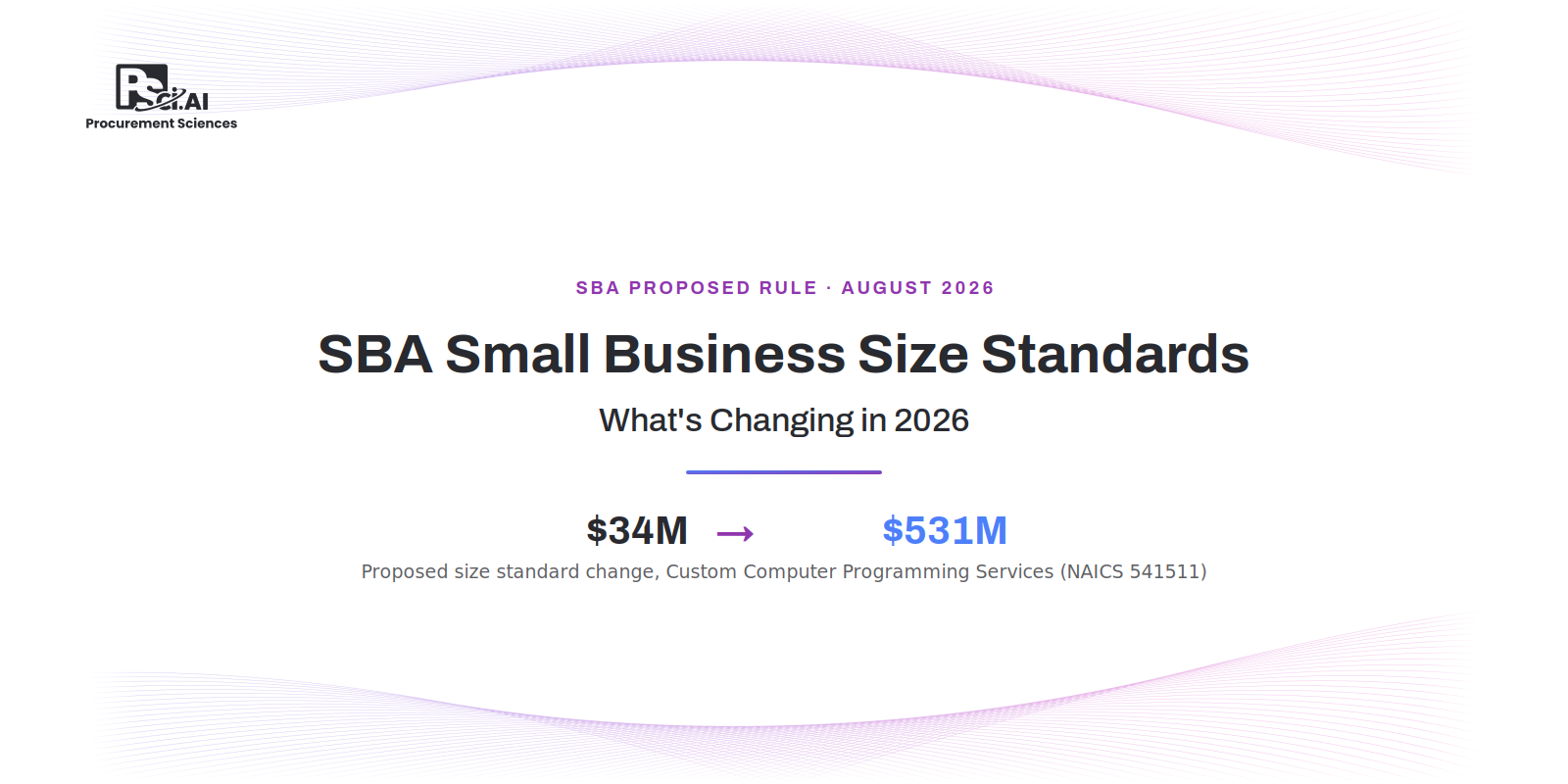
SBA Small Business Size Standards Are Changing: Here's What Government Contractors Need to Know
On August 20, 2026, the Small Business Administration (SBA) published a proposed rule that would rewrite its small business size standards, the thresholds that determine which companies qualify as "small" for federal contracting, SBA loans, and related programs.
SBA Small Business Size Standards Are Changing: Here's What Government Contractors Need to Know
Procurement Sciences AI Named a High Performer in G2's Fall 2026 Government Procurement Grid®
We're proud to share that Procurement Sciences AI has been named a High Performer in G2's Fall 2026 Grid® Report for Government Procurement Software.
Procurement Sciences AI Named a High Performer in G2's Fall 2026 Government Procurement Grid®