
What Is an IDIQ Contract? A Guide for Government Contractors


Indefinite Delivery, Indefinite Quantity (IDIQ) is a federal contract vehicle that lets an agency order an unknown amount of supplies or services, within stated limits, over a fixed period of time, rather than committing to a fixed quantity up front.
If you've spent any time browsing SAM.gov, you've run into the acronym constantly. IDIQs are one of the most common contract types in the federal marketplace, and also one of the most misunderstood. Winning one doesn't hand you revenue; it hands you eligibility. This guide walks through what an IDIQ actually is, how the ordering process works, and what separates contractors who turn a vehicle into a durable pipeline from those who win the award and then stall out.
What Is an IDIQ Contract?
The definition comes straight from the Federal Acquisition Regulation, specifically FAR 16.504(a), which describes an IDIQ as an arrangement providing for an indefinite quantity of supplies or services, within stated limits, during a fixed period. IDIQs are one of three types of indefinite-delivery contracts under FAR Subpart 16.5, alongside definite-quantity contracts and requirements contracts, but they make up the large majority of vehicles contractors encounter.
Think of an IDIQ contract vehicle as a standing agreement rather than a single purchase order. The agency isn't committing to buy a specific amount of anything up front. It's setting the ground rules: pricing, terms, scope, and the pool of contractors it will draw from, so it can issue orders as real needs materialize. Whether you call it an IDIQ government contract or just "the vehicle," the mechanics are the same.
How the Ordering Process Works
Winning an IDIQ award doesn't put any money in your pocket. It's better described as earning a seat at the table. The revenue comes later, through task orders (for services) or delivery orders (for supplies) issued under that base contract. The basic flow:
- The agency awards the IDIQ to one or more contractors after a competitive solicitation.
- The agency identifies a specific need that falls within the IDIQ's scope.
- Orders are issued directly, on a single-award IDIQ, or through a "fair opportunity" competition among all IDIQ holders on a multiple-award IDIQ.
- Contractors deliver against each order, get paid, and the cycle repeats until the ceiling or period of performance is reached.
Single-Award vs. Multiple-Award IDIQs
Single-award IDIQs go to one contractor, who receives every task order issued under that vehicle for its duration. The FAR generally prefers multiple awards to preserve competition, but single-award vehicles are still common in practice.
Multiple-award IDIQs, sometimes bundled into Government-Wide Acquisition Contracts (GWACs) or Multi-Agency Contracts (MACs), split the award among several contractors, often somewhere between 3 and 15 companies. Once you're one of the winners, you're no longer competing against the entire federal marketplace; you're competing against a much smaller, known field for each order. That's a meaningful advantage, and a big part of why multiple-award IDIQs are so coveted.
Under FAR 16.505(b)(1), agencies generally must give every IDIQ holder a fair opportunity to compete for orders above the micro-purchase threshold, currently $15,000 under FAR 2.101. There are limited exceptions, like unacceptable urgency or a need only one contractor can reasonably meet, but fair opportunity is the default, not the exception.
Ceilings, Minimums, and Why the Gap Matters
Every IDIQ has two numbers worth watching closely:
- The ceiling: the maximum the government can spend under the contract. This figure is often the headline, but it's a cap, not a guarantee.
- The minimum guarantee: the smallest amount the agency is legally obligated to order. The FAR requires this minimum to be more than nominal, but in practice it's often just a few thousand dollars.
The gap between those two numbers can be enormous. GSA's Alliant 2, the flagship IT GWAC used by more than 100 federal agencies, carries a $90.75 billion ceiling and a $2,500 minimum guarantee per contractor. That's not a typo. The government's binding commitment to any individual Alliant 2 holder is $2,500. Everything else, all $90.75 billion of headroom, is earned by competing for and winning task orders against the other vehicle holders.
That gap is the central uncertainty of IDIQ work. Being on the vehicle guarantees eligibility, not revenue. What you actually collect depends on how competitively you pursue task orders once you're in, which is why market intelligence on who else holds the vehicle, what's been ordered historically, and when recompetes are coming matters as much as the base award itself.
Pricing Structures Within an IDIQ
The IDIQ is the ordering mechanism, not the pricing model. Individual orders typically follow one of the standard FAR Part 16 contract types:
- Fixed-price orders lock in costs upfront and shift performance risk to the contractor, well suited to clearly defined requirements.
- Cost-reimbursement orders reimburse allowable costs plus a fee, keeping more risk with the agency, common for less-defined or research-heavy work.
- Time-and-materials (T&M) orders pay hourly labor rates plus materials, blending both approaches.
Some IDIQs establish fixed labor categories and rates at the base-contract level that then apply uniformly across every order issued under it.
Why Contractors Pursue IDIQs
- A smaller competitive field. Once you're a vehicle holder, you compete against a defined group of peers instead of the open market for every order.
- Multi-year revenue visibility. IDIQs typically run several years, supporting more confident hiring and capacity planning.
- Deeper agency relationships. Repeated performance builds the past-performance history that helps you win the next order, and the next vehicle.
- Set-aside access. Many IDIQs are reserved for small businesses, including 8(a), WOSB, and SDVOSB firms, narrowing the field further.
Getting on an IDIQ Vehicle, and What to Do Once You're There
Competition for the base IDIQ is typically open to any qualified company that meets the solicitation's requirements. Once it's awarded, the door generally closes: only existing holders compete for task orders, unless the agency later opens an on-ramp.
That makes the initial capture effort for an IDIQ solicitation especially high-stakes: you're not bidding on one job, you're bidding on years of future eligibility to bid on jobs. The same discipline that goes into building a government contracting win strategy applies here, arguably with higher stakes, since the "opportunity" you're capturing is the vehicle itself. A few things worth doing before you commit resources:
Step 1: Map the Incumbent Landscape
Who currently holds similar vehicles, and how concentrated is the award history among them?
Step 2: Size the Realistic Opportunity
Look past the ceiling. Pull historical order data on comparable vehicles to see what actually got spent against the minimum-to-ceiling range.
Step 3: Identify Likely Competitors
Map the field for the base award and plan your differentiation before the solicitation drops.
Step 4: Track Every Task Order Notice
Once awarded, monitor every order issued under the vehicle so you're never caught missing a fair-opportunity window.
Step 5: Build the Agency Relationship Continuously
Don't wait for recompete. Repeat performance is what wins the next order.
This is where market intelligence tools earn their keep. Manually tracking which contractors hold which IDIQs, what's been ordered historically, and when a vehicle is coming up for recompete used to mean digging through USASpending and SAM.gov by hand. Platforms like HigherGov by Procurement Sciences surface that data (vehicle holders, award history, ceiling utilization, upcoming recompetes) in one place, and Procurement Sciences' Intelligence solution layers market insight on top of it so BD and capture teams know which vehicles are worth the pursuit before they commit resources.
Frequently Asked Questions
What does IDIQ stand for?
Indefinite Delivery, Indefinite Quantity. It describes a contract where the government knows it will need a category of supplies or services but doesn't know the exact quantity or timing up front.
Is it "indefinite delivery indefinite quantity" or "indefinite quantity indefinite delivery"?
Both phrasings point to the same contract type. The official FAR term and acronym order is Indefinite Delivery, Indefinite Quantity (IDIQ), but you'll see the words reversed in casual use. It doesn't change what the contract is or how it works.
Does winning an IDIQ guarantee revenue?
No. It guarantees the agency will order at least the contract's stated minimum, which can be as low as a few thousand dollars. Actual revenue comes from competing for and winning task orders issued under the vehicle.
What's the difference between an IDIQ and a GWAC?
A GWAC (Government-Wide Acquisition Contract) is a specific type of multiple-award IDIQ, established by one agency for use by any federal agency, most commonly for IT products and services. Every GWAC is an IDIQ, but not every IDIQ is a GWAC.
Can small businesses compete for IDIQ contracts?
Yes. Many IDIQs are set aside specifically for small businesses under programs like 8(a), WOSB, and SDVOSB, and small businesses can also compete on full-and-open multiple-award vehicles.
How do agencies decide who gets a task order on a multiple-award IDIQ?
Under FAR 16.505(b)(1), agencies must give every IDIQ holder a fair opportunity to compete for orders above the micro-purchase threshold, currently $15,000, with limited exceptions for urgency or unique capability. The competition is typically a scaled-down "mini-RFP" among the vehicle holders.
Related Reading
- How to Find IDIQ Contracts and Task Order Opportunities, the follow up guide to this article.
See Where the IDIQ Opportunities Are
Winning the base vehicle is only half the work. The contractors who get the most out of an IDIQ are the ones tracking task order activity, ceiling utilization, and recompete timing across every vehicle they hold. Procurement Sciences' Intelligence platform gives BD and capture teams that visibility in one place, built on data from HigherGov.
Procurement Sciences is the AI platform for government contractors. Our platform supports business development, capture, proposal, and delivery teams across the full GovCon lifecycle. Request a Demo to learn more.
Click here to schedule a demo to get the full scoop on how our product actually works and discover how AI can transform your approach to government contracting.
Explore More Resources
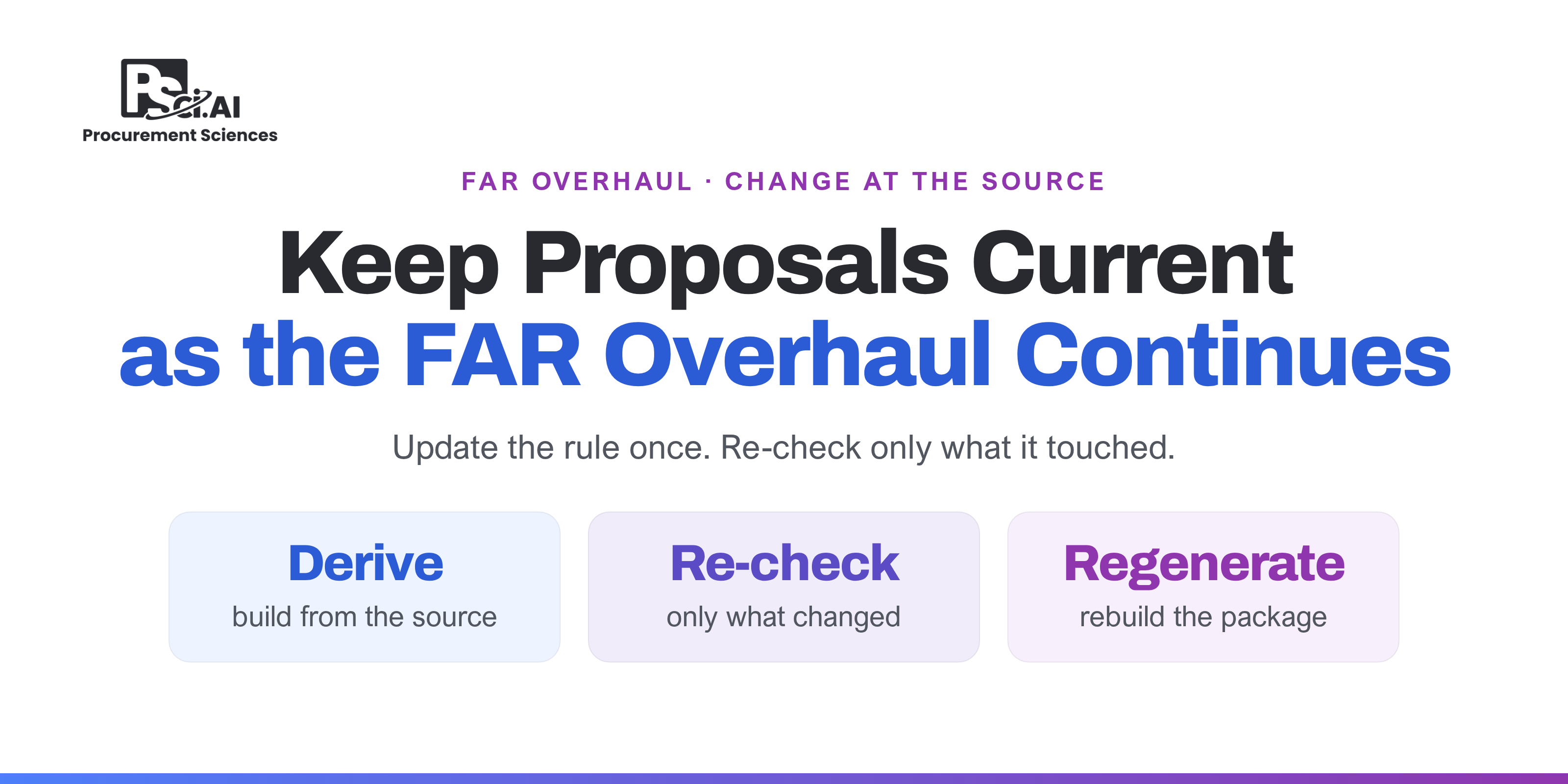
How to Keep Proposals Current as the FAR Overhaul Continues
The FAR overhaul means the rules governing your bid can change while you write it. The fastest way to keep up is to organize your proposal content so every item traces back to the rule it relies on. Update the rule once, and you know exactly what to re-check. We call this Change at the Source.
How to Keep Proposals Current as the FAR Overhaul Continues

Webinar Recap: Outgrowing Small Business, Using AI to Write and Win Like a Prime
Procurement Sciences recently joined APMP for a webinar on one of the most challenging transitions in government contracting: what happens when a small business outgrows its set-aside protections and has to compete in the full and open market against primes with ten times the resources.
Webinar Recap: Outgrowing Small Business, Using AI to Write and Win Like a Prime
Microsoft Copilot Alternatives for Government Contracting: What GovCon Teams Should Know
Microsoft Copilot has become a significant part of the enterprise AI landscape, bringing generative AI directly into applications many government contractors already use every day.
Microsoft Copilot Alternatives for Government Contracting: What GovCon Teams Should Know