
How to Build a Government Contracting Win Strategy in 2026

%20(1).png)
A government contracting win strategy is a structured plan that helps contractors identify which opportunities to pursue, understand their competitive position, and make the decisions that maximize their probability of winning before an RFP drops.
Most government contractors approach business development reactively by responding to solicitations as they appear, relying on tribal knowledge, and spending B&P dollars on opportunities they were unlikely to win in the first place. A win strategy changes that. It gives your team the intelligence to compete proactively, allocate resources to the right pursuits, and build relationships before the competition does.
This guide walks through what a strong government contracting win strategy covers, how to build one, and how AI is changing the speed and precision with which contractors can develop them.
What Is a Government Contracting Win Strategy?
A government contracting win strategy is a capture and business development plan built around a specific opportunity or market segment. It answers five core questions:
- Where should we compete? Which agencies, vehicles, and opportunities match our capabilities and past performance?
- Who are we up against? Who holds the incumbent contracts, what are their weaknesses, and where do we have a competitive opening?
- What does the buyer actually want? What are the agency's priorities, pain points, and evaluation criteria beyond what the RFP says?
- How do we position to win? What win themes, differentiators, and teaming strategies give us the strongest path?
- What do we do first? Which actions, in which order, move the needle on probability of win?
A win strategy is not a proposal. It is the intelligence and decision-making framework that informs the proposal and everything that happens before it.
Why Most GovCon Teams Skip the Win Strategy
The reality is that most government contracting teams are too busy executing to build strategy. Proposal managers are managing color reviews. BD directors are chasing the next opportunity. Capture managers are stretched across five pursuits at once.
The result is a pattern that costs contractors more than they realize:
- Pursuing opportunities with low fit scores because they were visible, not because they were winnable
- Walking into proposals without understanding who the incumbent is or why they might be vulnerable
- Missing recompetes because no one was tracking the agency relationship 18 months out
- Spending $150,000 in B&P on a pursuit where a competitor had an 80% incumbent advantage
A strong win strategy eliminates most of this waste. The teams that win consistently are not submitting more proposals. They are submitting better ones — because they started earlier and with better intelligence.
The 5 Components of a Strong Government Contracting Win Strategy
1. Opportunity Intelligence
Before committing to a pursuit, your team needs to understand the full landscape. This means going beyond the solicitation itself to answer:
- What is the agency's actual spending trajectory in this area?
- Is this a new requirement or a recompete?
- How was the previous contract structured and who performed it?
- Are there any protest risks or past performance concerns on the incumbent?
HigherGov and similar market intelligence platforms give teams access to historical award data, agency spend patterns, and upcoming recompete timelines. The contractors who use this data proactively, not reactively, build a significant competitive advantage over time.
2. Competitive Landscape Analysis
Understanding who you are competing against is not optional. It is the foundation of every win theme and differentiator you will write into a proposal.
A competitive landscape analysis for a specific opportunity should identify:
- Who holds the incumbent contract and how long they have been there
- Whether the incumbent has any CPARS performance flags or protest history
- Which other contractors are likely to bid and what their strengths are
- Where your company has a genuine competitive opening
This is commonly called a Black Hat analysis in the GovCon industry. Done well, it tells you not just who you are up against, but how the evaluators are likely to score each competitor.
3. Buyer Intelligence
Agencies are not monolithic. The program office that will evaluate your proposal has specific priorities, constraints, and preferences that are rarely spelled out in an RFP.
Buyer intelligence means understanding:
- What the agency's strategic goals are for the coming fiscal year
- Who the key decision-makers and influencers are in the program office
- What the agency has said publicly about its priorities through budget justifications, industry days, and RFIs
- What the incumbent has gotten wrong that the agency wants fixed
This intelligence is built over months through agency shaping conversations, FOIAs, and careful attention to public signals. Teams that wait for the RFP to start this work are already behind.
4. Win Theme Development
Win themes are the three to five core messages that explain why your company is the best choice for this specific contract at this specific moment. They are not generic capability statements. They are claims that are directly tied to the buyer's priorities, supported by your past performance, and designed to differentiate you from the likely competition.
A strong win theme sounds like: "We have performed this exact scope for a civilian agency at FedRAMP Moderate, which is a requirement [INCUMBENT] cannot currently meet."
A weak win theme sounds like: "We bring deep expertise and a proven track record of delivering results."
Win themes should be developed during capture, not during proposal writing. By the time you are writing a proposal, you should know your win themes well enough to ghost the competition with them.
5. Pursuit Scoring and Prioritization
Not every opportunity deserves equal investment. A win strategy includes a systematic way to score and prioritize pursuits based on:
- Fit with your past performance and capabilities
- Competitive position relative to the incumbent and likely bidders
- Contract value and strategic importance
- Timeline and resource availability
Probability of win (PWIN) scoring gives BD and capture leaders a shared framework for making resource allocation decisions. It also creates accountability. If a pursuit's PWIN drops below a threshold, the team can make a deliberate go/no-go decision rather than drifting forward out of sunk cost.
How AI Is Changing Government Contracting Win Strategies
Building a complete win strategy used to take weeks. A BD team would need to manually pull award data from USASpending, search SAM.gov for incumbent contracts, request CPARS data, review agency budget documents, and compile everything into a capture plan.
AI tools built specifically for government contracting have compressed this timeline dramatically.
Platforms like Awarded AI can now mine 100M+ federal contracting data points, map the competitive landscape for a specific opportunity, score where a contractor has the strongest path to win, and assemble a custom strategy in minutes rather than weeks.
This does not replace the human judgment that experienced capture managers bring to a pursuit. It accelerates the intelligence-gathering phase so that judgment can be applied earlier and to better information.
For contractors who are scaling their BD operations or competing in markets where they do not yet have deep incumbency, AI-driven win strategies provide a meaningful equalizer.
How to Build a Government Contracting Win Strategy: Step by Step
Step 1: Define your target market. Identify the agencies, contract vehicles, and NAICS codes where your past performance is strongest and your competitive position is favorable. This is your hunting ground.
Step 2: Build your opportunity pipeline. Use market intelligence data to identify upcoming recompetes, new requirements, and high-value opportunities in your target market 12-18 months in advance.
Step 3: Score and prioritize. Apply PWIN scoring to your pipeline. Invest capture resources in the opportunities where you have the strongest realistic path to win.
Step 4: Run competitive analysis on priority pursuits. For each high-priority opportunity, identify the incumbent, assess their vulnerability, and map the likely competitive field.
Step 5: Begin agency shaping. Build relationships with the program office before the solicitation. Understand their priorities. Position your company as the solution before the RFP is written.
Step 6: Develop win themes. Based on your competitive analysis and buyer intelligence, develop three to five win themes for each priority pursuit. Test them against the likely evaluation criteria.
Step 7: Make go/no-go decisions deliberately. At each gate, pre-RFP, RFP release, draft proposal, make a formal go/no-go decision based on your current PWIN score and resource availability.
Frequently Asked Questions
What is the difference between a win strategy and a capture plan?
A capture plan is the full document that records all intelligence, decisions, and actions related to a pursuit. A win strategy is the strategic foundation of the capture plan: the core decisions about positioning, competitive differentiation, and resource allocation. Every capture plan should be built on a win strategy.
How early should you start building a win strategy?
For large opportunities ($25M+), capture should begin 12-18 months before RFP release. For smaller opportunities, 6-9 months is a reasonable target. Starting after RFP release almost always means you are competing against contractors who have been shaping the requirement for months.
What data sources are most useful for building a win strategy?
HigherGov for market intelligence and opportunity data, USASpending for historical award and incumbent information, SAM.gov for active solicitations and entity data, agency budget justifications for buyer priorities, and CPARS data for incumbent performance signals.
Can small businesses build effective win strategies?
Yes. The process scales to any size. Small businesses often have an advantage in specific agencies or NAICS categories where they have strong past performance relationships. A focused win strategy helps small businesses punch above their weight by concentrating resources where they have the highest PWIN.
How is AI changing win strategy development for government contractors?
AI tools built for GovCon can now automate the intelligence-gathering phase of win strategy development by pulling market data, mapping competitive landscapes, and scoring opportunities in minutes instead of weeks. This gives BD and capture teams more time to focus on the human judgment and relationship-building that AI cannot replace.
Build Your Free AI Win Strategy
Procurement Sciences built a free AI Win Strategy tool for government contractors. Our agents mine 100M+ government contracting data points, map your competitive landscape, and assemble a custom strategy around your company and pursuits delivered to your inbox at no cost.
Build your free AI Win Strategy today.
Procurement Sciences is the AI platform for government contractors. Our platform supports business development, capture, proposal, and delivery teams across the full GovCon lifecycle.
Click here to schedule a demo to get the full scoop on how our product actually works and discover how AI can transform your approach to government contracting.
Explore More Resources
How to Find IDIQ Contracts and Task Order Opportunities
Open IDIQ solicitations are posted on SAM.gov like any other contract opportunity. Task orders issued under IDIQs you already hold are a different problem entirely, since most never touch SAM.gov at all.
How to Find IDIQ Contracts and Task Order Opportunities

What Is an IDIQ Contract? A Guide for Government Contractors
Indefinite Delivery, Indefinite Quantity (IDIQ) is a federal contract vehicle that lets an agency order an unknown amount of supplies or services, within stated limits, over a fixed period of time, rather than committing to a fixed quantity up front.
What Is an IDIQ Contract? A Guide for Government Contractors
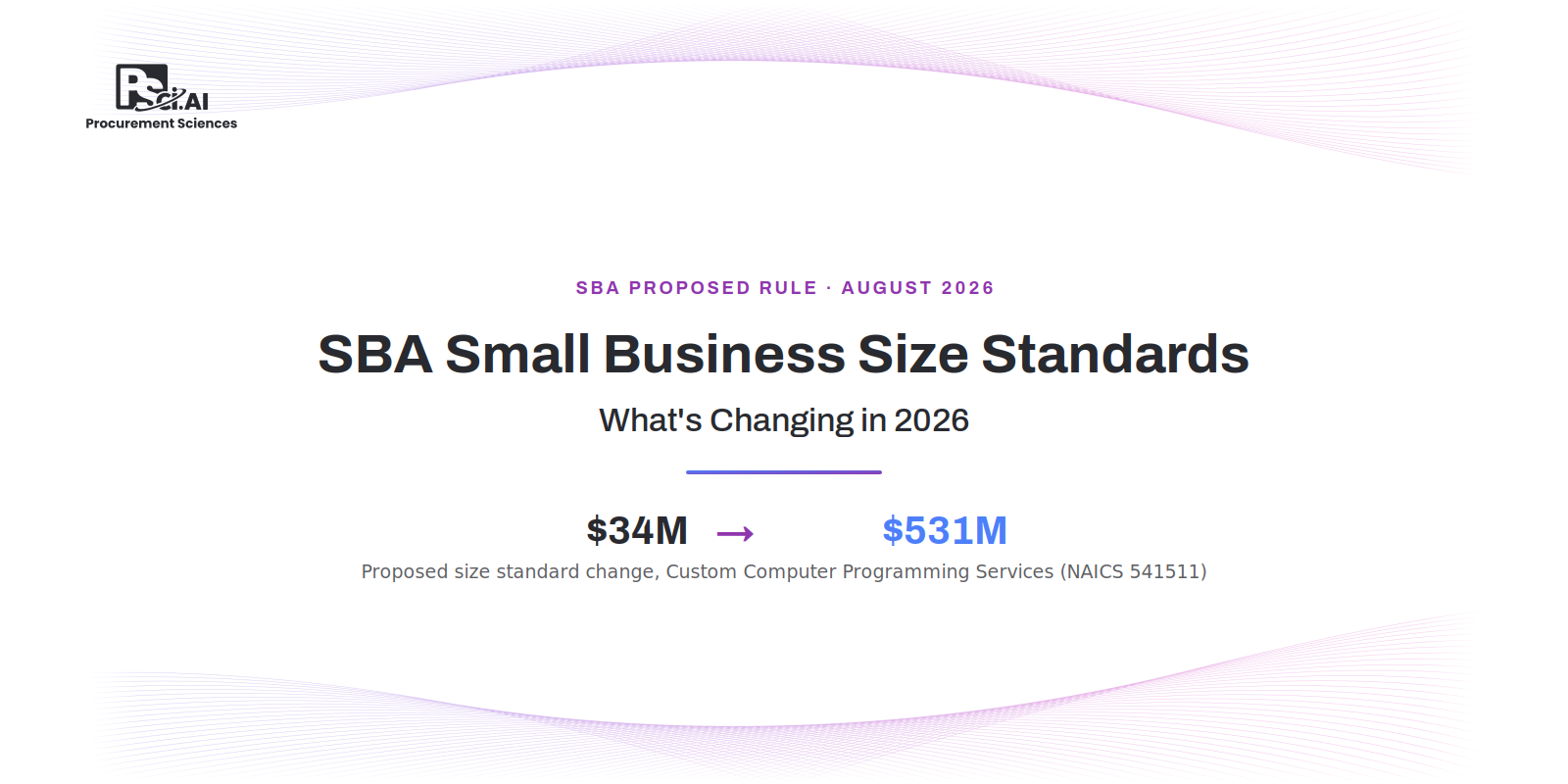
SBA Small Business Size Standards Are Changing: Here's What Government Contractors Need to Know
On August 20, 2026, the Small Business Administration (SBA) published a proposed rule that would rewrite its small business size standards, the thresholds that determine which companies qualify as "small" for federal contracting, SBA loans, and related programs.
SBA Small Business Size Standards Are Changing: Here's What Government Contractors Need to Know