
CLEATUS AI Alternatives for GovCon Teams: How to Evaluate Secure Compliant Platforms

.png)
CLEATUS AI is an AI-powered platform designed to help government contractors find opportunities, analyze contracts, and generate proposals more efficiently.
As teams evaluate CLEATUS AI pricing, competitors, and alternative platforms, many begin looking for solutions that go beyond automation to support capture strategy, analysis, and proposal execution across the full lifecycle.
In this article, we’ll cover how to evaluate CLEATUS AI alternatives and what to look for when choosing the right platform.
CLEATUS AI alternatives generally fall into two categories: platforms focused on automation and efficiency, and those designed to support the full government contracting lifecycle. Understanding this distinction is key when evaluating which approach best fits your workflow.
Key Takeaways
- Use a GovCon-weighted scorecard to compare CLEATUS AI alternatives across security, compliance traceability, drafting support, and workflow fit.
- Validate tools by running the same live RFP through requirement extraction, compliance mapping, drafting, and color-team review.
- Prioritize data ownership, retention, and deployment options early to avoid rework in CUI/CMMC-aligned environments.
- Expect trade-offs: some tools excel at discovery, others at drafting; few support end-to-end continuity into post-award.
- Awarded AI is designed for full-lifecycle GovCon execution from discovery through post-award, with secure deployment options and strict data privacy.
Why GovCon Teams Look for CLEATUS AI Alternatives
It's common for GovCon teams to adopt technology solutions to simplify proposal writing and other lead-capture and close initiatives. Although solutions like CLEATUS AI help to some degree in this area, teams may need more features.
For example, one of the most challenging aspects of government contracting is navigating compliance requirements. Even if a proposal draft is 99% compliant, a single missed requirement can lead to disqualification. This often results in excessive proposal rework and increased operational friction.
Another challenge with generic GovCon tools is that they generate "noise" for teams by surfacing too many low-fit contract opportunities. When tools lack deep market intelligence or data governance is unclear, it can be difficult to make informed bid decisions.
Ultimately, GovCon teams need a platform that helps them accelerate their lead-capture workflows while still meeting their business’s internal security and delivery needs. This requires a dedicated platform evaluation framework.
These limitations are often why teams begin comparing CLEATUS AI competitors and evaluating alternative platforms that provide deeper workflow support.
Evaluation Framework for a CLEATUS AI Replacement
Whether you're looking for a CLEATUS AI replacement or researching your first GovCon solution, it's important to follow an evaluation framework weighted on achieving specific operational outcomes.
We'll provide you with the criteria to look for when scoring a replacement platform around these key areas:
- Security
- Discoverability
- Quality
- Traceability
- Continuity
Security, Data Ownership, and Deployment
Security gating should be one of the most critical stages of your GovCon platform evaluation. Although many platforms may make a range of marketing claims supporting their "security-first" approach, verifying how data is actually handled is critical.
Prioritize platforms with clear guidelines on the following areas:
- Data training and retention: Confirm that proprietary data—like past bidding performance or pricing strategies—isn't used to train AI-driven models. Look for platforms that use stateless inference, where data is processed and then immediately purged. (Ask: Is customer content used to train models by default? What are the retention and deletion terms for uploaded RFPs and proposal libraries?)
- Auditability and access controls: Your platform should provide a comprehensive log of all user actions. This is especially important for meeting CMMC Level 2 requirements when handling sensitive data. (Ask: What security controls and access logging are available?)
- Deployment options: Ensure the provider offers environments that match your data sensitivity. This may include commercial SaaS, private cloud environments, or an on-premises solution that supports CUI-sensitive workflows. (Ask: What deployment options exist for CUI-sensitive workflows?)
While researching these areas first is helpful, getting written confirmation of compliance will ensure you're investing in a solution you can trust.
For a broader view of the category, see our guide to AI tools for government contracting.
Opportunity Discovery Depth and Bid/No-Bid Rigor
Although many GovCon platforms feature some form of opportunity alerting, it's important to look for those that offer "enterprise-grade discovery" capabilities. This leverages capability-based matching to align your organization's unique strengths and historical performance with specific bid requirements.
These more advanced GovCon solutions help connect your capabilities to specific NAICS and PSC codes as well as agency-specific buying patterns. You can then filter results by set-asides and identify teaming signals early in the capture lifecycle to focus on the most impactful opportunities.
Choosing a solution with these features helps speed up gate reviews with clear match rationales. As a result, more focused discovery can improve ROI by reducing labor waste and ensuring a smoother handoff to delivery.
Proposal Drafting and GovCon Writing Quality
When evaluating a platform’s generative writing capabilities, the accuracy of output should only be one of your criteria. You also want to ensure the system can intelligently adhere to the RFP's formatting structure.
The tool should also be able to reference approved, historical content to maintain a consistent voice. Having this feature keeps outputs sales-driven while minimizing AI hallucinations.
To make sure your GovCon platform can deliver on all your proposal drafting requirements, test its performance against these RFP sections:
- Executive Summary
- Technical Approach
- Management Plan
- Staffing and Key Personnel
- Past Performance Narratives
Taking this approach helps to accelerate SME reviews and dramatically reduces rewrite cycles that can negatively impact win rates.
Compliance Traceability and Team Execution
Compliance automation is another important capability to look for in your GovCon solution. Having this feature enables automated requirement extraction, often called "shredding," to identify every mandate in an RFP before you start drafting proposals.
It's important to assess the depth of the automation to ensure it generates a dynamic compliance matrix that maintains live traceability. This connects every requirement directly to its response location, ensuring you never miss a mandatory statement.
You should also look for a system that automatically flags revisions and allows for review governance. This includes clear versioning, automated reviewer assignments, and inline comment resolution. All of this helps to provide a complete audit trail that maintains accountability across your organization.
Some teams also evaluate how AI tools for government contracting compare to ChatGPT.
Post-Award Continuity and Recompete Leverage
Keep in mind that the GovCon platform you choose can impact your entire contract lifecycle, not just your proposal workflows. Post-award continuity is critical since your deliverable tracking and performance evidence directly shape your CPARS posture as you scale.
Leveraging a platform that can capture these details can help you build stronger pitches and more compelling recompete narratives.
When evaluating these types of solutions, specific features to look for include:
- Structured data handoffs: Confirm that the platform can export bid data in a format your project management teams can use.
- Native integrations: Look for platforms that offer seamless connections with your CRM, ERP, or document storage solutions.
- Audit-ready data exports: Verify that you can easily pull historical proposal data to support future audit requests or past performance write-ups.
Top 4 CLEATUS AI Alternatives for Government Contractors
When considering alternatives to CLEATUS AI, it can be difficult to narrow down your options. To help simplify this process, we've compiled a list of the top four GovCon platform solutions worth transitioning to:
Procurement Sciences (Awarded AI)
Procurement Sciences Awarded AI is a purpose-built platform for government contracting teams that need support across the full lifecycle, from opportunity evaluation through capture strategy and proposal execution.
Unlike platforms focused primarily on automation or proposal generation, Procurement Sciences connects intelligence, strategy, and execution into structured workflows that support how teams actually win work.
Procurement Sciences Awarded AI features a GovCon-specific design that ensures secure deployment and strict content governance from lead discovery to closure. It also reinforces strict data privacy standards by ensuring your proprietary information is never used to train external models.
Key features:
- Full-lifecycle continuity that lets teams manage the entire government bid process in one unified environment
- Federal-grade security design that supports GovCloud and on-premises deployments to protect sensitive workloads
- Compliance-first automation that provides automated RFP shredding and requirement extraction for your proposals
Best for:
Procurement Sciences Awarded AI is for growing businesses seeking to scale their bid throughput without increasing headcount. It's also ideal for organizations that want to ensure consistent and compliant outcomes while maintaining strict data control.
HigherGov
HigherGov is a government market intelligence and opportunity discovery platform designed to help contractors find, qualify, and track federal, state, local, education, and grant opportunities in one place.
Rather than focusing primarily on proposal automation, HigherGov helps business development and capture teams identify better-fit opportunities, research agencies and awardees, monitor recompetes, evaluate competitors, and build a stronger pipeline before the proposal process begins.
For teams evaluating CLEATUS AI alternatives, HigherGov is especially valuable when the primary pain point is opportunity discovery, market research, teaming intelligence, and pipeline development.
Key features:
- Federal, SLED, grant, forecast, recompete, and award search across a broad government contracting data set
- Company, agency, awardee, and partner research to support capture planning and competitive analysis
- Saved searches, alerts, pursuit tracking, and market intelligence workflows to help teams focus on better-fit opportunities
Best for:
HigherGov is best suited for GovCon teams that want stronger market intelligence, better opportunity discovery, and more informed bid/no-bid decisions. It is especially useful for business development and capture teams that need to replace manual research, reduce low-fit opportunity noise, and build a more predictable pipeline.
For teams that want to go beyond discovery into AI-assisted capture, proposal generation, compliance review, and post-award workflows, HigherGov can pair naturally with Procurement Sciences’ Awarded AI platform.
Unanet ProposalAI
Unanet ProposalAI is a specialized proposal generation workspace that's part of the broader Unanet ecosystem. One of the platform's primary features is its ability to automate the more labor-intensive aspects of federal bidding cycles—creating compliant proposal drafts.
Although Unanet ProposalAI is great for accelerating proposal creation, this feature has narrower capabilities when compared to other solutions on the market. Because of this, it's important to consider whether its opportunity discovery and post-award continuity meet your specific operational needs before investing.
Key features:
- Extracts RFP requirements automatically and maps them to a dynamic matrix
- Provides a private knowledge hub that uses past proposals to generate content tied to your organization's voice
- Offers an on-demand AI assistant that navigates project history to provide technical insights for drafting new proposals
Best for:
Unanet ProposalAI is best suited for teams that already use other Unanet products and are looking for an easier way to draft their GovCon proposals.
SamSearch
SamSearch is a specialized discovery and market intelligence platform designed to maximize deal visibility. Unlike federal-only tools, the platform aggregates opportunities from over 5,000 sources, including state, local, and education (SLED) portals and defense-specific feeds such as DIBBS.
The platform's core strength lies in its AI-powered natural-language search and smart alerting system. Instead of memorizing complex Boolean strings, users can describe organizational capabilities in plain language and get back curated daily opportunity matches.
Key features:
- Unified multi-source discovery model that provides access to a wide range of procurement opportunities
- Powerful AI assistant that uses natural language processing (NLP) to summarize opportunities based on business match
- Monitors upcoming recompetes and procurement forecasts 6–18 months in advance
Best for:
SamSearch is ideal for lean business development teams that want to prioritize quick opportunity discovery and triage. It’s ideal for organizations seeking high lead volumes with less need for automated proposal generation.
How To Run a Side-by-Side Evaluation
One of the most effective ways to validate the effectiveness of your GovCon platform is to run a side-by-side trial method using the same RFP, the same internal content set, and the same reviewers.
Taking this approach helps reduce bias when making decisions and maximizes the chances of a successful integration. Here is how you can approach this process:
Use One Real RFP and One Controlled Content Library
Begin your evaluation by choosing a single solicitation, including all amendments and Q&A documents. You should also pair these with an approved boilerplate and proven performance library to ensure you have a consistent baseline for testing.
To measure success, focus on the completeness of extracted requirements, traceability, and time-to-first-draft. As a test scenario, you could use a recent IDIQ task order RFP for comparison.
Look for accuracy in requirement extraction and matrix completeness. You should also evaluate drafting quality under a 48-hour window to see how each tool performs under tight deadlines.
Score Outputs on Compliance, Rework, and Cycle Time
Proposal leaders should track compliance gaps found during red team reviews, the volume of rewrites per section, and the total cycle time from document upload to a review-ready draft.
Using a clear map from solicitation requirements to the response is an effective way to achieve this. Concentrate on the volume of manual corrections required and the total time saved during the initial drafting phase.
By tracking these metrics closely, you get a clearer picture of which solutions can reduce your teams' administrative overhead and help them close deals faster.
Validate Integrations and Operational Fit
It's important to test how each platform integrates into your current tech stack. For example, look at how easy it is for AI-powered features to integrate with your existing SharePoint, Teams, and Word workflows.
You should confirm whether you're able to automate your CRM handoffs. If permissions or export controls are clunky, it can lead to extensive efforts to reformat proposals and cause other friction points in the business, essentially erasing any time savings your AI tools promise.
CLEATUS AI Pricing and Considerations
CLEATUS AI platform cost may vary depending on the number of users, feature configuration, and usage and workflow automation needs. As with many AI platforms in this category, pricing is typically customized based on organizational requirements.
Teams evaluating CLEATUS AI pricing often compare it with alternatives that provide different approaches to workflow structure, data handling, and lifecycle support.
CLEATUS AI vs Alternatives: Key Differences
When comparing CLEATUS AI to alternatives, the primary differences often include:
- Automation-first platforms vs full lifecycle workflow support
- Task execution vs structured capture and proposal processes
- Efficiency-focused tools vs strategy-driven platforms
CLEATUS is designed to automate large portions of the contracting workflow—from discovery through proposal generation—while alternatives may place more emphasis on how teams structure and execute across the lifecycle.
Accelerate Wins With Procurement Sciences
Choosing the right GovCon platform for your business really comes down to unique business needs. But no matter which solution your teams use, prioritizing compliance and data security is essential for long-term success.
Procurement Sciences’ Awarded AI is a GovCon platform that manages the full acquisition lifecycle within a completely secure and consistent environment. While many other tools focus primarily on isolated drafting tasks, Procurement Sciences provides a unified workspace that bridges the gap between discovery, proposal execution, and post-award continuity.
Request a demo to see how Procurement Sciences compares to CLEATUS AI in real workflows.
FAQs
What makes a GovCon AI platform a true CLEATUS AI replacement?
A true replacement supports GovCon workflows end to end: defensible bid/no-bid inputs, compliant drafting aligned to RFP structure, compliance traceability, review governance, and security/data controls suitable for sensitive capture environments.
What should we ask vendors about data privacy and model training?
Ask for written confirmation of whether your content is used for model training, how long content is retained, how deletion works, what access logging exists, and what deployment options are available for sensitive data.
What is the best way to compare proposal drafting quality?
Run the same RFP and the same approved content library through each tool, then score drafts based on requirement coverage, RFP outline adherence, evaluator-ready tone, and how much SME rewrite is required.
Can we migrate our existing proposal library from CLEATUS AI to another platform?
Most platforms support import in some form, but confirm how they handle structured past performance, approved boilerplate, tagging, and governance so you do not recreate your library manually.
How long does onboarding typically take?
Timelines vary based on content migration, integrations, and security review. Many teams can pilot quickly with a controlled RFP trial, then expand after governance and access controls are validated.
Click here to schedule a demo to get the full scoop on how our product actually works and discover how AI can transform your approach to government contracting.
Explore More Resources
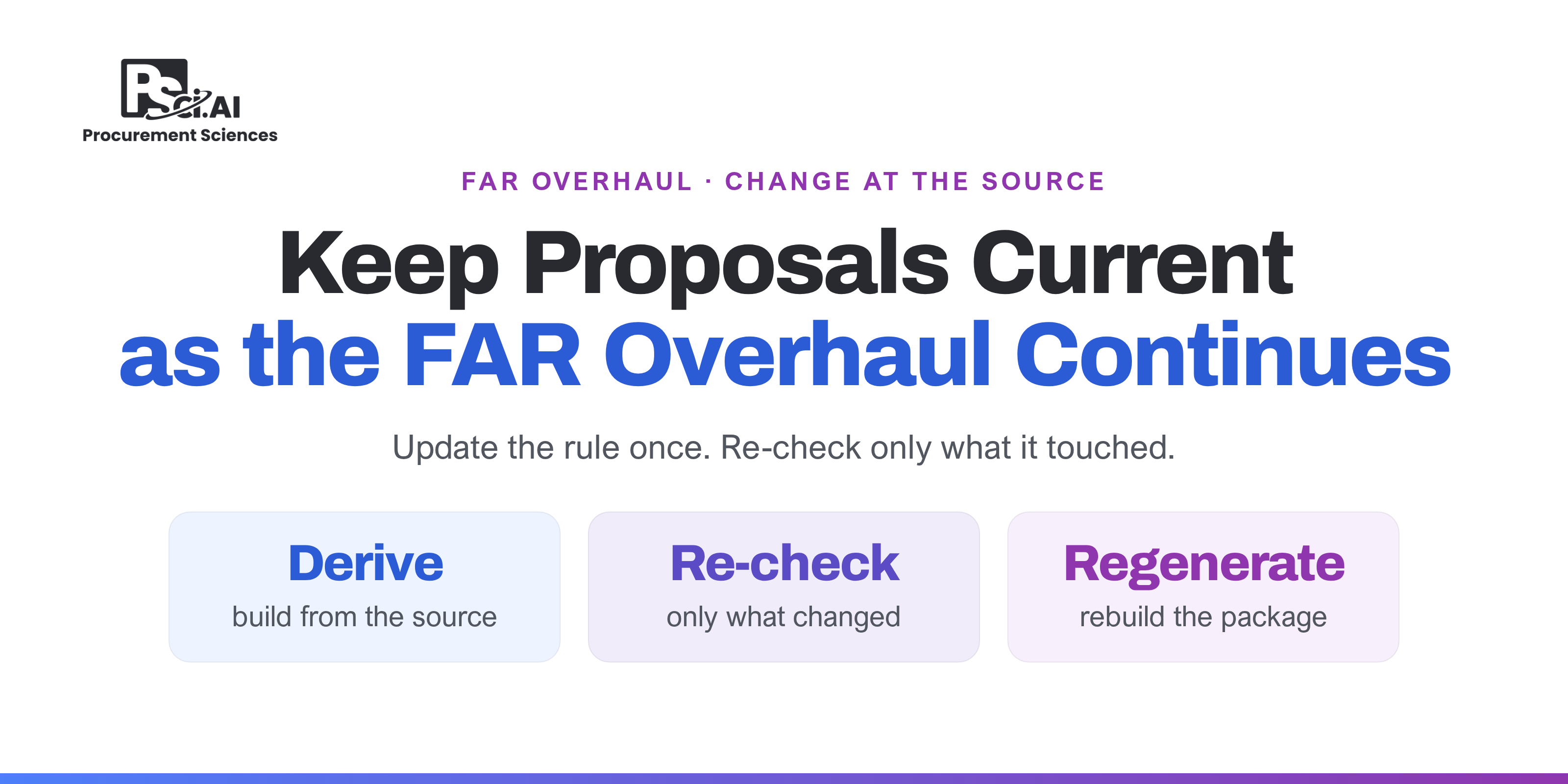
How to Keep Proposals Current as the FAR Overhaul Continues
The FAR overhaul means the rules governing your bid can change while you write it. The fastest way to keep up is to organize your proposal content so every item traces back to the rule it relies on. Update the rule once, and you know exactly what to re-check. We call this Change at the Source.
How to Keep Proposals Current as the FAR Overhaul Continues

Webinar Recap: Outgrowing Small Business, Using AI to Write and Win Like a Prime
Procurement Sciences recently joined APMP for a webinar on one of the most challenging transitions in government contracting: what happens when a small business outgrows its set-aside protections and has to compete in the full and open market against primes with ten times the resources.
Webinar Recap: Outgrowing Small Business, Using AI to Write and Win Like a Prime
Microsoft Copilot Alternatives for Government Contracting: What GovCon Teams Should Know
Microsoft Copilot has become a significant part of the enterprise AI landscape, bringing generative AI directly into applications many government contractors already use every day.
Microsoft Copilot Alternatives for Government Contracting: What GovCon Teams Should Know