
Government Contract Management Software: What It Is and How to Evaluate Platforms

Managing government contracts has never been simple. As federal regulations shift and agency expectations increase, the stakes remain high and the margin for error stays slim. Yet post-award contract administration is still often treated as a back-office burden instead of a controllable business risk.
That approach does not scale. Spreadsheets, email chains, and shared drives make it difficult to track FAR and DFARS obligations, deliverable deadlines, subcontracting plans, funding status, and contract modifications across active awards. The result is compliance gaps, weaker audit readiness, and performance issues that can erode margin and hurt recompete positioning.
Government contract management software helps streamline these activities into a single system. These purpose-built platforms centralize compliance tracking, deliverable management, funding visibility, and audit preparation, giving teams a clear, audit-ready view of contract execution.
This guide explains what these platforms do, why generic contract lifecycle management (CLM) tools fall short in GovCon environments, and how to evaluate options based on the workflows that matter most.
Key Takeaways
- Government contract management software centralizes compliance tracking, deliverable management, and funding visibility into a single platform, replacing fragmented spreadsheets and email chains that create audit exposure.
- Generic contract lifecycle management tools lack the FAR/DFARS awareness, CLIN tracking, and CDRL management capabilities required for post-award execution.
- AI-powered features like clause parsing and predictive risk alerts help teams catch compliance drift early and respond to modifications faster than manual review.
- Secure deployment options, including FedRAMP-ready SaaS and air-gapped private cloud, allow contractors to manage sensitive data without compromising security posture.
- Evaluating platforms against your actual contract portfolio reveals workflow fit and integration gaps that demos and feature lists often miss.
What Is Government Contract Management Software?
Government contract management software is a specialized platform designed to centralize and automate the execution of federal contracts after award. While generic CLM tools focus on private-sector agreements, government-specific platforms are built to handle the structural and compliance requirements of federal contracting.
This includes native fields for CAGE code tracking and cybersecurity compliance, along with built-in libraries for the Federal Acquisition Regulation (FAR) and Defense Federal Acquisition Regulation Supplement (DFARS).
Pre-award tools focus on opportunity discovery and proposal development. Contract management software is built for post-award execution. It bridges the gap between winning a bid and closing it out by providing a single source of truth for the following core functions:
- Track contract terms, modifications, and option periods: Maintain an accurate record of every change so teams don’t rely on outdated versions
- Manage CLINs and CDRLs: Link Contract Line Item Numbers (CLINs) to their associated Contract Data Requirements List (CDRLs) submissions
- Monitor funding ceilings and burn rates: Provide real-time visibility into obligated versus expended funds to prevent overruns
- Maintain FAR/DFARS compliance: Map clause requirements to actions and track them throughout execution
- Prepare audit documentation: Generate the reports and logs required for government oversight
Centralized visibility is critical when managing multiple active contracts. Without it, missed deadlines, compliance gaps, and cost overruns become more likely as the portfolio grows. Disconnected systems create a fragmented view where critical details are harder to track, putting both current margins and future recompete positioning at risk.
To support these goals, features like version comparison, redlining, change tracking, and document templates for Indefinite Delivery, Indefinite Quantity (IDIQs) contracts and task orders ensure every modification is documented and defensible. This level of rigor supports a strong compliance posture and reduces the risk of compliance drift over time.
Procurement Sciences integrates these post-award controls into a broader suite, helping teams move away from manual tracking toward a more structured, audit-ready workflow.
For an in-depth look at how this applies to FAR/DFARS, check out Navigating FAR 2.0: Stay Agile with Awarded AI.
High-Stakes Challenges in Federal Contract Management
Managing federal contracts involves a level of regulatory and operational complexity that manual processes cannot sustain. As a contract portfolio grows, the risks associated with manual tracking compound, turning simple oversights into high-stakes liabilities.
Compliance Drift and Audit Exposure
Compliance drift is the gradual loss of visibility into specific clause obligations as a contract progresses through its lifecycle. FAR and DFARS requirements evolve over time, and agency-specific clauses often require ongoing attention beyond the initial review.
When teams rely on spreadsheets, email chains, and shared drives, they lose the ability to demonstrate a continuous compliance history. This increases audit exposure and makes it harder to show how requirements were managed over time. If an auditor asks how a specific clause was implemented across multiple years of performance, a lack of structured records can trigger findings that impact both CPARS scores and recompete positioning.
Automated clause tracking and compliance dashboards help surface gaps early, giving teams the visibility needed to stay ahead of issues rather than reacting to them later.
For more on common industry pain points, see The Importance of Set-Asides and Navigating Changing Landscapes in GovCon.
Funding Ceiling Blind Spots
A critical post-award risk is the funding ceiling. Government contracts have strict limits on authorized spending, and exceeding them can lead to serious legal and contractual consequences.
Without real-time visibility into obligated versus expended funds across CLINs, task orders, and modifications, contractors operate with a significant blind spot. Manual tracking is slow and prone to error, delaying burn-rate visibility until there is little time to request a modification and adjust funding.
Real-time funding dashboards surface these risks earlier, enabling more informed staffing, subcontracting, and scope decisions before issues escalate.
Why Generic CLM Tools Fall Short for GovCons
Many contractors attempt to adapt commercial platforms like Salesforce, Deltek, or OpenGov to manage their contract portfolios. While these tools are powerful in their respective domains, they aren’t designed for the specific demands of federal execution.
Salesforce, for example, is primarily a CRM for relationship tracking and business development. It excels at managing the pursuit flow but lacks the post-award capabilities needed for FAR clause parsing or CDRL tracking. Similarly, OpenGov focuses on the buying side of government operations, emphasizing vendor workflows rather than the risks contractors must manage, such as funding ceilings or compliance drift.
Deltek provides a broad business suite for finance and project management, but it doesn’t offer the level of specialization required for contract control tasks like clause libraries and audit-ready change logs.
Generic CLM platforms are built for private sector agreements, which don’t carry the same compliance structures, terminology, or reporting requirements as federal contracts. As a result, they’re missing critical capabilities such as:
- Built-in clause libraries: No native support for FAR/DFARS updates
- CLIN/CDRL management: Inability to track government-specific deliverable structures
- Integration gaps: Limited connectivity with SAM.gov, FPDS, and USAspending
Adapting these tools requires heavy customization, increasing implementation time and ongoing maintenance. Purpose-built GovCon software treats these requirements as core features, not edge cases.
Core Capabilities Every Government Contractor Needs
Effective government contract management requires more than a document repository. It needs an integrated system where compliance, deliverables, and performance data are connected.
Clause and Compliance Matrix Automation
Your software should do more than store clauses. It should parse them. Advanced platforms automatically identify applicable clauses based on contract type, agency, and the scope of work.
This enables an automated compliance matrix that maps each clause requirement to a specific action, owner, and deadline, creating clear accountability across the team. When regulations change, the system flags affected contracts, helping prevent the compliance drift common in manual processes. This reduces manual research time and minimizes compliance lag.
CLIN and CDRL Tracking
CLINs are the line items that structure pricing and deliverables, while CDRLs define the required data deliverables under the contract. Effective tracking links each CLIN to its funding status, performance metrics, and associated CDRLs, while also monitoring submission deadlines and approval status.
Missed CDRLs are a common cause of cure notices and poor performance ratings, making reminders and status visibility critical for protecting recompete positioning. Automated dashboards should highlight upcoming deadlines, overdue items, and bottlenecks at a glance so program managers can intervene early.
By tracking funds at the CLIN level, teams can avoid exceeding authorized amounts and keep burn rates within the contract’s scope. This level of visibility also supports broader improvements in AI-driven GovCon workflows, where data from contract execution feeds into more proactive decision-making.
Post-Award Performance Dashboards
Executives and program managers need a high-level view of portfolio health. Post-award performance dashboards aggregate data on schedule status, cost variance, deliverable completion, and compliance posture. These dashboards help teams detect issues early and provide portfolio-level visibility across multiple contracts.
By capturing historical performance data, dashboards turn contract administration into a tool for supporting CPARS narratives and strengthening recompete positioning by documenting on-time delivery and compliance.
Dashboards should be configured to match how the contractor organizes programs, customers, and contract types, rather than forcing a one-size-fits-all view. This level of visibility reduces workforce strain by eliminating manual status reporting and allowing teams to focus on execution.
Latest AI Advances in Contract Management Software
Artificial intelligence is no longer a futuristic concept in procurement. It’s a practical tool for reducing administrative burden. AI has quickly become a top investment priority for government contractors as teams look for ways to improve efficiency and reduce manual workload.
The focus of AI in post-award administration is on speeding up analysis and reducing the manual review work that often leads to human error. AI should augment human judgment rather than replace expert interpretation.
FAR/DFARS Clause Parsing
One of AI's most immediate benefits is its ability to scan and extract key data from dense contract documents and modifications. Tasks that once took an expert six hours can now be completed in minutes with high-accuracy parsing. This applies to both intake and modification processing, not just initial contract review.
This speed is especially critical when processing large task orders or complex modifications where clause flowdowns must be identified and managed. Accuracy depends on the AI being trained on specific government contracting data, as GovCon-specific models outperform general-purpose tools on federal terminology and clause structures.
Predictive Risk Alerts
Beyond simple reminders, AI can provide predictive alerts. By analyzing historical burn rates and deliverable patterns, it can identify trends that signal funding ceiling risk or potential schedule slip. Alerts should be actionable and tied to specific contracts with clear next steps, rather than generic warnings that create alert fatigue.
When implemented correctly, these alerts give managers the lead time needed to intervene before the government takes formal action, such as issuing a cure notice or stop-work order. As more historical data accumulates, these capabilities improve, making adoption a compounding investment over time.
Secure Deployment Options for Sensitive GovCon Data
Security is the primary concern when managing sensitive contract information. Deployment architecture plays a central role in aligning with frameworks like NIST 800-171, Cybersecurity Maturity Model Certification (CMMC), and agency-specific requirements for handling Controlled Unclassified Information (CUI). As a result, it becomes a key factor when evaluating contract management platforms.
FedRAMP-Ready SaaS vs. Air-Gapped Private Cloud
- FedRAMP-ready SaaS: FedRAMP is the federal cloud security standard, and authorized platforms undergo rigorous assessment. These solutions are often the best choice for contractors looking to reduce internal IT burden while maintaining strong security controls. Contractors must verify that the authorization level (Low, Moderate, or High) aligns with their specific contract data requirements.
- Air-gapped private cloud: For the most sensitive defense and intelligence work, some contractors require air-gapped or private cloud deployments. These options provide maximum control over the data environment but require greater internal IT responsibility.
Selecting the right deployment model is essential to ensure contract management doesn’t compromise your security posture. Vendors should also provide implementation support for complex deployment scenarios, not simply deliver the software.
Evaluation Checklist for Choosing the Right Platform
When selecting a platform, contractors should evaluate providers based on how well they solve specific operational pain points, not just a list of features.
Align Features to Pain Points
Before reviewing software, identify where your current processes break down. Are you spending too much time on manual reporting? Have you missed a funding ceiling? Do you lack visibility into burn rates? Use these specific operational pain points to guide your evaluation. Focus on features that address recurring workflow gaps, such as automated compliance matrices or real-time burn rate tracking.
Document key failure scenarios in your current processes and test how each platform handles them during demos.
Verify GovCon Dataset and Integrations
Generic AI tools often struggle with the nuances of federal terminology. Platforms built or trained on government contracting data tend to be more accurate than tools adapted from commercial use cases.
Ensure any AI capability is trained on government-specific datasets. Integration with your existing ERP, document management, and timekeeping systems is equally critical to avoid creating new data silos that increase manual effort.
Integration quality matters as much as feature completeness. Disconnected tools create the same version control problems as spreadsheets and email chains. The goal is a seamless flow of data that reduces manual work and provides a single source of truth. Contractors should conduct demos using their actual contract documents to validate accuracy, reporting capabilities, and workflow fit, rather than relying on vendor-prepared examples.
This is especially important when comparing post-award tools with government proposal management software used earlier in the contract lifecycle.
Take the Next Step Toward Modern Contract Control
As government contracting becomes more competitive, the ability to manage post-award execution efficiently is a clear differentiator. Centralizing compliance, funding visibility, and deliverable tracking helps teams improve operational efficiency, reduce risk, protect margins, and improve recompete positioning across a growing contract portfolio.
Procurement Sciences provides purpose-built tools to support both pre-award and post-award workflows, from pursuit through closeout. By combining clause tracking, funding visibility, and performance dashboards in a single system, teams can manage contract execution with greater control and confidence.
Move beyond spreadsheets: Schedule a demo today to take control of your contract portfolio.
FAQs
What is the best software for contract management?
The “best” software depends on your portfolio complexity and compliance requirements. For government contractors, a purpose-built GovCon platform is essential. These tools outperform generic CLM software because they are designed to handle FAR/DFARS libraries, CLIN structures, and CDRL tracking that commercial tools lack.
How do you manage government contracts effectively?
Effective government contract management requires centralizing contract data, including clauses, ceilings, and deadlines, into a single, audit-ready system rather than across spreadsheets and email. This includes mapping clause obligations to specific owners, tracking funding at the CLIN level in real time, and using automated alerts to ensure deliverable deadlines are met.
What is the difference between contract management software and CLM?
Contract lifecycle management (CLM) is a broad term often used in the commercial sector for managing private-sector agreements. Government contract management software is a specialized subset of CLM that includes capabilities for federal execution, such as automated compliance matrices, government-specific reporting, and integration with systems like SAM.gov.
Does contract management software help with audits?
Yes. By maintaining a structured, timestamped record of every modification, approval, and deliverable submission, the software makes audit preparation significantly faster. Instead of searching through years of emails or shared drives, you can produce a comprehensive audit trail in a few clicks.
How does AI improve government contract management?
AI reduces manual review time from hours to minutes by extracting and categorizing clauses from complex documents. It also provides predictive insights, such as flagging potential funding ceiling breaches based on current burn-rate trends and identifying patterns that indicate schedule slip, allowing teams to focus on strategic decisions rather than administrative tasks.
Click here to schedule a demo to get the full scoop on how our product actually works and discover how AI can transform your approach to government contracting.
Explore More Resources
How to Keep Proposals Current as the FAR Overhaul Continues
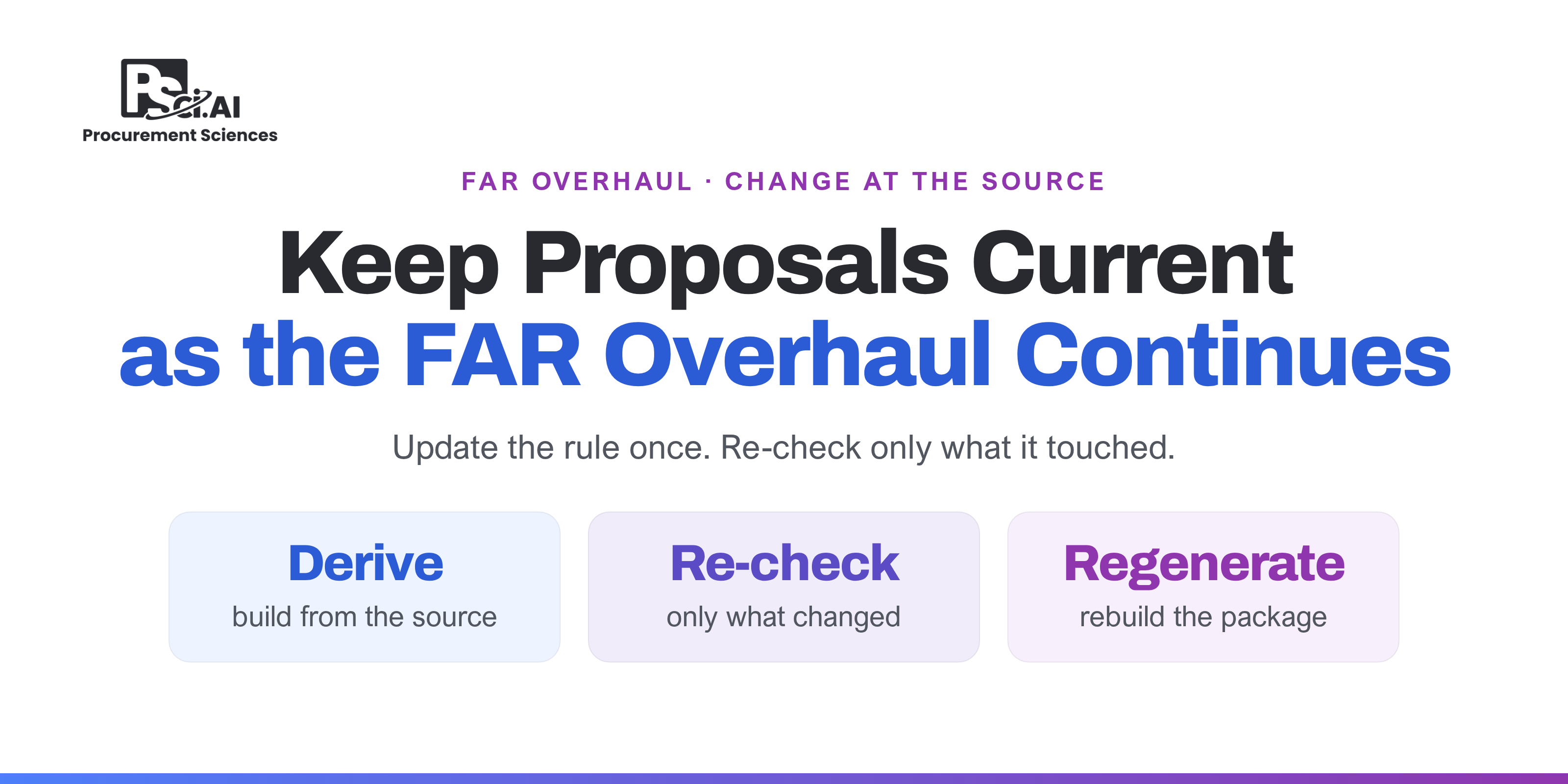
The FAR overhaul means the rules governing your bid can change while you write it. The fastest way to keep up is to organize your proposal content so every item traces back to the rule it relies on. Update the rule once, and you know exactly what to re-check. We call this Change at the Source.
How to Keep Proposals Current as the FAR Overhaul Continues

Webinar Recap: Outgrowing Small Business, Using AI to Write and Win Like a Prime
Procurement Sciences recently joined APMP for a webinar on one of the most challenging transitions in government contracting: what happens when a small business outgrows its set-aside protections and has to compete in the full and open market against primes with ten times the resources.
Webinar Recap: Outgrowing Small Business, Using AI to Write and Win Like a Prime
Microsoft Copilot Alternatives for Government Contracting: What GovCon Teams Should Know
Microsoft Copilot has become a significant part of the enterprise AI landscape, bringing generative AI directly into applications many government contractors already use every day.
Microsoft Copilot Alternatives for Government Contracting: What GovCon Teams Should Know