
From Prompts to Processes: Why AI Agents Are the Future of Proposal Writing

We recently hosted a webinar on a question everyone in the AI space seems to be asking right now: Is prompt engineering dead? It's a provocative question — and the honest answer is more nuanced than a simple yes or no.
Prompting isn't dead. But it's also not a strategy.
That distinction matters more than most teams realize, especially in high-stakes, deadline-driven environments like government proposal writing. Here's what's actually changing — and why it should change how your organization thinks about AI.
The Shift That's Already Happening
A few years ago, getting value out of AI meant learning how to craft the perfect prompt. The better your prompt, the better your output. That created a cottage industry of "prompt engineering" as a specialized skill.
But AI models have evolved dramatically. Modern models handle messier inputs, longer context windows, and iterative refinement far better than their predecessors. As the engine improves, the exact words matter less than the system around it — interpreting your intent and working within your context.
That's the core shift: the competitive advantage is moving away from crafting good prompts and towards workflow design, context quality, and operational governance.
What Proposal Teams Are Seeing Right Now
During the webinar, we asked attendees where their organizations are today with AI in capture and proposal workflows.
The results highlight just how early most teams still are:
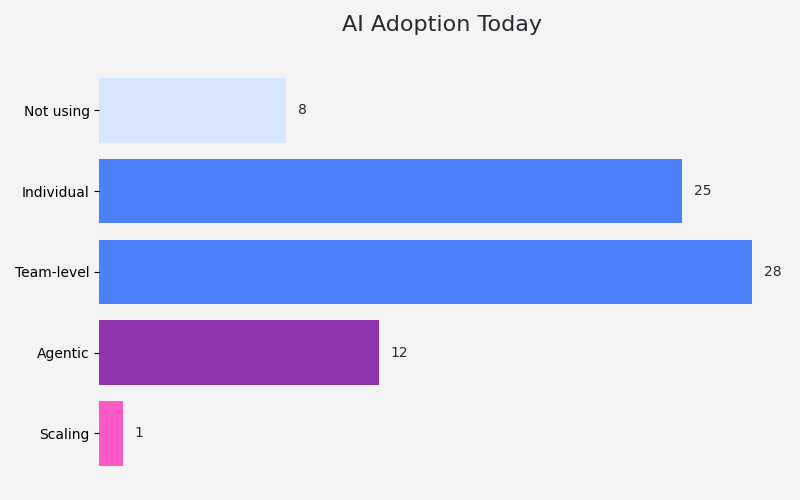
In other words, most teams are still experimenting, not operationalizing. That gap is exactly where the next competitive advantage will come from.
We also asked a second question: if an agentic workflow could eliminate one bottleneck in the next 60 days, where would it have the biggest impact?
Here’s what teams prioritized:
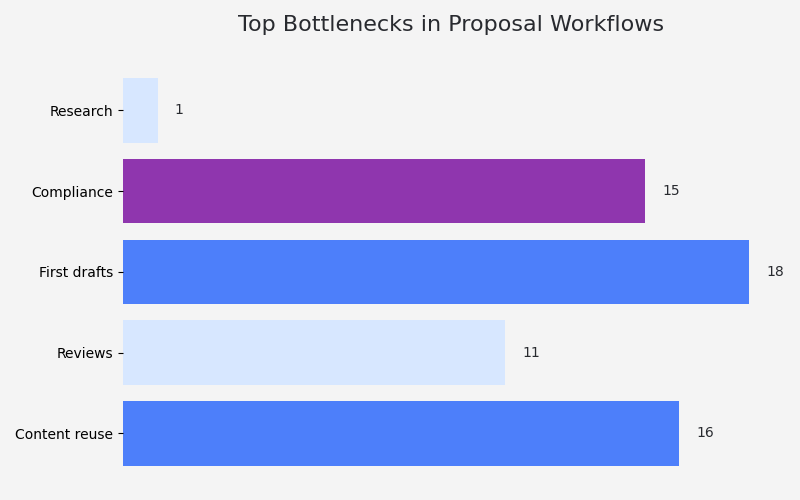
The biggest opportunities aren’t one-off tasks. They’re repeatable, high-friction workflows. That is exactly where agentic approaches outperform prompt-based ones.
So What Is an AI Agent, Really?
Strip away the buzzword, and an AI agent is best understood as a workflow coordinator — an engine that executes a series of defined steps with minimal human input, except at the specific review gates you've built in.
Here's what that looks like in practice. Instead of asking AI to "summarize this RFP," an agentic workflow would:
- Extract all requirements
- Build a compliance matrix
- Flag gaps
- Generate a checklist for review
Instead of asking AI to "draft an executive summary," an agentic workflow would pull relevant win themes and past performance, draft the summary, check it against evaluation criteria, and produce a version ready for human review — all in sequence, automatically.
That's the difference between AI as a tool you pick up occasionally and AI as something embedded in how you work.
Why This Matters for Your Team
The appeal of agentic workflows isn't just speed. It's what speed unlocks.
Capacity without burnout. Repetitive, time-consuming tasks such as compliance checks, knowledge retrieval and first drafts, bleed into evenings and weekends for proposal professionals. Automating these through structured workflows frees your team to focus on what actually requires human judgment: strategy, differentiation, and final decision-making.
Consistency at scale. Prompt-based approaches are fragile. One person leaves, one prompt gets tweaked, and your output quality shifts. Agentic workflows embed the process itself — inputs, templates, review gates — so the value isn't locked in one person's head.
Better go/no-go decisions. This is one of the most underrated benefits. When AI can surface objective, fact-based assessments of an opportunity — capabilities match, incumbency factors, internal capacity — leaders stop chasing bids they can't win and start protecting their team's bandwidth for worthwhile pursuits.
Measurable ROI. This is what actually gets leadership buy-in. Not "it feels like it helped," but concrete metrics: time saved per proposal, compliance error rates, draft turnaround time, or win rate on pursued bids. Agentic workflows make these measurable in ways that one-off prompting simply doesn't.
Prompts Aren't Dead — They're Building Blocks
Here's the reframe that ties it all together: prompts are the foundation of agentic workflows, not the strategy itself.
The teams seeing real results aren't training everyone to be a prompt specialist. They're taking well-crafted prompt templates and standardizing them inside repeatable workflows. Think of it as graduating from cooking one dish at a time to running a kitchen with consistent recipes, prep, and quality checks built in.
Three prompt patterns worth standardizing as you build:
- Role + Output + Constraints: Give the AI a defined role, specify the format you want, and constrain what it can and can't draw from.
- Ask for assumptions and uncertainty: Rather than going back and forth, prompt the AI to surface what it's unsure about upfront.
- Force structure: If you have a compliance matrix template, tell the AI to fill it.
How to Start Without Overhauling Everything
The biggest mistake teams make is trying to do too much at once. A more practical approach:
Pick one workflow. Choose something painfully manual, consistently repeated, and measurable. Compliance checks are often the easiest starting point — the process is predictable, the steps are the same every time, and the cost of errors is high.
Define success before you start. What does improvement look like? Set a baseline and track it across time, cost, quality, and risk.
Put someone in charge. This is arguably the biggest predictor of successful adoption. An internal champion who owns the outcome, facilitates knowledge sharing, and keeps the team accountable makes the difference between a pilot that fades and one that scales.
Governance isn't optional. Decide early what data goes into AI, what requires human review, and what's off-limits entirely. Build those guardrails into the workflow before you scale, not after.
The Bottom Line
AI agents aren't coming for your proposal team's jobs. They're alleviating the parts of the job that nobody actually wants — the box-checking, the late-night compliance sweeps, the fourth email to an SME who still hasn't responded, etc.
What's left when those tasks are automated? The work that requires seasoned human judgment, institutional knowledge, and strategic thinking. The work your best people were hired to do.
The organizations that operationalize AI into structured, governed, repeatable workflows will outpace those still experimenting with prompts on a case-by-case basis. The gap between those two groups is widening.
The question isn't whether to adopt agentic workflows. It's how quickly you can define the first one worth automating. We go deeper on this with real examples of agentic workflows in proposal teams in our recent webinar.
Click here to schedule a demo to get the full scoop on how our product actually works and discover how AI can transform your approach to government contracting.
Explore More Resources
.png)
What Is SEWP VI? A Guide to NASA's Next-Generation IT GWAC
NASA SEWP VI is the sixth generation of one of the federal government's oldest and largest IT acquisition vehicles, a Government-Wide Acquisition Contract (GWAC) that lets any federal agency buy commercial IT, communications, audio/visual, cloud, cybersecurity, and enterprise IT services without running its own competition.
What Is SEWP VI? A Guide to NASA's Next-Generation IT GWAC
.png)
Webinar Recap: Beyond the Audit, CMMC, FedRAMP, and Compliance at Mission Speed
Procurement Sciences recently joined GovConWire and Executive Mosaic for a practical session on where CMMC and FedRAMP stand right now, what the phase two pause actually changed, and what government contractors should be doing today to stay compliant and ready.
Webinar Recap: Beyond the Audit, CMMC, FedRAMP, and Compliance at Mission Speed
Claude for Government Contracting: Claude vs. Purpose-Built AI
Claude has become a widely used generative AI platform for research, writing, document analysis, coding, and complex reasoning. For government contractors, however, evaluating Claude involves more than asking what the model can do.
Claude for Government Contracting: Claude vs. Purpose-Built AI