
Organizational Change Management for AI Adoption

Executive Summary
Organizational Change Management (OCM) helps companies be successful with the human side of change. Applying proven OCM principles to Artificial Intelligence (AI) adoption for GovCon companies helps maintain workforce morale and reduce resistance to change during times of transition.
Applying OCM principles to AI adoption for GovCon business development (BD) helps companies make their AI journey a success. Generative AI (GenAI) burst into public awareness in late 2022. Since then, GovCon BD teams have adopted and used GenAI platforms to achieve startling increases in human productivity and proposal quality. GenAI enables companies to bid more and win more, with impressive bottom-line impact - but first the GenAI platform must be deployed and integrated into the user’s business program.
At Procurement Sciences, we have learned from supporting AI adoption at over 350 GovCon customer companies that successful adoption comes from early acceptance and buy-in from the people most affected. OCM enables companies to empower their workforce, improve processes, and secure a competitive edge in the market, all while completing the technical aspects of implementation. Early and effective application of OCM ensures a smooth transition by anticipating and addressing the concerns, perceptions, and behaviors of your BD practitioners.
What Is OCM?
Organizational Change Management “is the structured discipline, set of processes, and toolkit used to prepare, support, and guide individuals, teams, and entire organizations through transitions from a current state to a desired future state, particularly when implementing new strategies, technologies, processes, or structures.” Artificial Intelligence, love it or hate it, is a democratizing new technology that brings exactly this sort of impactful change.
Succeeding in GovCon BD requires building a culture focused on compliance, auditability, traceability, and differentiation. Consequently, successful adoption demands GenAI capabilities that dovetail smoothly with existing workflows.
OCM brings the focus on people needed to build such a culture. The technical issues associated with integrating a new Service as a Software (SaaS) platform into a regulated security environment are well understood. In contrast, OCM attends to the always varying and sometimes unanticipated needs, concerns, and responses of people. By helping leaders and managers prepare and act to address these elements, OCM ensures that change initiatives are widely accepted so that speed of AI adoption increases, workforce commitment remains high, risks are effectively mitigated and intended business goals are met.
Phase 1: Pre-Deployment Preparation
The principles of OCM demand corporate commitment that starts before the platform is deployed, as the company begins to identify, characterize, and select an AI platform for BD users. This is especially critical for GenAI adoption because this is a very new and profoundly different technology. Pre-Deployment Preparation includes leadership laying out a vision; setting up infrastructure for AI governance; stakeholder engagement; and establishing focus on ethics and compliance.
Leadership Vision. Leaders must initiate the transition to a GenAI platform by developing and sharing a vision that aligns with organizational goals and resonates with stakeholders, especially employees. This means that leaders must explain the compelling business case for GenAI adoption value, by highlighting benefits such as improved employee experiences, greater collaboration, and breakdown of data silos. These outcomes, once realized, result in economic value from higher return on investment as well as better work experience for personnel.
AI Governance. Effective governance means identifying and empowering the corporate roles that direct AI adoption, sustainment, and use for performance as well as adherence to legal, ethical, and compliance standards. Governance begins with writing an AI Governance Plan that describes the purpose, roles, responsibilities, and empowerment of the oversight program. Often, the AI Governance Plan is accompanied by an Acceptable Use Policy that makes clear to employee users and non-users the conditions and constraints for use of GenAI technology.
Stakeholder Engagement. Leadership and the principals for AI governance survey and drive collaboration between stakeholder groups to ensure AI systems are implemented safely and ethically and meet all regulatory requirements. The AI governance leads use a structured approach to stakeholder engagement: identifying impacted groups; mapping their relationships and influence; and tailoring communications to each stakeholder group to increase buy-in, elicit concerns, and foster the exchange of ideas. This structure is retained throughout deployment and ongoing operations as formal feedback loops to gather input, recognize early wins, validate benefits, and allow for adjustments.
Ethical and Compliance Focus. Leadership must focus on ethics and compliance during the Pre-Deployment phase, to communicate the idea that GenAI systems will be used responsibly and in accordance with legal and regulatory standards. Communicating with stakeholders, and across the workforce, before AI platform deployment gives people the chance to process implications, safeguards the organization's reputation, and fosters confidence that GenAI tools are being used to enhance productivity. Such communication goes a long way to addressing reasonable employee concerns about change, especially the potential for job displacement. To build confidence that GenAI is being used ethically and in compliance with standards, the AI governance structure must include clear policies on acceptable AI uses, data sourcing, and output transparency.
Phase 2: Onboarding
Organizational Change Management views the Onboarding phase as a pivotal moment in AI adoption, as employees shape their views based on initial user experience and consistency (or lack thereof) with the leadership vision. It is essential that leadership and AI governance leads set and communicate reasonable expectations during this time. The critical OCM activities for AI onboarding include providing users with the training and infrastructure to facilitate learning; continuing communications for sharing status and progress; measurement of progress; and identifying and overcoming inertia and outright resistance to change.
Training and Enablement. A comprehensive training program during onboarding is critical to the successful integration of GenAI into a BD program. The training must provide users with hands-on, interactive training tailored to their specific roles and real-world applications. The company must also provide, and users quickly master, an enablement ecosystem that contains resources for information, support, and communication.
Communication and Transparency. Frequent, tailored communications increase workforce confidence as users begin their AI journey, alleviating concerns on GenAI role and impact. Providing compelling narratives that explain AI-driven changes ensures that users understand the reasons behind transitions and dispels common misconceptions, such as job displacement fears and concerns about AI accuracy. Similarly, sharing early success stories and testimonials from in-house champions help reinforce the idea that AI tools are meant to augment and empower rather than replace human expertise.
Reinforcement and Measurement. Reinforcement identifies and promotes desired behaviors by celebrating achievements and recognizing champions within the organization who effectively use GenAI to improve performance. Continuous encouragement and feedback boost morale and expand the circle of engagement so that others feel comfortable in adopting AI technology. Measurement provides the necessary tools to keep track of AI adoption progress and impact.
Addressing Resistance. Resistance is a natural and valuable part of any change process - the company’s challenge is to treat resistance as an opportunity to engage directly with those who feel the most need to oppose change, allow for understanding their concerns, and address those concerns with facts and transparency. It is crucial to characterize GenAI as a tool for empowerment, emphasizing its role in augmenting human capabilities and increasing productivity, rather than replacing jobs. By clarifying roles, promoting career development, and reassuring personnel about ongoing training and job security, organizations can foster a positive attitude toward AI adoption.
Phase 3: Ongoing AI Success
Once the initial phases of adoption are complete, activities that empower and engage the workforce continue. AI governance continues to use the methods deployed for reinforcement and measurement to track longer term trends and behaviors. These activities, begun in the Onboarding phase, include capturing and celebrating early wins, tracking and analyzing metrics, and soliciting subjective feedback through surveys and discussions. Metrics such as AI tool adoption rates, proposal turnaround times, and user satisfaction scores become key performance indicators for measuring progress.
Conclusion
Over the last three years, AI platform developers have accrued experience in helping their GovCon customers onboard and sustain. This article fills a gap by providing those same developers with an OCM-grounded approach expressly designed to help their GovCon customers prepare and succeed in AI adoption.
By embedding the core principles of OCM from Pre-Deployment through Onboarding to Sustainment, user organizations can mitigate the risks associated with AI implementation while unlocking significant productivity gains and improved quality. The journey to AI transformation becomes more resilient when leadership invests in continuous improvement, values stakeholder engagement, and nurtures power users who bridge knowledge and practice.
Click here to schedule a demo to get the full scoop on how our product actually works and discover how AI can transform your approach to government contracting.
Explore More Resources
How to Find IDIQ Contracts and Task Order Opportunities
Open IDIQ solicitations are posted on SAM.gov like any other contract opportunity. Task orders issued under IDIQs you already hold are a different problem entirely, since most never touch SAM.gov at all.
How to Find IDIQ Contracts and Task Order Opportunities

What Is an IDIQ Contract? A Guide for Government Contractors
Indefinite Delivery, Indefinite Quantity (IDIQ) is a federal contract vehicle that lets an agency order an unknown amount of supplies or services, within stated limits, over a fixed period of time, rather than committing to a fixed quantity up front.
What Is an IDIQ Contract? A Guide for Government Contractors
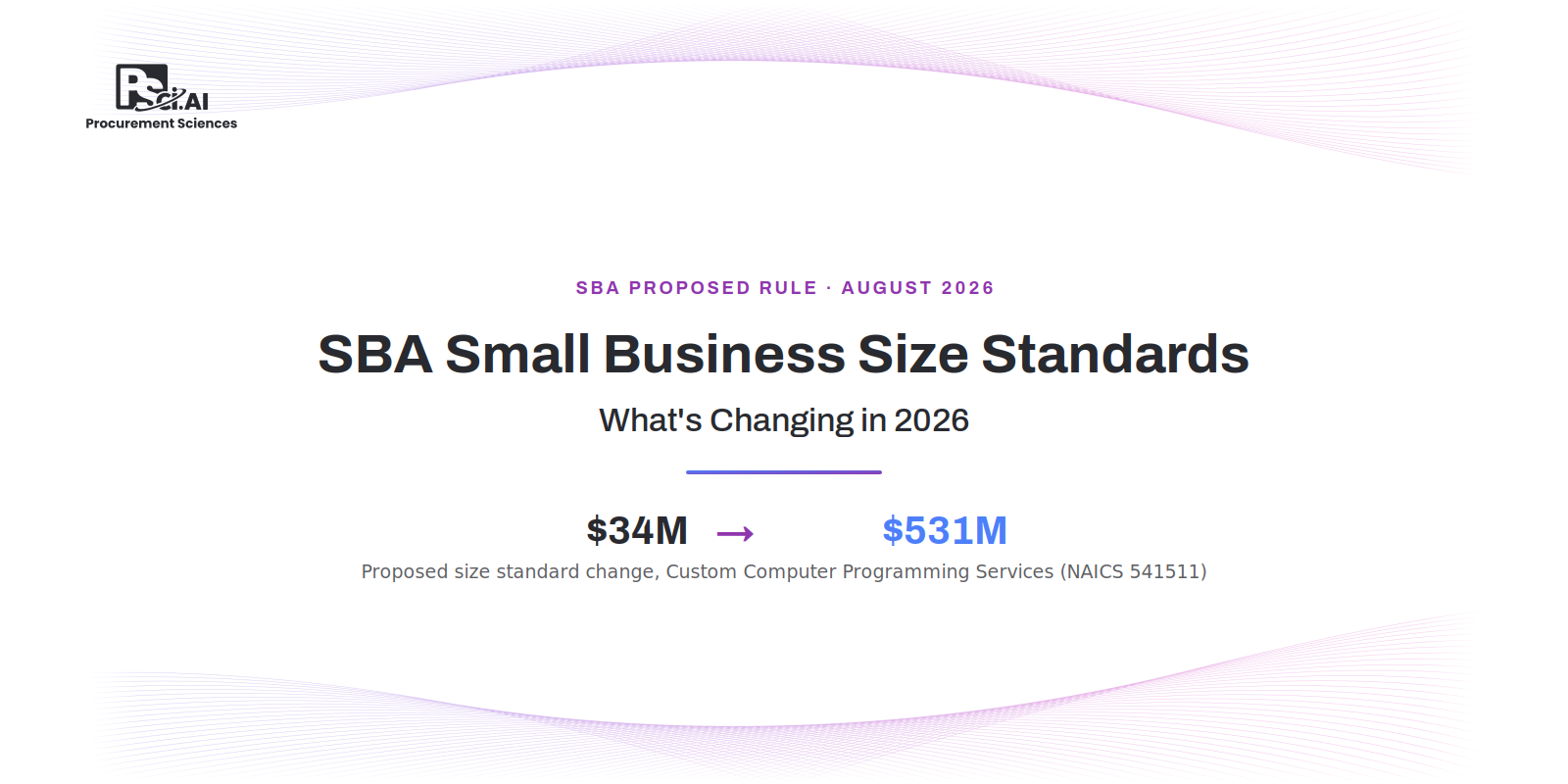
SBA Small Business Size Standards Are Changing: Here's What Government Contractors Need to Know
On August 20, 2026, the Small Business Administration (SBA) published a proposed rule that would rewrite its small business size standards, the thresholds that determine which companies qualify as "small" for federal contracting, SBA loans, and related programs.
SBA Small Business Size Standards Are Changing: Here's What Government Contractors Need to Know