
Build vs. Buy: What GovCon Leaders Are Learning About AI Adoption


Most GovCon teams evaluating AI start in the same place:
We should probably build this internally.
Many do. Nearly all reassess. The question isn’t whether you can build, it’s whether you want to operate a platform long term.
What We See Across GovCon Teams
Over the past several years, Procurement Sciences has worked with hundreds of government contractors evaluating how to deploy AI across capture and proposal workflows.
The pattern is consistent. Teams can build something quickly, but what happens next is where the decision actually gets made.
The Reality of Internal Builds
Early prototypes often work. Teams can generate content, test workflows, and prove initial value in a matter of weeks. But moving from a working demo to a system that actually changes how teams operate is a different challenge entirely.
Where most efforts slow down:
- Governance
- Integration
- Adoption
The gap between a prototype and a production-ready platform is where most internal builds stall.
The Timeline Most Teams Experience
Across organizations, internal AI efforts tend to follow a similar progression:
- Months 0–3: The prototype works and early enthusiasm is high.
- Months 3–6: Governance, security, and integration challenges emerge.
- Months 6–9: Adoption slows and usage remains inconsistent across teams.
- Months 9–12: Leadership reassesses long-term ownership and direction.
The challenge isn’t building something. It’s sustaining and operating it long-term.

How Teams Evaluate the Decision
As organizations move through this process, most evaluate three paths:
- Productivity Tools: General-purpose AI tools that improve individual output.
- Internal Builds: Custom solutions developed by engineering teams.
- Purpose-Built Platforms: Systems designed specifically for capture and proposal workflows.
The difference isn’t access to AI models. It’s workflow depth, integration, and long-term ownership.

From Experimentation to Operation
AI adoption in GovCon is no longer about experimentation. It’s about operational impact. The organizations seeing the most value aren’t just building capabilities, but are embedding them into how their teams work every day. That requires a system, not just a prototype.
Read the Full Executive Brief
We’ve summarized these patterns in more detail in our executive brief on build vs. buy decisions in government contracting.
Click here to schedule a demo to get the full scoop on how our product actually works and discover how AI can transform your approach to government contracting.
Explore More Resources
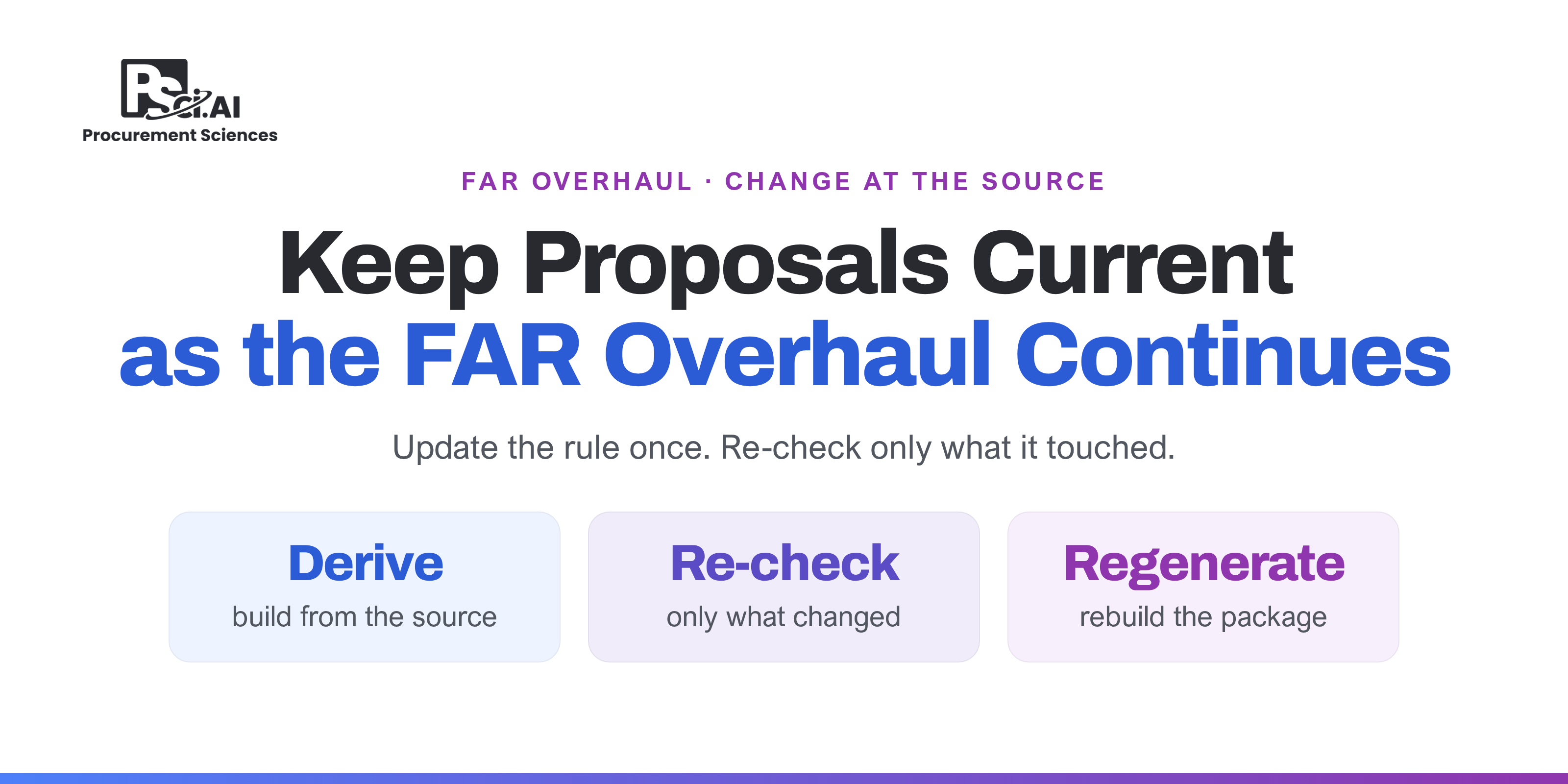
How to Keep Proposals Current as the FAR Overhaul Continues
The FAR overhaul means the rules governing your bid can change while you write it. The fastest way to keep up is to organize your proposal content so every item traces back to the rule it relies on. Update the rule once, and you know exactly what to re-check. We call this Change at the Source.
How to Keep Proposals Current as the FAR Overhaul Continues
Webinar Recap: Outgrowing Small Business, Using AI to Write and Win Like a Prime
Procurement Sciences recently joined APMP for a webinar on one of the most challenging transitions in government contracting: what happens when a small business outgrows its set-aside protections and has to compete in the full and open market against primes with ten times the resources.
Webinar Recap: Outgrowing Small Business, Using AI to Write and Win Like a Prime
Microsoft Copilot Alternatives for Government Contracting: What GovCon Teams Should Know
Microsoft Copilot has become a significant part of the enterprise AI landscape, bringing generative AI directly into applications many government contractors already use every day.
Microsoft Copilot Alternatives for Government Contracting: What GovCon Teams Should Know