
Best AutogenAI Alternatives for Enterprise and GovCon teams

AutogenAI is an AI-powered proposal-writing platform designed to help organizations develop, manage, and improve complex bids and proposals.
As government contractors evaluate AutogenAI alternatives, they may be looking for capabilities beyond proposal drafting, including opportunity intelligence, capture strategy, compliance workflows, and broader support across the contracting lifecycle.
In this guide, we'll explore five AutogenAI alternatives, how they compare, and what government contracting teams should consider when selecting a platform.
For a broader overview of available solutions, explore our guide to AI platforms for government contracting.
Many teams comparing AutoGen alternatives also evaluate AutoGen pricing to understand the total cost of implementation and ongoing usage.
Key Takeaways
- AutogenAI focuses on AI-powered proposal development, while alternatives may offer different combinations of market intelligence, capture strategy, proposal management, and compliance support.
- Procurement Sciences brings together HigherGov's government market intelligence with Awarded AI's purpose-built workflows for capture, proposals, pricing, and reviews.
- Important evaluation criteria include proposal quality, content governance, compliance support, collaboration, opportunity intelligence, and workflow integration.
- Testing platforms against real government contracting workflows can help teams determine which approach best fits their requirements.
Why Teams Look for AutogenAI Alternatives
AutogenAI specializes in generating full-length, narrative-heavy proposals for enterprise clients. The platform excels at creating compliant government and corporate proposals at scale, with custom AI engines trained on individual company content.
However, AutogenAI's high price point, enterprise-first focus, and limited governance features have led many GovCon teams to look for alternatives. Some verified reviewers also complain of a clunky interface and limited AI research capabilities.
What To Consider Before Changing Platforms
Adopting a new platform is a significant investment of both time and money, so it's crucial to make the right decision the first time.
The most important evaluation criteria include:
- Reliability: Does the platform consistently produce accurate, tailored results that win bids?
- Governance: Does the platform include the governance controls needed to secure government contracts?
- Security: Is the platform secure? FedRAMP authorization? CMMC Level 2?
- Integration: Does the platform connect effectively with other external tools you use?
- Fit: Does the platform fit the way you work, or does it force you to change your workflows?
One more thing: Don't settle based on a demo alone. To fully understand which platform is best for your organization, put it to the test using real proposal workflows.
This is why teams comparing AutoGen competitors often evaluate AutoGen pricing alongside implementation complexity and ongoing infrastructure costs.
Top 5 AutogenAI Alternatives
This curated list is for teams seriously evaluating AutogenAI replacements. We won't shy away from opinions either, sharing our take on what makes each entry a stronger choice than AutogenAI.
We've ordered these five platforms by relevance for enterprise, regulated, and GovCon use cases. For a broader overview, see AI tools for government contracting.
1. Procurement Sciences
Procurement Sciences brings together HigherGov's government market intelligence with Awarded AI's purpose-built AI workflows to support how government contractors find, qualify, pursue, and win opportunities.
HigherGov supports opportunity discovery, agency and market research, recompete tracking, competitive intelligence, and partner identification.
Awarded AI supports downstream workflows including capture planning, requirements analysis, proposal development, compliance reviews, pricing, and collaboration.
For teams evaluating AutogenAI alternatives, Procurement Sciences offers a broader find-to-win approach that extends beyond proposal generation to include the intelligence and capture activities that inform which opportunities to pursue and how to pursue them.
Integration between HigherGov and Awarded AI continues to expand, with the goal of connecting opportunity discovery more closely to downstream execution.
Key Features
- Government opportunity discovery and tracking through HigherGov
- Agency, award, competitor, and recompete intelligence
- AI-assisted capture planning and opportunity qualification
- Proposal drafting, requirements analysis, and compliance reviews
- GovCon pricing and proposal collaboration workflows
- Security and governance capabilities designed for regulated contracting environments
Best For
Government contractors looking to combine opportunity intelligence, capture strategy, and AI-powered proposal execution within a broader GovCon platform.
Particularly relevant for teams evaluating how to connect market research and pursuit planning with structured proposal development.
2. Responsive (Formerly RFPIO)
Responsive has positioned itself as a leader in strategic response management, offering AI-enabled solutions used across complex RFPs, RFIs, and security questionnaires.
The Responsive platform can automatically generate a first draft and automate workflow management. AI-powered RFP response automation also enables teams to draft answers and manage collaborative workflows across a wide range of formats, including RFPs, RFIs, DDQs, VSQs, and sales proposals.
So it's a broad solution that supports proposal teams generally, but be aware that Responsive is not a GovCon-specific solution.
Key features:
- AI-assisted answer suggestions steer teams in the right direction.
- Centralized content library and response automation keep proposals on message without manual drafting.
- Support for a wide range of outputs, including RFPs, RFIs, DDQs, VSQs, and due diligence questionnaires, provides greater flexibility.
- Strong integration ecosystem includes over 75 APIs and integrations with major business tools.
Best for:
With its general-market focus, Responsive is best for cross-industry teams needing high-volume response capabilities. It may also support organizations with the ability to layer GovCon compliance processes over the top of their AI response software.
3. DeepRFP
DeepRFP positions itself as an AI-native proposal automation tool focused on accelerating drafting and response creation. The platform includes specialized proposal-writing models, virtual SMEs, and multi-language support. DeepRFP prioritizes quick deployment and immediate value for proposal teams.
As a lighter-weight option, DeepRFP fills a niche for teams that want the speed and value of targeted AI content generation but won't particularly benefit from enterprise-level capabilities.
Key features:
- AI-generated proposal drafts cut down writing and editing time significantly.
- Multi-language support produces proposals in 28 languages from an English interface.
- Automated response creation leverages past content to produce accurate responses.
- Fast setup for proposal writing assistance.
- One of the least expensive AI proposal software solutions.
Best for:
DeepRFP is best for smaller teams looking to speed up early-stage drafting. Its tools and capabilities may also be attractive to organizations that are comfortable managing compliance and workflow outside the platform.
4. Altura
Altura represents the new generation of AI-powered bid and proposal management platforms, focusing on opportunity analysis and response support. It boasts some AI agent capabilities and is especially strong at increasing teams' efficiency in assessing and responding to opportunities.
However, Altura primarily serves the U.K. and E.U. markets, so some of its tools and capabilities may not be a good fit for U.S. GovCon teams.
Key features:
- AI-driven bid analysis and response support enable confident bid decisions.
- Content reuse and proposal drafting tools speed up proposal responses.
- Opportunity evaluation assistance leverages AI to find best-fit tenders and proposals.
Best for:
Altura is a strong fit for teams prioritizing bid qualification and response speed. Organizations that need support in both assessing opportunities and proposal creation may find this combination effective, as long as the European focus is not a deal-breaker.
5. PandaDoc
PandaDoc has emerged as a popular choice for document management that goes beyond proposals. The platform offers e-signatures, contract management, and mild workflow automation.
PandaDoc is not primarily a proposal generation tool, nor was it designed for government proposals or compliance-heavy workflows. But for smaller commercial or sales teams, the combination of features could be an attractive and streamlined alternative to AutogenAI.
Key features:
- Document creation and e-signature workflows keep information and approvals flowing.
- Templates and basic content reuse save time and improve accuracy.
- Sales-focused document tracking provides visibility into status and progress.
Best for:
PandaDoc is best for commercial or sales teams creating lightweight proposals who would benefit from some of the platform's additional capabilities, like e-signature creation or CRM integration. Organizations that don't specifically need structured GovCon compliance workflows may find PandaDoc a simpler and more affordable solution to AutogenAI.
Where Most AI Proposal Tools Fall Short for Government RFPs
AI proposal tools that aren't built for GovCon tend to have gaps like:
- Weak requirement tracking
- Limited (or no) compliance alignment
- Lack of structured review workflows
- Minimal understanding of proposal language
These shortcomings often don't show up early on. Instead, they hit late in the proposal process, often when teams are scrambling under deadline pressure and mistakes are the most costly.
When you've already invested time and energy into a proposal, errors that cause rework, delay, or even bid loss cut into profitability and efficiency.
Why Procurement Sciences Stands Out for Government Proposal Teams
Procurement Sciences is designed around the specific needs of government contractors, bringing together government market intelligence and purpose-built AI workflows across business development, capture, and proposals.
HigherGov supports the research and opportunity intelligence that inform pursuit decisions, while Awarded AI helps teams manage requirements, develop proposal content, coordinate reviews, and support compliance throughout the proposal process.
This approach allows contractors to evaluate not only how AI can accelerate proposal writing, but also how opportunity intelligence, capture planning, and proposal execution fit together. As integration between HigherGov and Awarded AI expands, Procurement Sciences is working toward a more connected find-to-win experience.
Procurement Sciences also assigns specific dedicated customer success agents to each client, all with backgrounds in government contracting. We offer unlimited training and live support, staying with clients until their implementation fits their workflows and their team knows how to use the platform effectively.
Built for Real Proposal Workflows, Not Generic Drafting
AI-powered proposal platforms can help teams generate content, reuse organizational knowledge, and streamline reviews. For government contractors, however, proposal development is only one part of the pursuit lifecycle.
Procurement Sciences supports structured GovCon workflows across opportunity qualification, capture strategy, proposal development, requirements analysis, compliance reviews, and pricing.
HigherGov adds government opportunity discovery, agency intelligence, competitor research, and recompete tracking to the broader Procurement Sciences offering.
For teams comparing AutogenAI alternatives, the distinction is how much of the government contracting lifecycle they want their platform to support, from identifying and evaluating opportunities through proposal execution.
Designed for Compliance-Heavy and Regulated Proposal Environments
Government proposals are distinct from general business RFPs in the level of security controls required. In GovCon, auditability and traceability through the entire response process or lifecycle are essential, often with specific requirements unique to government work.
Procurement Sciences supports these needs through rigorous compliance and security controls:
- Controlled content reuse locks onto compliant content, repurposing it where possible to avoid the risk of creating new, non-compliant content.
- Granular permissions support auditability, traceability, and data security.
- Structured workflows aid compliance while helping ensure that contractors have the necessary level of data.
When evaluating AI proposal platforms for government contracting, teams should verify the specific security controls, deployment options, access permissions, and compliance capabilities available in each solution. Requirements vary by contract, data type, and operating environment, so these considerations should be evaluated alongside proposal functionality.
AutogenAI vs Alternatives: Key Differences
When comparing AutogenAI with alternative platforms, government contractors should evaluate how each solution supports proposal development and the broader pursuit lifecycle.
Key considerations include:
- Proposal development: AI-assisted drafting, content reuse, requirements analysis, and collaboration
- Compliance and governance: Requirements tracking, review workflows, permissions, and security controls
- Market intelligence: Opportunity discovery, agency research, competitor insights, and recompete tracking
- Capture strategy: Opportunity qualification, bid/no-bid decisions, and pursuit planning
- Workflow connectivity: How effectively market intelligence and capture activities connect with proposal development
AutogenAI specializes in AI-powered proposal development. Procurement Sciences brings together HigherGov's government market intelligence with Awarded AI's capture, proposal, pricing, and review workflows, supporting a broader find-to-win approach as integration between the platforms expands.
Making a Confident Decision on AI Proposal Software
Choosing the right AI proposal platform starts with understanding your team's priorities.
Organizations focused primarily on proposal drafting, content development, and response management should evaluate how well each platform supports those workflows.
Government contractors looking for broader lifecycle support should also consider opportunity intelligence, capture planning, pricing, and how those activities connect to proposal execution.
Procurement Sciences brings together HigherGov's government market intelligence with Awarded AI's purpose-built workflows for capture, proposals, pricing, and reviews. As integration between the platforms expands, this approach is designed to connect more of the find-to-win lifecycle.
Request a demo to explore how Procurement Sciences supports your government contracting workflows.
FAQs
What should government contractors look for in AI proposal software?
Teams should focus on workflow support, compliance alignment, content governance, and collaboration, not just drafting speed or AI features.
Do AI proposal tools replace proposal managers or SMEs?
No. These tools are designed to reduce manual effort and support teams, not replace human expertise or judgment.
How can teams evaluate AI proposal software effectively?
Running a real RFP through the platform is the best way to assess how it handles requirements, content reuse, and review workflows.
What Are the Best AutogenAI Alternatives for Government Contractors?
The best AutogenAI alternative depends on whether a team prioritizes proposal drafting, compliance, capture strategy, market intelligence, or broader workflow integration. Procurement Sciences combines HigherGov's government market intelligence with Awarded AI's purpose-built workflows across capture, proposals, pricing, and reviews.
How Does Procurement Sciences Compare to AutogenAI?
AutogenAI focuses on AI-powered proposal development for enterprise and government contracting teams. Procurement Sciences brings together HigherGov's opportunity discovery, agency intelligence, and competitive research with Awarded AI's capture, proposal, pricing, and review capabilities. This supports a broader approach to finding, evaluating, and pursuing government opportunities.
Click here to schedule a demo to get the full scoop on how our product actually works and discover how AI can transform your approach to government contracting.
Explore More Resources
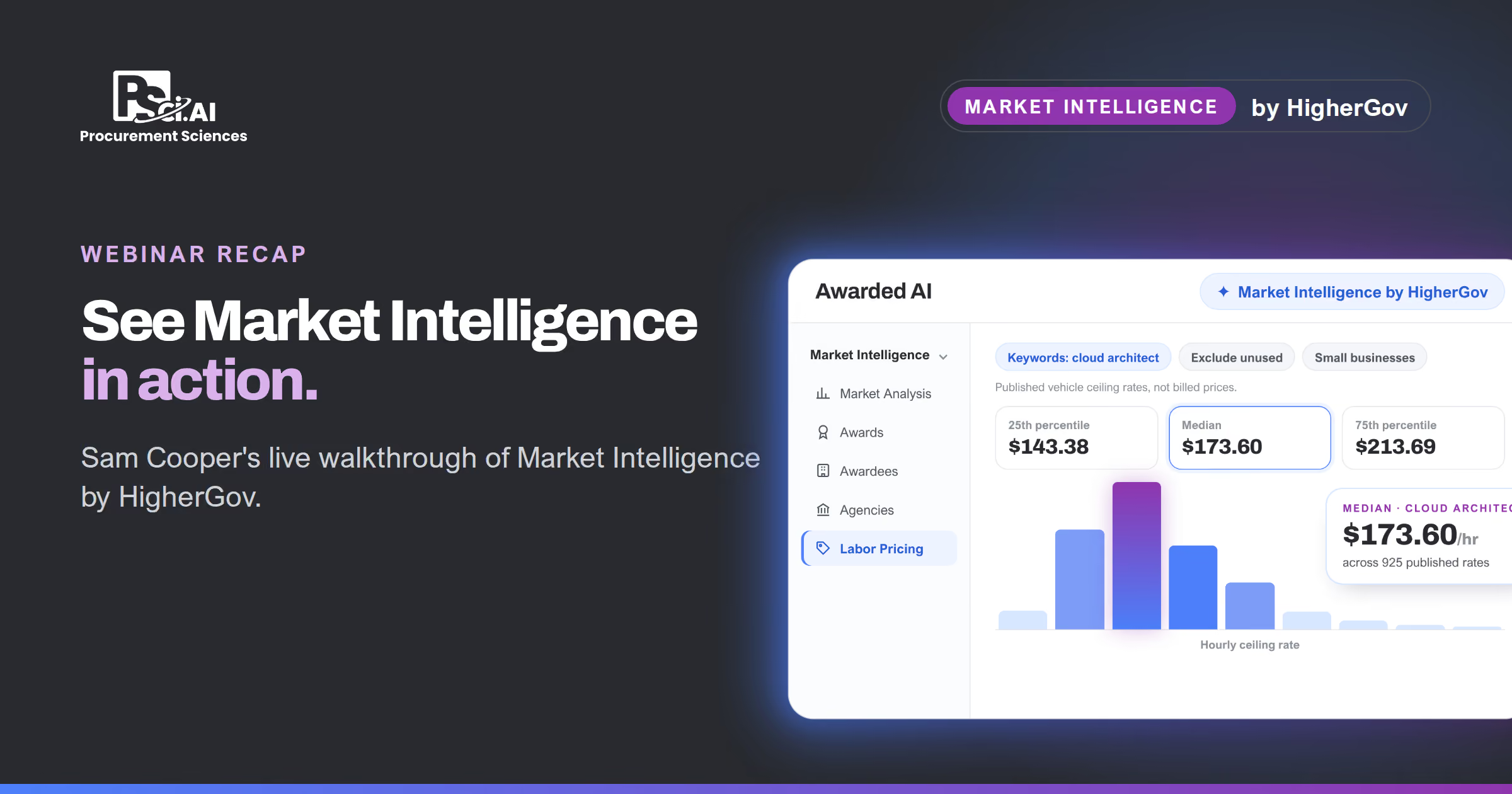
Webinar Recap: Product Spotlight, Market Intelligence by HigherGov Inside Awarded AI
Procurement Sciences recently hosted a product spotlight session on Market Intelligence by HigherGov, the newly integrated data layer now available inside Awarded AI. Sam Cooper, Director of Solutions Consulting, walked through what the integration means in practice, why it matters for the BD lifecycle, and demonstrated it live.
Webinar Recap: Product Spotlight, Market Intelligence by HigherGov Inside Awarded AI
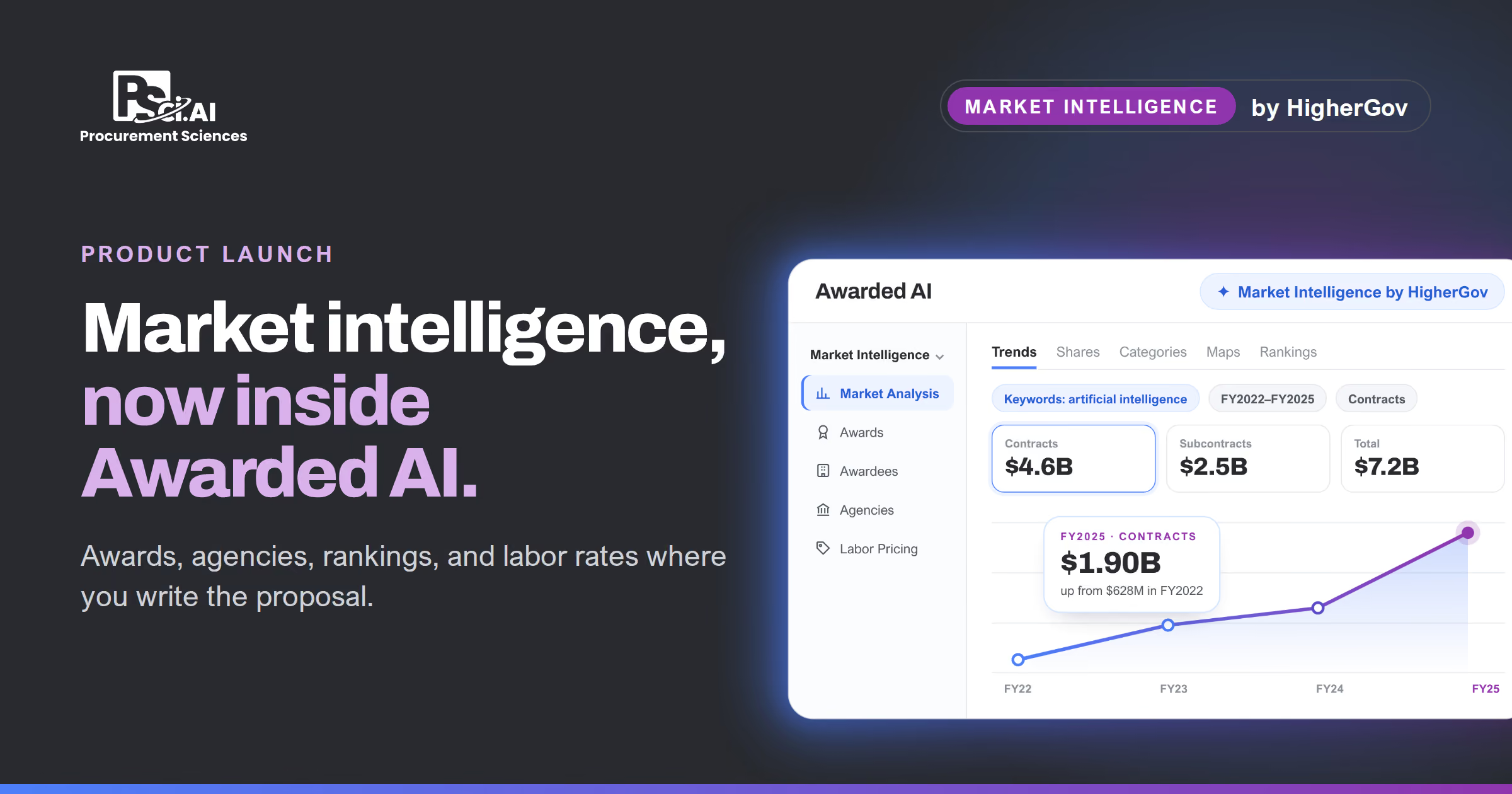
Introducing Market Intelligence by HigherGov: Know the Market Before You Bid
Today we're launching Market Intelligence by HigherGov, which brings HigherGov's federal market data directly inside Awarded AI. The research behind every bid now lives in the same secure platform where you capture and write.
Introducing Market Intelligence by HigherGov: Know the Market Before You Bid
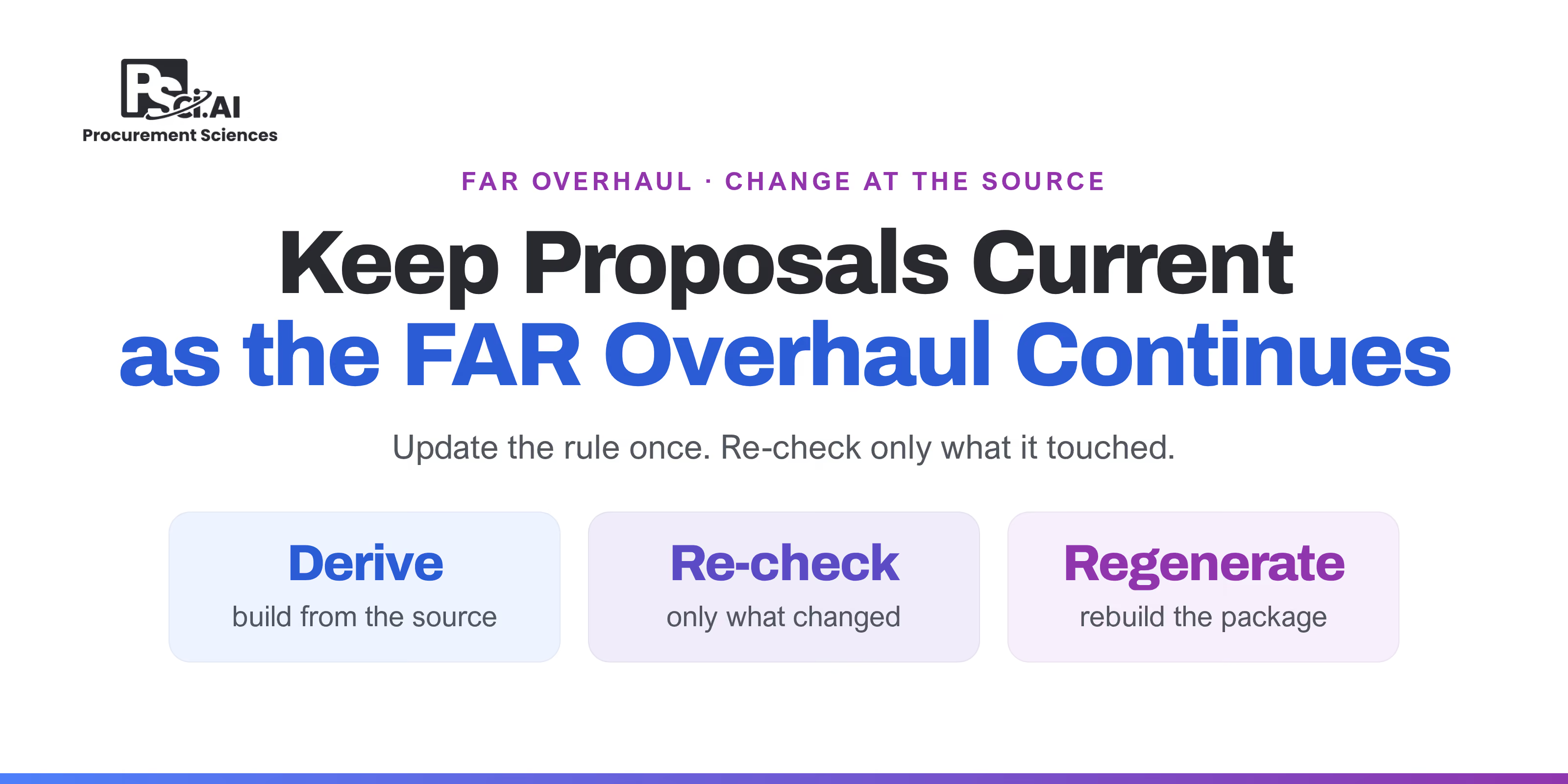
How to Keep Proposals Current as the FAR Overhaul Continues
The FAR overhaul means the rules governing your bid can change while you write it. The fastest way to keep up is to organize your proposal content so every item traces back to the rule it relies on. Update the rule once, and you know exactly what to re-check. We call this Change at the Source.
How to Keep Proposals Current as the FAR Overhaul Continues