
The Future of Business Development & Capture — AI-Driven Decisions, Not Gut Feel


A recap of the AFCEA Webinar Series panel discussion, hosted by SIGNAL Magazine and sponsored by Procurement Sciences
Capture and business development in government contracting are changing faster than most teams realize. AI is no longer just a drafting tool — it's reshaping how GovCon teams find opportunities, evaluate fit, identify teaming partners, and build capture strategies that actually increase probability of win.
In a recent AFCEA webinar moderated by SIGNAL Magazine Editor in Chief George Seffers, Procurement Sciences CEO, Christian Ferreira, led a candid panel discussion with three experienced GovCon practitioners:
- Jenna Young, Director of Strategic Growth, Arlo Solutions
- J. Scott Throckmorton, Senior Director of Federal Services, SSI Synergy
- Steve Skeldon, Director of Capture, Chickasaw Nation Industries
The conversation focused on practical workflows, real decision-making shifts, and hard-won lessons — no sales pitches, no product demos. Just operators talking about what's actually changing on the front end of the GovCon lifecycle.
Here are the five most important takeaways.
1. Gut Feel Is Still Running the Show — And It's Costing Teams
When it comes to bid/no-bid decisions, instinct still dominates at most organizations. You've heard the phrases:
- "We've always supported this customer."
- "The incumbent is weak — we can beat them."
- "We just need more in our pipeline."
The problem? None of those statements are grounded in data, win probability, or strategic alignment. They're emotional reactions — and they have real downstream consequences.
Jenna Young put it plainly: gut-feel decisions lead to teams chasing low-probability opportunities, burning through proposal budgets, overloading already-stretched proposal staff, and — perhaps most dangerously — inflating pipelines with revenue that was never realistic in the first place. "Leadership ends up building revenue projections based on optimism rather than evidence," she noted, "and that bad information can ripple across the entire organization."
This is exactly where AI begins to add value. Not by replacing human judgment, but by introducing objective signals that either validate or challenge those instincts before a team commits time and money to a pursuit.
2. The Signals That Actually Matter in Opportunity Qualification
So if gut feel isn't enough, what should teams actually be evaluating? The panelists converged on a few core signals that cut through the noise quickly.
Capability alignment was the top priority across the board. Just because your team can write the proposal doesn't mean you can win the work. Steve Skeldon framed it this way: if you can't point to where you've actually done this work before — even without a formal past performance requirement — you're starting the bid at a significant disadvantage.
Steve uses a four-bucket framework to evaluate any new opportunity quickly:
- Bid-ability — Are we even eligible? Are we on the right vehicle? Does the set-aside apply to us?
- Bid risk — Does this fit our corporate risk profile?
- Bid alignment — Do we have the capability and the customer relationship to tell a credible story?
- Bid preparedness — Do we have the people, the key personnel, and the time to write it well?
This is where capabilities like instant RFP triage — one of the workflows the panel highlighted as a genuine competitive differentiator — start to pay off. AI can accelerate this evaluation by pulling relevant past performance, mapping contract history, and surfacing capability gaps before your team invests hours going down the wrong path.
3. The First 15 Minutes of an RFP Review Are Everything
RFPs are dense. They're full of requirements, attachments, and compliance language that can easily consume hours of analysis before anyone asks whether the opportunity is even worth pursuing. The most effective capture teams have learned to flip that script.
Jenna described her approach: in the first 15 minutes, she's trying to answer three questions — Is it strategically aligned with our growth plan? Is it winnable? Is it worth burning B&P dollars on? If those questions can't be answered with confidence, the opportunity may not deserve a deeper look yet.
AI is particularly powerful here because document analysis is one of its strongest capabilities. By running an RFP against a tailored prompt, teams can extract structured insights in minutes rather than hours — getting clear answers on scope, requirements, evaluation criteria, and competitive signals without manual page-by-page review. What used to take days is now genuinely a 15-minute exercise.
The practical tip from the panel: build your standard evaluation questions into a reusable prompt and run every new opportunity through it. You'll compress early-stage analysis dramatically and make faster, better-informed pursuit decisions from day one.
4. Killing Bad Deals Early Is Hard — But It's One of the Highest-Value Habits You Can Build
Here's the uncomfortable truth every capture professional knows: walking away from a bad opportunity is often harder than it should be. There's emotional investment. There's pipeline pressure. There's optimism bias — that voice that says, "Sure, it's a long shot, but someone wins the lottery."
As Steve put it: "Nobody wants to hear their baby called ugly."
AI helps introduce objectivity into that conversation. It can flag weak past performance alignment, surface capability gaps, highlight resource overextension, and quantify probability-of-win factors — all before a team gets deep into proposal development. The goal the panelists described is to fail fast: make the no-bid decision as early as possible, so time and resources are protected for opportunities worth winning. CNI even tracks the delta between time-to-identification and time-to-kill or submit, using that metric to measure whether the team is making decisions earlier in the process.
That said, AI shouldn't make the kill decision automatically. There are legitimate strategic reasons to pursue a long shot — building name recognition with a new customer, establishing a foothold in a new market, or strengthening a teaming relationship. The value of AI is that it forces teams to be honest about why they're pursuing something. Is it strategy, or is it hope? Knowing the difference is what separates disciplined capture teams from ones that are always busy but never quite winning.
5. AI Is Reshaping How Teams Find and Evaluate Teaming Partners
Teaming decisions have always been relationship-driven — and for good reason. Trust, reliability, and past partnership history matter enormously when you're putting your bid reputation on the line with another company.
But the panelists acknowledged a real risk in leaning too heavily on existing relationships: you end up assembling a team of familiar faces rather than the most qualified partners for the specific opportunity in front of you. Scott Throckmorton noted that experienced BD teams often have an "institutionalized pool" of teaming partners they return to repeatedly — which works, until the opportunity calls for something outside that familiar circle.
This is where data-driven teaming alignment — another capability the panel called out as an emerging competitive advantage — begins to change the game. AI enables teams to analyze capability statements, contract performance history, and complementary skill sets across a much broader pool of potential partners. Steve described a practical example from CNI: centralizing the capability statements received throughout the year into a queryable database, then using AI to surface the best match for a given requirement — even if that company isn't one they've worked with directly before.
The result is a smarter, more expansive view of the teaming landscape, while still allowing established relationships to guide the final decision.
The Bottom Line: Winning Teams Don't Use More AI — They Make Better Decisions Earlier
Every panelist landed on the same conclusion: AI doesn't replace the judgment, relationships, or strategic thinking that wins government contracts. What it does is raise the bar for everything supporting those decisions.
It compresses research time. It surfaces signals that get missed. It challenges assumptions before they become costly mistakes. And it gives BD and capture professionals more time to focus on the work that actually requires human expertise — building relationships, shaping requirements, crafting compelling narratives, and making smart strategic bets.
The capabilities that felt out of reach just a few years ago — semantic opportunity discovery, instant RFP triage, data-driven teaming alignment — are quickly becoming table stakes. The teams that will pull ahead aren't necessarily the ones that adopt AI the fastest. They're the ones that learn to combine AI-driven insight with human judgment most effectively.
Click here to schedule a demo to get the full scoop on how our product actually works and discover how AI can transform your approach to government contracting.
Explore More Resources
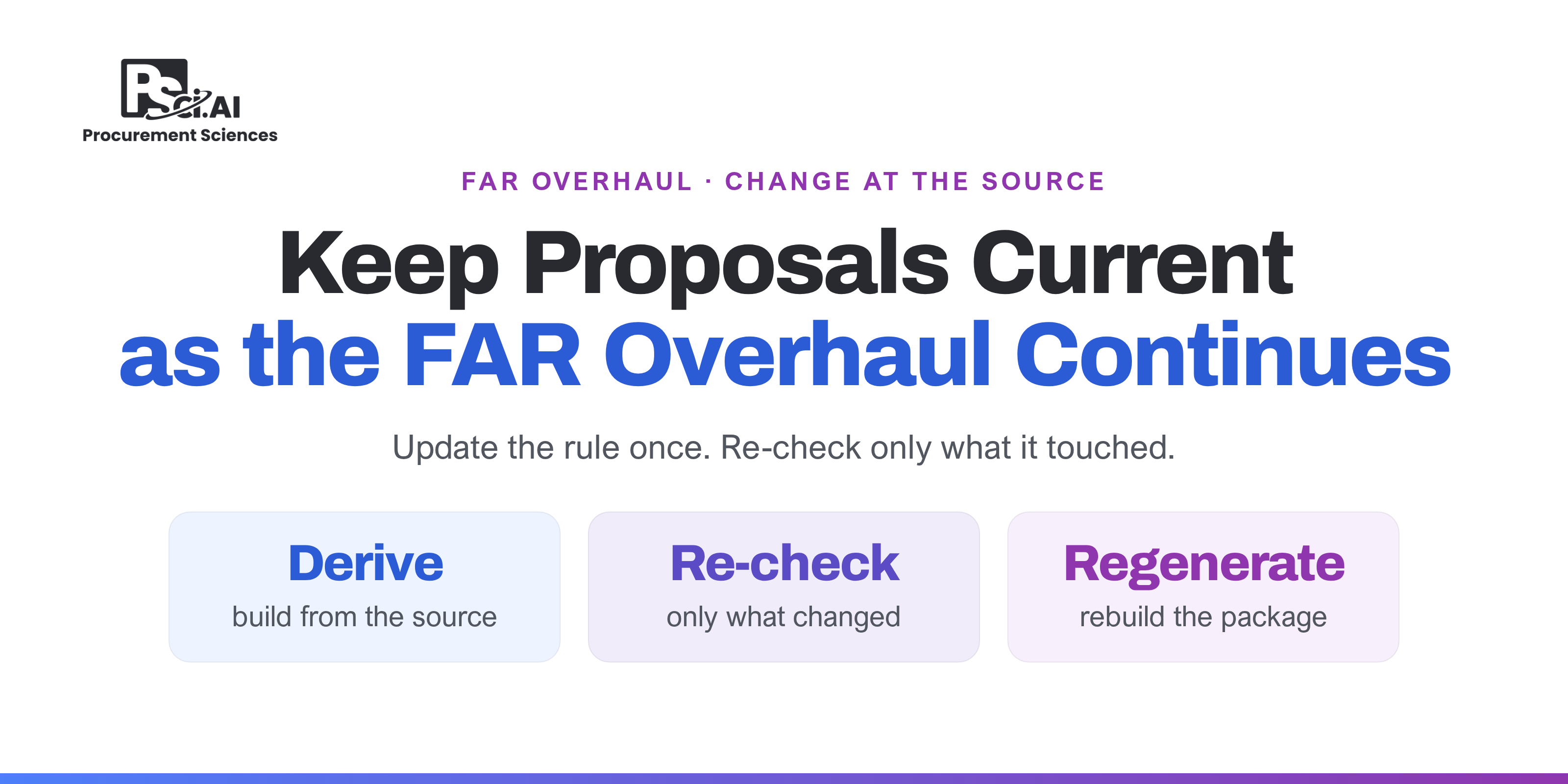
How to Keep Proposals Current as the FAR Overhaul Continues
The FAR overhaul means the rules governing your bid can change while you write it. The fastest way to keep up is to organize your proposal content so every item traces back to the rule it relies on. Update the rule once, and you know exactly what to re-check. We call this Change at the Source.
How to Keep Proposals Current as the FAR Overhaul Continues

Webinar Recap: Outgrowing Small Business, Using AI to Write and Win Like a Prime
Procurement Sciences recently joined APMP for a webinar on one of the most challenging transitions in government contracting: what happens when a small business outgrows its set-aside protections and has to compete in the full and open market against primes with ten times the resources.
Webinar Recap: Outgrowing Small Business, Using AI to Write and Win Like a Prime

Microsoft Copilot Alternatives for Government Contracting: What GovCon Teams Should Know
Microsoft Copilot has become a significant part of the enterprise AI landscape, bringing generative AI directly into applications many government contractors already use every day.
Microsoft Copilot Alternatives for Government Contracting: What GovCon Teams Should Know