
Best Contract Lifecycle Management Software for Government Contracting Teams

Winning a government contract is a major milestone. The next challenge is managing it through execution, modifications, option years, and closeout with a process that's repeatable and reliable.
Post-award is where the real operational pressure starts. Deliverables stack up. Modifications are issued. Compliance requirements shift. And if your team is still managing all of that through spreadsheets, shared drives, and email threads, you may be carrying risk that only becomes visible once it turns into a problem.
This guide is for GovCon teams at the decision stage of evaluating contract lifecycle management (CLM) software. If your current approach isn't scaling with your contract portfolio, you don't want new technology just for the sake of it, nor do you want generic solutions. The tools covered here are assessed through a government contracting lens, not a generic enterprise software lens.
Key Takeaways:
- Contract lifecycle management becomes increasingly critical after award, when compliance, deliverables, and modifications introduce operational risk.
- Government contractors need CLM software that supports auditability, visibility, and structured workflows across the full contract lifecycle — not just execution or signatures.
- Evaluating CLM tools through real post-award scenarios reveals gaps that feature lists and demos often hide.
- Platforms that connect contracts to upstream proposal data and downstream execution workflows reduce handoff friction and improve accountability.
Why Contract Lifecycle Management Matters
Framing CLM purely as a "contracts and legal function" is too narrow and often leads to underinvestment in the tools and processes that protect revenue.
Poor contract management creates risk in places that don't always show up on a dashboard until something goes wrong, like a missed deliverable deadline or an option year that wasn't flagged for renewal review. For teams managing more than a handful of active contracts, there are plenty of potential operational risks.
Government contracts carry tighter controls than commercial agreements by design. FAR compliance, reporting obligations, data rights provisions, and agency-specific requirements don't disappear after contract award. Far from it. They become your day-to-day operating environment.
And unlike commercial contracts, where a missed deadline might create a negotiation, a missed obligation in a government contract can trigger a cure notice, a performance assessment, or worse.
A well-implemented CLM solution brings structure to that sort of environment. It gives contracts teams visibility into what's due, when, and who owns it, while giving program managers a single source of truth for contract terms and modifications.
It also provides leadership with the reporting they need to manage risk across an entire portfolio, in a function that touches revenue, audit readiness, and long-term agency relationships.
What To Look for in Contract Lifecycle Management Software
Most CLM platforms are designed for commercial legal teams managing vendor agreements and sales contracts. Government contractors operate differently, and evaluating CLM software without accounting for that difference can lead to poor fit and clunky workarounds.
Look for the features that matter most for GovCon teams:
Compliance, Auditability, and Contract Visibility
In government contracting, auditability is a requirement. Your CLM platform needs to support version control, document traceability, and a clear record of who approved what and when. If you can't reconstruct a contract's modification history on short notice, that's a risk.
FAR clauses, agency supplements, and contract-specific compliance requirements also create ongoing obligations that need to be tracked and enforced throughout performance. A CLM tool that treats compliance as a pre-execution checklist, rather than integrating it into the complete lifecycle, will leave gaps that create audit exposure.
Real-time visibility is the operational layer. Teams need to see contract status, upcoming milestones, obligation owners, and modification history without digging through folders or asking program managers to pull reports manually.
Workflow Automation Across Contract Stages
Manual handoffs between legal, contracts, operations, and delivery teams are where things fall through the cracks. A deliverable gets missed because ownership wasn't clear. Or maybe a renewal window opens and closes before anyone flags it for review.
Workflow automation and AI-first architecture help close those gaps. The right CLM platform automates the routing, approval, and notification steps that currently depend on someone remembering to do them.
This lets you do more with the resources you already have by eliminating administrative busywork — the same manual admin that often leads to preventable errors on tougher, long-duration contracts.
Integration With Upstream and Downstream Systems
It's easy to evaluate a CLM platform on its own and select it based on its specific feature set, without asking how it connects to any of your other systems.
Upstream, your CLM should connect to the proposal and capture data that produced the contract. After award, contracts teams shouldn't have to re-enter the compliance requirements, teaming arrangements, and technical commitments documented during pursuit.
Downstream, a CLM needs to connect to finance, project management, and delivery systems. Contract terms should inform how work is tracked, how invoices are generated, and how performance is measured. Disconnected tools create gaps that make it harder to manage contract performance and demonstrate it during audits.
How To Evaluate CLM Tools Through a Government Contractor Lens
Feature comparisons and vendor demos are a starting point, but they shouldn't be the only factors driving your decision. The right way to evaluate CLM software is to run it against your actual contracts, including the messy, complex, multi-year ones with modifications and compliance requirements and multiple performance locations.
If a platform looks clean during a demo using perfectly curated sample data, but you can't figure out how it would handle a real IDIQ task order with seven active delivery orders and two pending modifications, that should be a red flag. A serious evaluation means comparing a potential platform against the full scope of what government contracting needs.
Align CLM Capabilities With Contract Complexity
Managing a single CPFF research contract is a much different operational challenge than managing a portfolio of IDIQ vehicles with dozens of task orders, multiple primes and subs, and agency-specific reporting requirements across each one. Clearly, contract type matters.
Map your CLM evaluation to the contracts you do manage, not the ones you wish you had. Look at your highest-risk contracts (the ones with the most compliance obligations, modification activity, and harder deliverable structures) and test whether the platform can handle them. If it can't, the fact that it handles simpler contracts well doesn't solve your problem.
GovCon-specific work also comes with challenges that commercial CLM platforms weren't designed for, such as:
- Government property tracking
- Subcontractor flow-down requirements
- Small business subcontracting plan compliance
- Data rights management
These are standard features of federal contract performance, and your CLM platform should treat them that way.
Consider Long-Term Scalability and Reporting Needs
A team managing five contracts today may be managing 25 in three years if their win rate is strong. The CLM platform you select now needs to scale with that growth, without requiring a full reimplementation or a parallel system to deliver the reporting your leadership and agency customers expect.
Visibility across the portfolio (not just within individual contracts) is also essential from a CLM tool. Leadership needs to see obligation status, renewal timelines, and performance risk across all active contracts, not just the ones that are actively in crisis. That larger holistic view enables more proactive management.
Best Contract Lifecycle Management Software Options
Our top platform picks have proven their worth in government contracting-specific use cases. Below, we'll explore what each platform offers, what it does well, and which teams are best positioned to get value from it.
1. Procurement Sciences
Procurement Sciences is built specifically with government contractors in mind. Most CLM tools were adapted from commercial legal platforms, but Procurement Sciences was built around the actual workflows of GovCon teams, from proposal development through contract execution and oversight.
The platform connects awarded proposals, contract terms, compliance requirements, and operational workflows within a single environment. That integration means the work and data your team poured into pursuit carry forward into contract execution — without requiring manual re-entry or a separate handoff process.
Procurement Sciences' AI capabilities also help in the bidding process itself, surfacing high-fit opportunities, understanding competitive positioning, drafting proposals, and flagging risks before you commit resources, so you can better connect to downstream execution.
Key features:
- Contract management tied directly to proposals and awards
- Compliance-aware workflows and auditability built for regulated environments
- Centralized contract data with role-based access controls
- Automation across post-award execution and oversight functions
Best for:
- Government contractors managing complex, regulated contract portfolios
- Teams seeking continuity from proposal creation through contract execution
- Organizations prioritizing compliance, visibility, and operational efficiency
2. Icertis
Icertis is an enterprise-grade CLM platform with a strong track record in large-scale contract governance. It's designed for organizations managing high contract volume across more in-depth legal and regulatory areas, and it has the infrastructure to support that scale.
Its main strengths are in clause management, obligation tracking, and enterprise reporting. For organizations with dedicated legal operations teams and the technical resources to implement and maintain a sophisticated CLM environment, Icertis delivers.
Key features:
- Advanced contract authoring and clause library management
- Obligation tracking and policy enforcement across the lifecycle
- Enterprise-grade reporting and analytics
- Scalable governance for large, distributed contract portfolios
Best for:
- Large enterprises with dedicated legal operations functions
- Organizations managing high contract volume across multiple regions or business units
3. Conga CLM
Conga CLM is largely deployed within Salesforce ecosystems, which makes it a natural fit for organizations where the CRM is the operational hub. Its strengths are in contract authoring, approval workflows, and template management.
For government contractors whose BD and capture process runs through Salesforce, Conga can extend that environment into contract management. The tradeoff, though, is that its GovCon-specific compliance capabilities are limited compared to platforms built specifically for higher-regulated environments.
Key features:
- Contract authoring and approval workflow automation
- Clause libraries and template management
- Salesforce-native integrations
- Renewal and amendment tracking
Best for:
- Sales-driven organizations with CRM-centric workflows
- Teams comfortable customizing CLM capabilities around commercial contract patterns
4. Ironclad
Ironclad is a CLM platform built around legal team efficiency and collaboration, with an emphasis on artificial intelligence. It handles contract drafting, negotiation workflows, and approval routing well, and its interface is designed for speed.
The limitation for GovCon teams is that Ironclad was designed for commercial legal teams with lighter regulatory requirements. It doesn't natively address the compliance tracking, auditability, and government-specific obligation management that federal contractors demand.
Key features:
- Collaborative contract drafting and negotiation workflows
- Workflow automation for legal approvals and routing
- Centralized contract repository with search and reporting
- Contract status and timeline visibility
Best for:
- Legal teams prioritizing speed and internal collaboration
- Organizations with commercial-heavy contract portfolios and lighter regulatory requirements
5. DocuSign CLM
DocuSign CLM builds on DocuSign's main eSignature capabilities and extends into broader contract lifecycle management. For teams that are already using DocuSign for execution and signatures, it provides an easy, user-friendly expansion into template management, lifecycle tracking, and basic reporting.
That said, it's most useful as an execution and agreement management layer, rather than a post-award management platform. Teams with compliance or operational oversight needs will likely have to supplement it with additional tools.
Key features:
- Contract generation and lifecycle tracking
- Integrated eSignature workflows
- Template and clause management
- Basic reporting and agreement analytics
Best for:
- Teams focused primarily on contract execution and approval workflows
- Organizations supplementing CLM with other operational and compliance tools
Why Procurement Sciences Stands out for Contract Lifecycle Management
Most CLM platforms only solve for part of the problem. They might handle contract storage, signature workflows, or clause management well, but what they don't solve is maintaining the continuity between pre-award and post-award. That's the point where proposal commitments get handed off to contracts and program teams, often imperfectly, and where operational risk starts piling up.
Procurement Sciences is designed around that gap, supporting the entire contract lifecycle. Because the platform connects proposal development to contract execution, the compliance requirements, technical commitments, and performance obligations documented during pursuit are available to the teams managing performance after award. That streamlines information flows and keeps it accessible and transparent through the organization.
For teams managing AI-supported bid decisions and proposal workflows earlier in the process, Procurement Sciences connects those decisions to downstream execution, making the entire integrated approach that much more valuable and fluid.
Built for Compliance-Heavy Government Environments
Compliance and auditability shouldn't operate as side processes. That's why Procurement Sciences' contract management solution builds them into your workflows from the start.
Teams don't have to manually maintain compliance documentation alongside their operational work. The platform structures that documentation as part of how work gets done, reducing audit risk and providing a clearer record of contract performance that supports agency relationships and future pursuits.
Choose the CLM Platform That Fits Your Operations
The right CLM system for your team should be specific to your contract types, your compliance obligations, your existing systems, and where your operational risk already is. High-level feature comparisons won't provide enough insight. Running your real contracts through a true-to-life platform evaluation will.
Procurement Sciences is built to support end-to-end government contract workflows in a way that commercial CLM platforms can't match.
See how it fits your operations: Contact the Procurement Sciences team to walk through your specific use cases.
FAQs
What Is Contract Lifecycle Management Software?
Contract lifecycle management (CLM) software helps organizations manage contracts from creation through execution, renewal, and closeout, with visibility and controls across each stage.
Why Do Government Contractors Need CLM Software?
Government contract cycles involve strict compliance requirements, audits, and long execution timelines. CLM software helps teams track obligations, manage changes, and reduce risk after award.
How Is GovCon CLM Different From Commercial CLM?
GovCon CLM must support auditability, role-based access, and compliance throughout the lifecycle — not just optimize contract creation and signing.
Who Typically Uses CLM Software Within an Organization?
CLM tools are used by a mix of legal, contracts, operations, and program management teams to ensure contracts are executed accurately and on time.
Click here to schedule a demo to get the full scoop on how our product actually works and discover how AI can transform your approach to government contracting.
Explore More Resources
.png)
Webinar Recap: Product Spotlight, Market Intelligence by HigherGov Inside Awarded AI
Procurement Sciences recently hosted a product spotlight session on Market Intelligence by HigherGov, the newly integrated data layer now available inside Awarded AI. Sam Cooper, Director of Solutions Consulting, walked through what the integration means in practice, why it matters for the BD lifecycle, and demonstrated it live.
Webinar Recap: Product Spotlight, Market Intelligence by HigherGov Inside Awarded AI
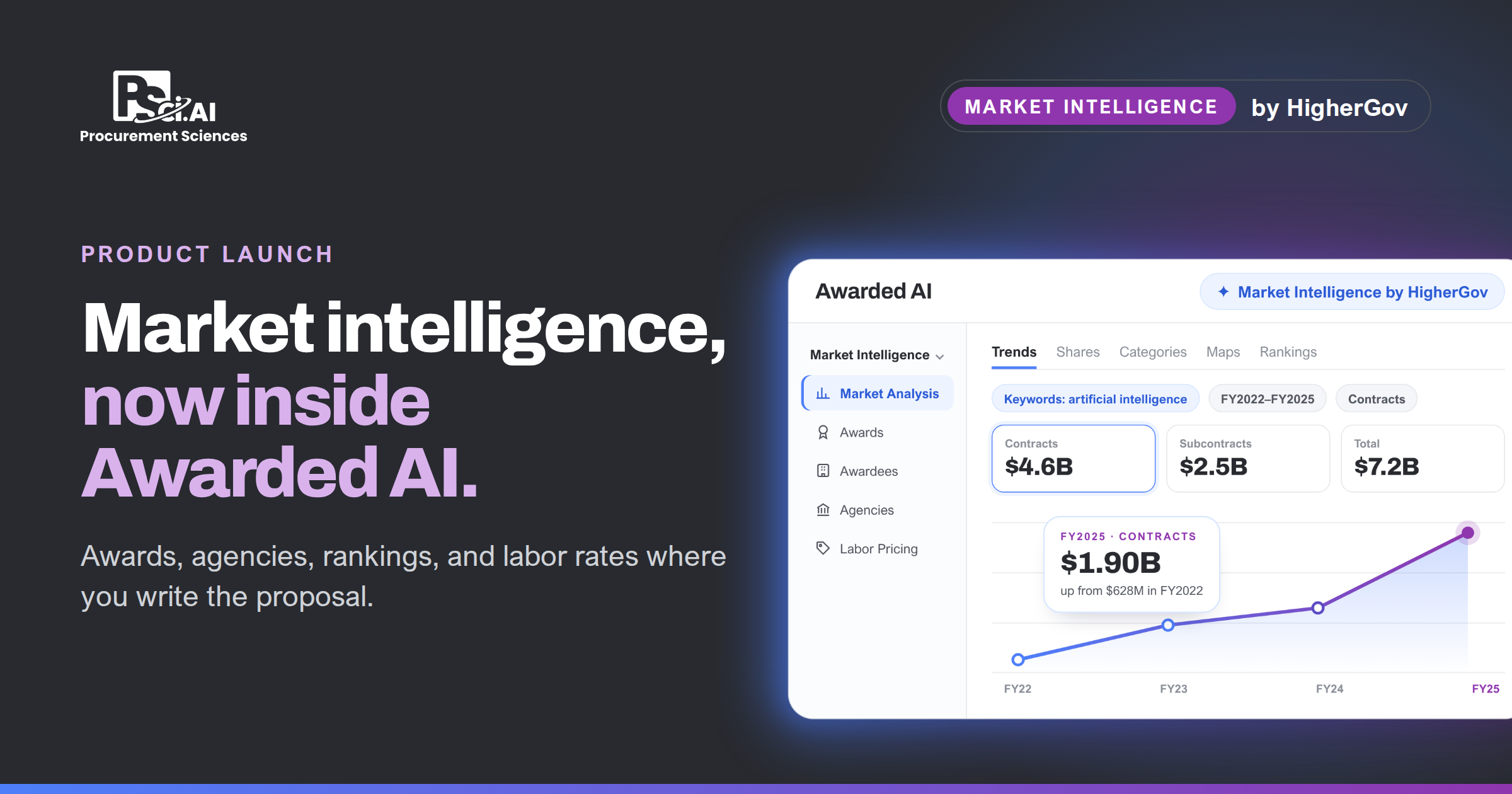
Introducing Market Intelligence by HigherGov: Know the Market Before You Bid
Today we're launching Market Intelligence by HigherGov, which brings HigherGov's federal market data directly inside Awarded AI. The research behind every bid now lives in the same secure platform where you capture and write.
Introducing Market Intelligence by HigherGov: Know the Market Before You Bid
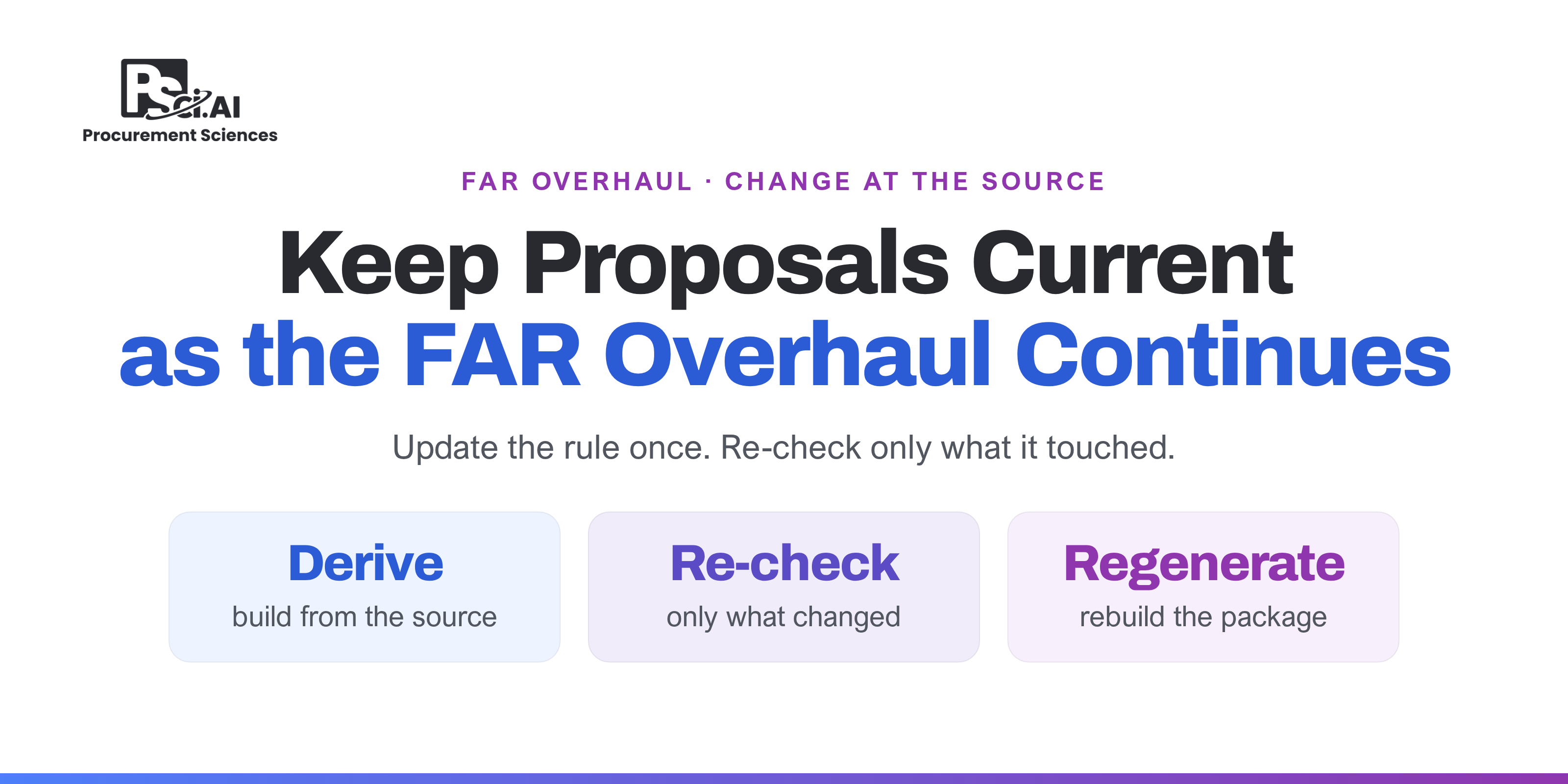
How to Keep Proposals Current as the FAR Overhaul Continues
The FAR overhaul means the rules governing your bid can change while you write it. The fastest way to keep up is to organize your proposal content so every item traces back to the rule it relies on. Update the rule once, and you know exactly what to re-check. We call this Change at the Source.
How to Keep Proposals Current as the FAR Overhaul Continues