
Top 5 Government Bid Sites

Government bid sites are the official platforms where federal agencies publish contract opportunities. If you’re building a federal pipeline in government contracting (GovCon), knowing where to look is not optional.
Many BD teams rely too heavily on a single portal or pay for an aggregator without understanding what it actually covers. The result is missed solicitations, wasted time, and an incomplete view of the pipeline. No single site captures everything, and each platform serves a different purpose in the federal procurement process.
This post breaks down the five government bid sites that matter most, what each one is designed to do, and how to get value from them as part of a repeatable opportunity monitoring process.
Key Takeaways
- Government bid sites are official channels that federal agencies use to publish contract opportunities, with SAM.gov serving as the central hub for registration and opportunity searches.
- Free official portals provide direct access to government requests for proposals (RFPs) and contract data, while paid aggregators add convenience features but should not replace primary source monitoring.
- Contractors who systematically check multiple bid sites and filter by NAICS code, agency, and set-aside type build stronger pipelines than those relying on a single source.
- AI-powered opportunity discovery tools like Awarded AI can automate the search process across multiple government bid sites, surfacing relevant RFPs faster than manual monitoring.
Why Contractors Rely on Government Bid Sites
Federal agencies post contract opportunities on government bid sites. These portals are the only legitimate way to view solicitations. There are no shortcuts or alternative sources that replace direct access.
Every registered contractor has the same visibility, regardless of existing agency relationships. The challenge is timing. Federal solicitations have strict response windows, and missing a posting by even a few days can mean missing the opportunity entirely.
To keep pipelines full, teams need to review government bidding websites daily as part of a disciplined GovCon business development process.
The Top 5 Government Bid Sites
Each of the following platforms serves a distinct role in the federal procurement process. SAM.gov is a must for every contractor, acting as the central source for active solicitations, while the others provide complementary data that supports bid decisions.
Used together, these sites give you a more complete view of the pipeline, from active opportunities to historical awards and agency buying patterns.
1. SAM.gov Contract Opportunities
SAM.gov is the single most important government bidding website. Once registered, you gain access to the government’s authoritative source for active solicitations, which allows you to pursue federal contracts.
SAM.gov consolidated several legacy systems, including FedBizOpps (FBO), the Central Contractor Registration (CCR), and ORCA, into one platform. It now supports entity registration, opportunity searches, award tracking, and access to the Dynamic Small Business Search (DSBS).
To get the most from SAM.gov, set up saved searches and filter by your primary NAICS codes, target government agencies, relevant set-aside types (small business, 8(a), SDVOSB, HUBZone), and estimated contract value. Check the platform daily to stay ahead of new deadlines, and keep your registration current. An expired registration can disqualify you before you submit.
2. GSA eBuy and Active Solicitations
GSA eBuy is the portal for contractors who hold GSA Schedule contracts and want to respond to RFQs issued through the platform. If your firm is on a GSA Schedule, eBuy should be part of your monitoring routine. Agencies use it to request quotes and issue task orders directly to Schedule holders.
Beyond eBuy, the GSA Active Solicitations page provides broader visibility into GSA-managed bid opportunities. This is especially useful for identifying work that may not yet appear in your eBuy feed but still aligns with your contract scope.
GSA eLibrary also plays a key role in competitive research, giving you access to existing contract information, pricing data, and vendor details. Reviewing similar contracts can help you understand how competitors are positioned and how agencies structure requirements under GSA vehicles.
The GSA CALC tool and the Bureau of Labor Statistics (BLS) Quick Rate tool support labor-rate benchmarking and cost analysis for proposals. You don’t need a GSA Schedule to use these tools. Any contractor can access eLibrary, CALC, and BLS data to strengthen pricing assumptions and market research.
3. USAspending.gov Award Database
USAspending.gov is where capture managers go for answers: who won, how much they won, and from which agency.
The platform provides historical contract award data across the federal government, making it a valuable resource for competitive intelligence, market sizing, and trend analysis. You can use it to confirm whether real demand exists before investing resources in an RFP, estimate typical contract values in your target space, and identify incumbents you’ll likely compete against.
The data is downloadable, so teams can pull it into Excel or a BI tool for deeper analysis and custom reporting. USAspending.gov gives BD leaders the historical context needed to make more precise bid/no-bid decisions.
4. Federal Procurement Data System (FPDS)
FPDS is a free database for government contract analytics. It’s one of the primary data sources that feeds USAspending.gov, but it provides more detailed filtering and reporting options. You can view NAICS codes, Product Service Codes (PSC), contracting agency, place of performance, contract type, competition status, and more.
Contractors use FPDS to verify demand before committing time and proposal budget to an opportunity. If you want to understand which agencies buy your services most frequently, how they structure contracts, and how competitive procurements are, FPDS is the right place to look.
5. DLA DIBBS for Defense Bids
The Defense Logistics Agency Internet Bid Board System (DIBBS) focuses on defense parts, equipment, and supply chain opportunities managed through the DLA. If your company sells physical products to military or defense agencies, DIBBS should be on your monitoring list alongside SAM.gov.
DIBBS follows standard federal bidding workflows, but it specializes in DLA-managed solicitations for items like spare parts, repair components, and supply chain materials. It’s a valuable tool for defense manufacturers and distributors seeking niche bid opportunities that may not appear on larger platforms.
Comparing Official Portals to Paid Aggregators
Paid services like GovWin IQ and BidNet consolidate multiple sources into a single interface. They offer enhanced filtering and, in some cases, layer competitive intelligence on top of raw solicitation data. That convenience is valuable for teams with high proposal volume and limited BD staff.
Aggregators are a supplement, not a substitute. The five platforms above are the authoritative sources; SAM.gov registration is mandatory, and award data on USAspending.gov and FPDS come directly from the government.
When evaluating a paid tool, consider whether the subscription fee delivers return on investment (ROI) compared to the cost of disciplined manual monitoring. For some teams, the answer is a clear yes. For others, structured use of free portals with saved searches and email notifications is enough to maintain a strong pipeline.
Choosing the Right Site for Your Pipeline
Most contractors anchor their workflow in SAM.gov. From there, priorities depend on your business. Defense product sellers should monitor DIBBS, and GSA Schedule holders need eBuy. Teams focused on competitive positioning and market research should regularly use USAspending.gov and FPDS.
Let proposal volume drive how you monitor these sites. If your team pursues five or more proposals a year, you need a repeatable system. Most platforms offer email alerts and saved searches that reduce the daily effort and help ensure you don’t miss new postings.
Your goal is to build a consistent workflow that covers the most important sites for your pipeline. In practice, that means combining daily monitoring of active opportunities with regular review of historical data to guide where you focus.
If you want to scale this further, AI-powered tools can automate cross-site monitoring and surface relevant government contract opportunities without adding headcount.
Speed Up Opportunity Search With AI-Driven Tools
Winning government contracts depends on consistent visibility across the right sources. No single site captures everything, and teams that rely on a structured, multi-site monitoring process are far less likely to miss relevant opportunities. The challenge is that manual searching takes time that should be spent on capture strategy and proposal development.
AI platforms built for government contracting help solve that problem. Procurement Sciences’ Awarded AI continuously scans official sources, filters by relevance to your capabilities, and flags new matches as they emerge. This streamlines the administrative search process and integrates opportunity discovery into a broader BD workflow, so your team can focus on evaluating pursuits and building stronger captures.
Scale your opportunity pipeline: Explore how Awarded AI supports government contract opportunity discovery.
FAQs
How often should I check each bid site?
Check SAM.gov daily because new bid solicitations post continuously, and deadlines are strict. Sites like USAspending.gov and FPDS are typically used weekly or monthly for market research rather than daily monitoring.
Can I rely on aggregators instead of SAM.gov?
No, SAM.gov registration is mandatory for federal contracting, and it’s the authoritative source for many opportunities. Aggregators can supplement your process, but they should not replace direct SAM.gov monitoring.
What filters save time when bidding on government contracts?
Filtering by your primary NAICS codes, relevant set-aside types (e.g., small business, 8(a), SDVOSB), target agencies, and contract value ranges helps surface opportunities that best match your capabilities. These filters also reduce time spent reviewing mismatched solicitations.
Do I need to pay for access to government bid sites?
No. The five official platforms covered in this post are free to use. Paid aggregators are optional tools that add convenience features but are not required to find and bid on federal opportunities.
What is the difference between SAM.gov and USAspending.gov?
SAM.gov is used to find and respond to active solicitations and to register your business for federal contracting. USAspending.gov is used to research historical awards and spending patterns for market and competitive analysis.
Click here to schedule a demo to get the full scoop on how our product actually works and discover how AI can transform your approach to government contracting.
Explore More Resources
How to Keep Proposals Current as the FAR Overhaul Continues
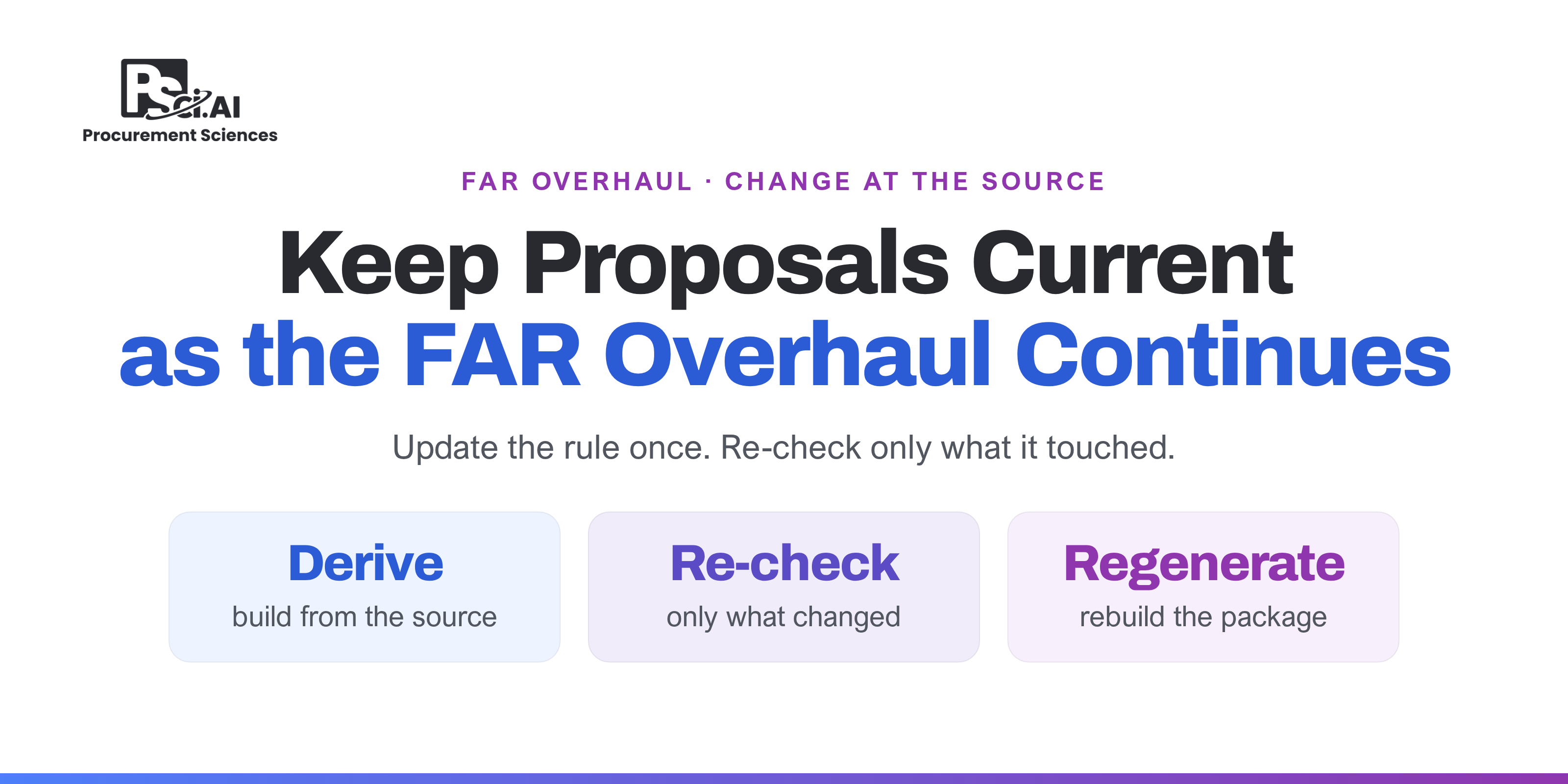
The FAR overhaul means the rules governing your bid can change while you write it. The fastest way to keep up is to organize your proposal content so every item traces back to the rule it relies on. Update the rule once, and you know exactly what to re-check. We call this Change at the Source.
How to Keep Proposals Current as the FAR Overhaul Continues
Webinar Recap: Outgrowing Small Business, Using AI to Write and Win Like a Prime
Procurement Sciences recently joined APMP for a webinar on one of the most challenging transitions in government contracting: what happens when a small business outgrows its set-aside protections and has to compete in the full and open market against primes with ten times the resources.
Webinar Recap: Outgrowing Small Business, Using AI to Write and Win Like a Prime
Microsoft Copilot Alternatives for Government Contracting: What GovCon Teams Should Know
Microsoft Copilot has become a significant part of the enterprise AI landscape, bringing generative AI directly into applications many government contractors already use every day.
Microsoft Copilot Alternatives for Government Contracting: What GovCon Teams Should Know