
The Government Contract Proposal Writer Role and How AI Is Changing It

.png)
Government contract (GovCon) proposal writers draft and edit proposal narratives, ensure compliance with solicitation requirements, and coordinate input from subject matter experts (SMEs), capture teams, and proposal managers. Their work directly impacts whether a proposal is compliant, competitive, and positioned to win.
But proposal writing is only one part of a larger GovCon workflow. As companies pursue more opportunities, proposal teams often become a capacity constraint due to the time required for drafting, compliance checks, and cross-functional coordination.
To overcome this, many contractors are turning to generative AI tools to improve proposal operations. With the right tools and workflows, teams can draft faster, reuse content, strengthen compliance, and increase proposal capacity without sacrificing quality.
Key Takeaways
- Government contract proposal writers are responsible for drafting proposal narratives, ensuring compliance with solicitation instructions, and coordinating inputs from technical teams, pricing teams, and capture managers.
- Proposal writing is part of a broader capture and proposal lifecycle that includes opportunity qualification, capture planning, proposal development, color reviews, and submission.
- Many government contractors are limited by proposal capacity rather than opportunity availability because proposal writing, compliance checks, and cross-team coordination require significant time and effort.
- Proposal teams scale quality and speed by building content libraries, improving collaboration workflows, and using AI to support drafting, compliance, and content reuse.
- Organizations that improve proposal workflows and increase proposal capacity can pursue more bids, improve win rates, and grow revenue without significantly increasing headcount.
What a Government Contract Proposal Writer Does
Government contract proposal writers create the written portions of proposals their organizations submit in response to government solicitations, including requests for proposals (RFPs), requests for quotes (RFQs), and requests for information (RFIs).
To do this well, they break down those solicitations to understand what the government agency is looking for and how responses will be evaluated. Proposal writers then translate information about their firm, including technical solutions, staffing approaches, past performance, management plans, and set-aside qualifications, into clear, persuasive narratives aligned with agency priorities.
Proposal writing is also a compliance function. The content must meet strict requirements, including formatting rules, page limits, instructions, and evaluation criteria.
Because of this, proposal writers work closely with capture managers, proposal managers, SMEs, pricing teams, contracts teams, and graphics teams to assemble the full proposal response.
Many proposal writers also maintain supporting documentation that improves efficiency and consistency across proposals, including:
- Proposal content libraries
- Reusable templates
- Past performance writeups
- Boilerplate sections reused across proposals
Where Proposal Writers Fit in the Government Contracting Lifecycle
The typical government contracting lifecycle looks like this:
Identify opportunity → bid/no-bid decision → capture planning → develop proposal → submit proposal → transition to post-award workflows
Proposal writers are most heavily involved after the bid/no-bid decision and capture planning phases, when it’s time to develop and submit the proposal. During this stage, they coordinate inputs from SMEs, ensure compliance with solicitation instructions, and revise content based on color team reviews.
Writers also support other parts of the lifecycle:
- Before proposal: Writers support capture teams by developing materials such as win themes, executive summaries, and early proposal outlines.
- After proposal submission: Writers support revisions, respond to clarification requests, and contribute to lessons learned after awards or losses.
The Government Proposal Writing Process
Here’s what the proposal writing process typically looks like within government contracting organizations.
Analyzing the Solicitation and Requirements
Proposal writers begin by reviewing the RFP or RFQ to understand requirements, evaluation criteria, and submission expectations.
Key questions to answer during the requirements breakdown:
- How will the government agency evaluate bids?
- What are the requirements of the contract, and do we qualify?
- What rules apply to formatting and submission?
During this step, teams typically create a compliance matrix to map solicitation requirements to proposal sections and show where each requirement will be addressed. This becomes the working document used throughout drafting and reviews to track coverage, assign ownership, and verify compliance before submission.
GovCon teams, including proposal writers, also use this early analysis to flag risks, identify missing information, determine where SME input is needed, and highlight sections that will require additional effort or focus.
Developing the Proposal Outline and Storyline
Based on the analysis from step one, proposal teams build a proposal outline and storyline. This includes strategy elements like win themes and messaging approaches. These are typically developed by capture teams and proposal managers, often with input from proposal writers, to guide drafting.
Once the outline is in place, proposal managers assign sections to team members (especially writers and SMEs) and build a proposal schedule with drafting deadlines, review cycles, and submission milestones.
Drafting Proposal Sections
With the strategy, outline, and schedule complete, teams are ready to write.
Proposal writers draft the sections assigned to them, often including:
- Executive summary
- Technical approach
- Management plan
- Staffing plan
- Transition plan
- Past performance
To do this, writers rely on input from others. Some information is available upfront, but gaps often emerge during drafting that require input from SMEs or technical teams. The writer’s role is to gather these inputs and translate them into clear, structured, and compelling proposal content.
Through the drafting process, writers must maintain a careful balance. A winning proposal must be technically accurate, persuasively written, and fully compliant with submission requirements. All of this happens under tight deadlines, often across multiple proposals.
Color Reviews and Revisions
Government proposals can become lengthy and complex, and every detail must be correct for a contractor to win consistently.
Business development and GovCon teams use color teams to manage this complexity. These are structured, staged reviews where different groups evaluate the proposal at key points in development, each focusing on specific aspects of the response.
For example, separate color teams may review alignment with solicitation requirements, technical accuracy, strategy, and overall quality of the narrative.
The proposal moves through each of these reviews, with proposal writers revising content based on feedback. During this process, writers must balance reviewer input with evaluation criteria and established win themes.
This review and revision is often iterative, which can create bottlenecks in the proposal development process.
Final Compliance Review and Submission
Once all color team revisions are complete, teams perform a final set of compliance checks to ensure the proposal is ready for submission:
- Does the proposal follow the RFP’s stated formatting requirements?
- Is the proposal within the given page limit?
- Does the proposal follow all instructions in the RFP exactly?
These checks confirm all submission requirements are met before finalization. Most contractors follow a defined approval workflow at this stage. Once the proposal manager signs off, a team member uploads the final response to the submission portal, such as SAM.gov.
After submission, the requesting agency may accept or reject the proposal, or request clarifications. When clarifications are required, teams must respond quickly, and this responsibility often falls to the proposal writer.
Why Proposal Teams Become Bottlenecks for Government Contractors
Most GovCons have a capacity problem, not an opportunity problem.
There are more solicitations than most organizations can realistically pursue. SAM.gov lists 24,000 new opportunities and notices each month, not including state, local, or niche postings on other platforms.
Even after narrowing the field to good-fit opportunities, most GovCons still cannot pursue all viable options because proposal teams are already at or near capacity.
Each proposal requires significant effort. Drafting, compliance checks, formatting, and coordination across SMEs and color teams all consume limited resources, which caps how many proposals a company can submit without adding staff.
When proposal teams become bottlenecks, companies are forced to pass on opportunities they could otherwise win. Over time, this limits growth by reducing the number of proposals submitted and the total pipeline of potential awards.
Government contractors that improve proposal efficiency can increase capacity, pursue more solicitations, and drive revenue growth without significantly increasing headcount.
Common Challenges Government Proposal Writers Face
Government proposal writers face persistent challenges as organizations try to scale proposal output. Most fall into three categories: complexity, focus, or structure.
Complexity: Proposal writing is one of the most time-intensive and complex parts of government contracting. Strict compliance requirements and tight timelines require writers to move quickly while maintaining near-perfect accuracy.
Additional factors increase this complexity:
- Pulling in, cross-checking, and reconciling inputs from multiple SMEs
- Maintaining version control across large teams
- Ensuring compliance with detailed and often complex instructions
- Repurposing content across proposals while making all required updates
Lack of focus: Instead of focusing on drafting, proposal writers often spend time searching past proposals for reusable content and managing detailed formatting tasks. This work is necessary but it limits time spent on higher-value writing and strategy.
Structural: Some challenges are rooted in workflow. Effective proposal development requires coordination across proposal, capture, pricing, and technical teams. Manual processes and standard office tools can slow this coordination, leading to delayed approvals, version control issues, and inefficient collaboration.
How Proposal Teams Scale Without Hiring More Writers
The most obvious way to scale proposal output is to hire more writers.
Hiring can increase capacity, but it doesn’t address the underlying constraints. Budget is one factor, but the larger issue is structural. The revenue needed to justify additional hires is often tied to contracts the organization cannot pursue because proposal teams are already at capacity.
Without improving processes and workflows, the same challenges remain. More writers increase coordination demands, stretch SMEs thinner, and amplify existing inefficiencies.
Mature proposal teams scale by reducing the amount of work required to produce each proposal. They rely on reusable content libraries, standardized templates, compliance matrices, and structured workflows to improve consistency and efficiency.
Many teams support this approach with collaboration tools built for contracting or even GovCon-specific contract management software. These solutions help centralize knowledge, streamline proposal management, and improve collaboration across teams, reducing manual effort and making it easier to reuse content and manage reviews.
AI Is Changing Government Proposal Writing
AI is changing how proposal teams approach drafting, compliance, and content reuse.
Many teams now use AI for proposals to draft content, summarize and extract requirements from RFPs, build compliance matrices, and identify reusable content from past proposals. For example, AI can take a section of an RFP, extract key requirements, and generate a structured draft aligned to those requirements in minutes.
Some of these tasks can be handled by general-purpose AI tools, but data privacy concerns are often more significant for GovCons. Other tasks, such as searching and adapting content from past proposals, require tools built specifically for government contracting workflows.
This is where government proposal management software becomes critical. AI trained on GovCon language and workflows can help proposal writers summarize technical inputs, break down requirements, and generate structured first drafts. These tools also make it easier to search content libraries, reuse approved content, and edit for clarity.
Solutions like Awarded AI from Procurement Sciences help proposal teams increase proposal capacity by reducing the time required to produce a compliant, competitive draft. They also help teams maintain consistency across proposals and verify compliance more efficiently.
Ultimately, AI allows proposal teams to focus more on strategy, win themes, and proposal quality, rather than repetitive drafting, formatting, and review work.
How Modern Proposal Teams Use AI and Proposal Software Together
Many government contractors are not limited by available opportunities but by proposal capacity, compliance workload, and coordination across teams. Improving proposal workflows allows organizations to pursue more bids and increase win rates without significantly increasing headcount.
Procurement Sciences helps address these challenges with Awarded AI, which connects opportunity search, capture planning, proposal development, compliance, and contract management into a single, integrated workflow.
With Awarded AI, teams can draft faster, reuse content more effectively, and streamline proposal development while reducing manual effort. The platform helps teams find the right opportunities, build high-quality proposals at scale, and deliver more efficiently to improve win outcomes over time.
Stronger proposals lead to more capacity, better compliance, and higher win rates. Schedule a demo to see how Procurement Sciences helps you get there.
FAQs
What does a government contract proposal writer do?
A government contract proposal writer develops the written portions of proposals submitted in response to government solicitations, such as RFPs, RFQs, and RFIs. The role involves translating technical solutions, staffing plans, and management approaches into clear, compliant proposal narratives aligned with evaluation criteria. Proposal writers also ensure formatting compliance, coordinate inputs from SMEs, support color reviews, and help finalize submissions.
How long does it take to write a government proposal?
The timeline varies depending on the size and complexity of the solicitation. Smaller proposals may take a few days to a few weeks, while large federal proposals can take several months and involve teams of writers, SMEs, pricing analysts, and proposal managers. Much of the time is spent on compliance checks, reviews, revisions, and coordination across teams, not just drafting.
What skills do government proposal writers need?
Government proposal writers need strong writing and editing skills, attention to detail for compliance requirements, and the ability to understand technical and management concepts. They must also manage deadlines, coordinate with SMEs, follow solicitation instructions closely, and revise content based on feedback. Organizational and collaboration skills are just as important as writing ability.
Can AI help write government proposals?
AI can help proposal teams draft initial content, summarize RFP requirements, build compliance matrices, and reuse content from past proposals. It doesn’t replace proposal writers, but helps them work faster, maintain consistency, and manage large volumes of proposal content. Many teams use AI to reduce drafting time and focus more on strategy, win themes, and proposal quality.
Click here to schedule a demo to get the full scoop on how our product actually works and discover how AI can transform your approach to government contracting.
Explore More Resources
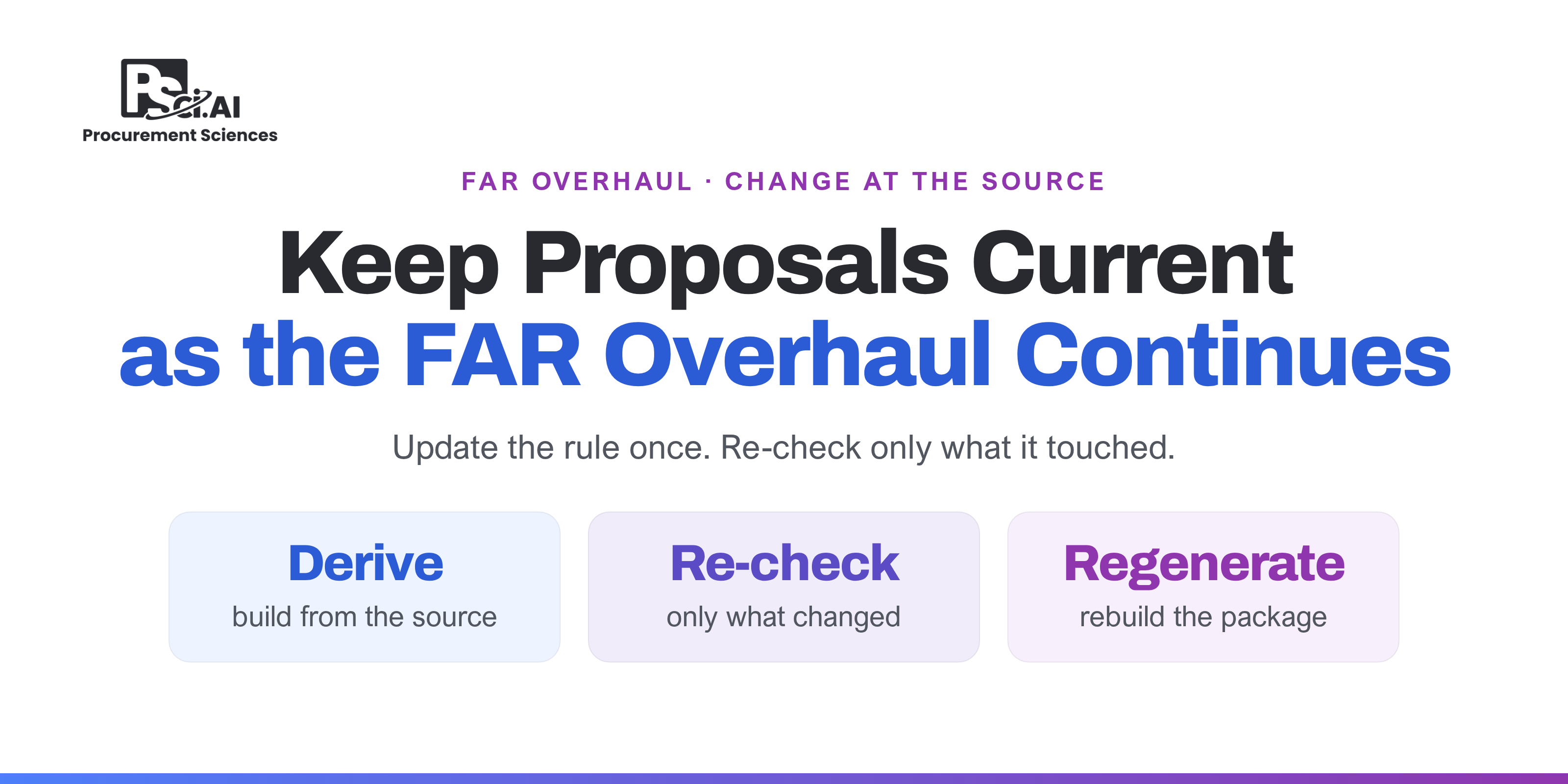
How to Keep Proposals Current as the FAR Overhaul Continues
The FAR overhaul means the rules governing your bid can change while you write it. The fastest way to keep up is to organize your proposal content so every item traces back to the rule it relies on. Update the rule once, and you know exactly what to re-check. We call this Change at the Source.
How to Keep Proposals Current as the FAR Overhaul Continues

Webinar Recap: Outgrowing Small Business, Using AI to Write and Win Like a Prime
Procurement Sciences recently joined APMP for a webinar on one of the most challenging transitions in government contracting: what happens when a small business outgrows its set-aside protections and has to compete in the full and open market against primes with ten times the resources.
Webinar Recap: Outgrowing Small Business, Using AI to Write and Win Like a Prime
Microsoft Copilot Alternatives for Government Contracting: What GovCon Teams Should Know
Microsoft Copilot has become a significant part of the enterprise AI landscape, bringing generative AI directly into applications many government contractors already use every day.
Microsoft Copilot Alternatives for Government Contracting: What GovCon Teams Should Know