
Top AI Use Cases for Government Contractors: Webinar Digest


We recently joined GovConWire and Executive Mosaic for a live webinar on how government contractors are actually using AI today, not in theory, not in pilot, but as part of daily workflows across the full BD lifecycle.
Sam Cooper, Senior Solutions Engineer at Procurement Sciences, led the discussion alongside two practitioners from Choice of Technology, both of whom use AI every day. Their insights cut through a lot of the noise around what works and what doesn't.
Here's what came out of the conversation.
The Opening Frame: Stop Thinking About AI as a Proposal Tool
The first thing Sam addressed was a bias most GovCon teams share: when someone says "AI," people immediately think proposals. And while proposals are a strong use case, that instinct is leaving a lot of value on the table.
The teams seeing the most ROI are the ones who've expanded their view across the full contract lifecycle: identifying and qualifying opportunities, building capture intelligence, writing and reviewing proposals, and managing post-award execution. Treating AI as a single-task tool captures a fraction of what's possible. Embedding it across the process is where the compounding benefits start to show up.
That lifecycle framing shaped the whole conversation.
Pipeline and Market Intelligence: More Opportunities, Smarter Decisions
The biggest benefit of AI at the top of the funnel is time.
A practitioner manually working through solicitations might get through five or ten in a day. With AI handling the triage, that same practitioner can evaluate dozens, getting go/no-go reads without having to comb through every section of every document. And because the AI isn't emotionally invested in chasing every opportunity, it gives an objective assessment based on actual fit, not optimism.
What makes that objectivity useful is customization. When a company profile is built from real evidence, past proposals, won contracts, demonstrated capabilities, the AI evaluates opportunities against what the company can actually do. The result is smarter pursuit decisions earlier, and smarter no-bid decisions too.
AI can pull from sources most teams don't have bandwidth to monitor. Expiring contract data, agency spending trends, forecasted opportunities, historical award patterns. The kind of research that used to require hours of manual digging can now come back in seconds, with citations that let you verify and present the sourcing. People who've been in the field for twenty or thirty years were seeing data they said they wouldn't have thought to look for.
Capture: Finding What You Couldn't Find on Your Own
Once an opportunity is in the pipeline, capture depends on intelligence: who's the incumbent, what does the agency care about, where are your competitors strong and weak.
AI accelerates all of it. In the webinar, Procurement Sciences customers walked through how they use it to identify likely incumbents, research their performance record, surface agency hot buttons from public sources, and pull patterns from historical awards. The AI isn't just searching, it's synthesizing across sources most teams would never have time to triangulate manually.
One use case that came up as particularly valuable: using AI to assess staffing feasibility before the BD team is already committed. If an opportunity requires fifty people with hard-to-find certifications and the hiring environment makes that unrealistic, it's far better to know in week one than after the proposal is in draft. The AI can research the labor market, flag the constraint, and save the entire team downstream pain.
AI lets you blend BD and capture into a single, faster analysis. You can get a comprehensive read on fit, competition, and execution risk before committing significant resources to pursuit.
Proposals: The Use Cases Beyond the First Draft
Yes, AI gets you to a first draft faster. That's real. But the more interesting discussion was about everything that comes after the blank page.
Compliance matrices, cross-reference charts, gap analyses: work that used to take significant manual effort can now be built in minutes, with citations pulled from your own past performance. You can see where your capabilities align with requirements, where the gaps are, and how they might be addressed.
In proposal review, AI can read a draft the way an evaluator would, catching compliance issues, undefined acronyms, inconsistent voice, and small errors a human reviewer under deadline might miss. She noted that catching those minor details has made a difference on bids.
Self-scoring proposals, oral presentations, non-standard task order formats. The agencies aren't all doing the same thing anymore, and teams whose AI workflows are locked to one format will struggle to adapt.
Post-Award: The Most Underutilized Part of the Lifecycle
From the moment a contract is won, there's an immediate need to extract every deliverable, milestone, and compliance requirement and get them organized. AI builds that tracker from the contract language in minutes. It surfaces requirements that can get buried in a long document, including specifics like a particular NDA format or a clause that differs from your standard template.
Right now, with contract modifications coming in frequently related to new executive orders and compliance requirements, the ability to quickly understand what changed and what's due has become genuinely critical.
There are also the broader tasks: clause reviews, risk analysis, program startup documentation, compliance plan writing.
What Makes It Work: Lessons from Two Years of Daily Use
Both webinar panelists had been using the platform for roughly two years, and their advice for teams just getting started was consistent.
Don't quit after the first response. The first output is a starting point. Prompting is a skill. Refine, iterate, and if you're not sure how to ask for what you want, ask the AI to help you write the prompt. Have it teach you how to instruct it.
Curate what goes in. Garbage in, garbage out. Teams that load irrelevant or conflicting documents get confused, inconsistent outputs. Load what's accurate and relevant, and be selective. Danica noted you can even ask the AI which documents it actually needs from a set you provide.
Keep humans in the loop. AI makes mistakes. Numbers get transposed. Sources get misread. Review is not optional. The goal is to shift human effort toward judgment and decision-making, not to remove it from the process.
Have the audacity to ask. This was Danica's phrase, and it stuck. People hold back because they think a question is too basic, or they're not sure how to phrase it. The AI doesn't judge. Ask anything. Be specific. Be persistent. That's how you get the output you actually need.
On Purpose-Built Platforms vs. General AI Tools
One comparison came up multiple times. Choice of Technology ran an internal evaluation, giving ten team members two months to test roughly twenty to thirty different AI tools. The conclusion: general-purpose tools like ChatGPT can write, but they don't know GovCon. Getting them to understand the context, the terminology, the structure of government contracting, requires so much setup work that by the time you've done it, a purpose-built platform has already moved through several opportunities.
The security piece is just as important. Loading proprietary company data, CUI, or sensitive customer information into a public AI tool is a real exposure. FedRAMP authorization at the moderate level is what makes it possible to actually use AI for the work GovCon teams need to do, without creating a compliance or data protection problem in the process.
Where to Start
The practical advice from both panelists: pick one specific problem that's eating your team's time, go deep on it, and don't expect it to be perfect immediately.
Opportunity triage. Compliance matrix generation. Post-award deliverable tracking. Start somewhere focused, learn how the AI responds to your prompts and what context it needs, and build from there. The teams seeing the most value didn't overhaul everything at once. They started somewhere specific, and expanded.
Want to see how Procurement Sciences supports the full GovCon lifecycle? Book a demo to talk through your specific use cases.
Click here to schedule a demo to get the full scoop on how our product actually works and discover how AI can transform your approach to government contracting.
Explore More Resources
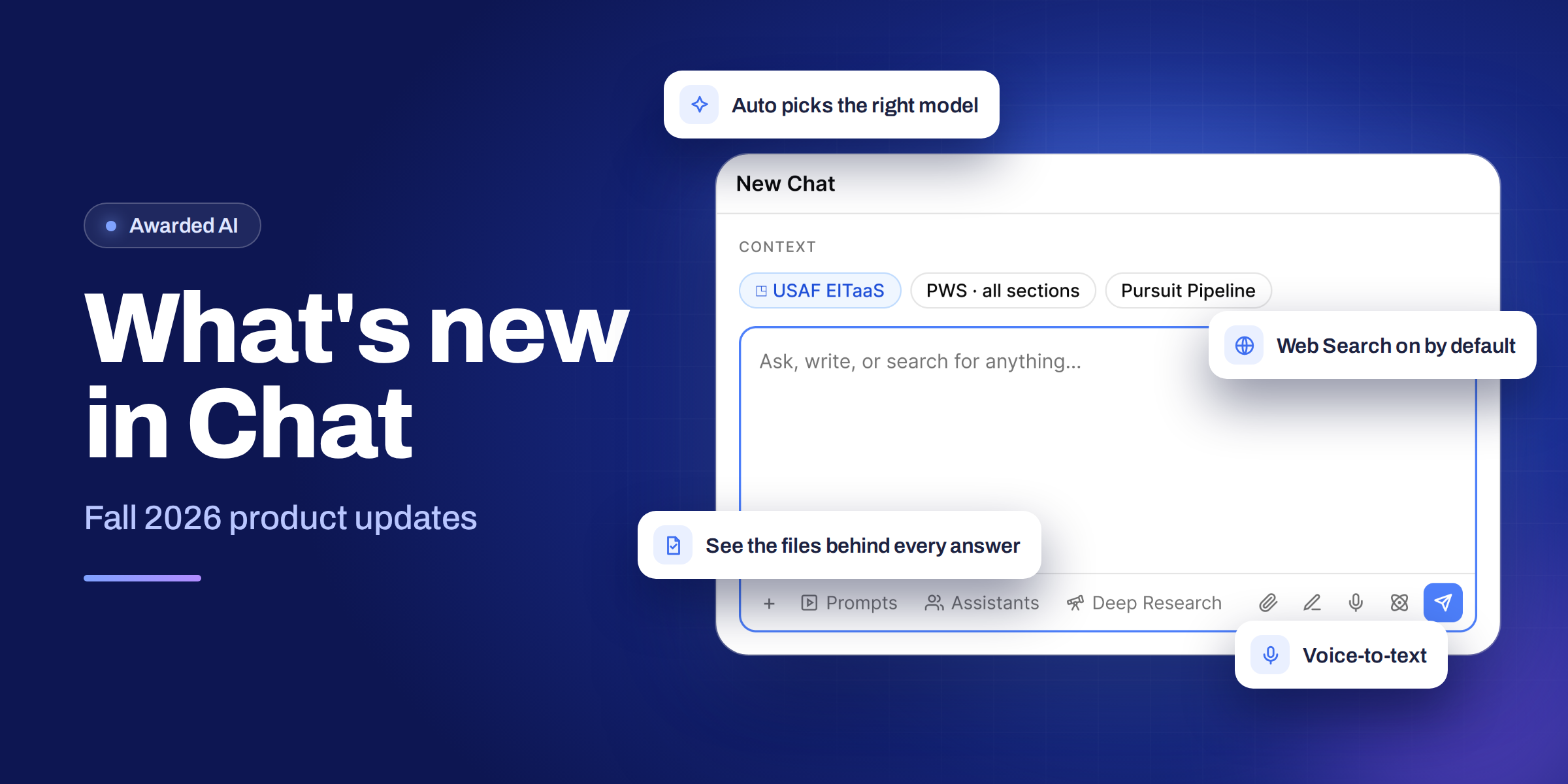
What's New in Awarded AI Chat: Fall 2026 Product Updates
Over the last few weeks, we shipped a steady run of small but mighty improvements to Chat in Awarded AI. Together, they change how it feels to do real capture and proposal work in Chat.
What's New in Awarded AI Chat: Fall 2026 Product Updates
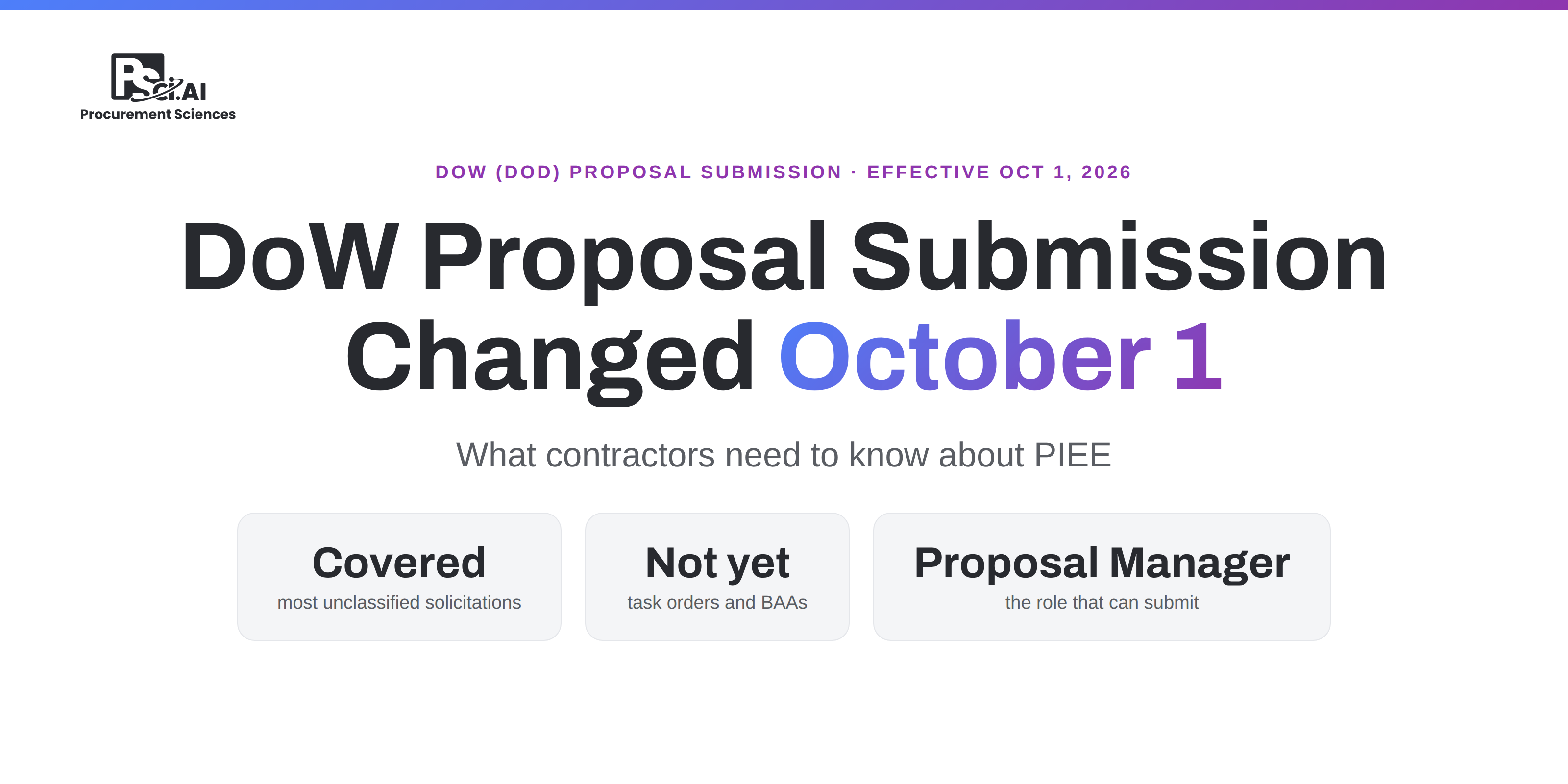
DoW Proposal Submission Changed October 1: What Contractors Need to Know About PIEE
As of October 1, 2026, Department of War (DoW) contracting officers must publish unclassified solicitations and receive offers through the PIEE Solicitation Module, unless an exception applies.
DoW Proposal Submission Changed October 1: What Contractors Need to Know About PIEE
.png)
What Is SEWP VI? A Guide to NASA's Next-Generation IT GWAC
NASA SEWP VI is the sixth generation of one of the federal government's oldest and largest IT acquisition vehicles, a Government-Wide Acquisition Contract (GWAC) that lets any federal agency buy commercial IT, communications, audio/visual, cloud, cybersecurity, and enterprise IT services without running its own competition.
What Is SEWP VI? A Guide to NASA's Next-Generation IT GWAC