
The New GovCon Battleground: Where Growth Leaders Will Win in the AI Era
.webp)

There is a shift happening right now across Government Contracting. It is not loud, and it is not being debated on panels or widely discussed in boardrooms. But it is real, and it is already separating companies.
Some firms are leaning into it and gaining ground. Others are still operating the way they always have, slowly losing position without fully understanding why. At the center of this shift is AI. Not as a feature or a tool, but as a fundamental change in how growth actually happens across BD, Capture, and Proposals.
The Mid-Tier Moment: Why $100M to $1B Firms Are Positioned to Break Out
Nowhere is that shift more evident than in the mid tier. For years, companies in the $100M to $1B range have been stuck in the middle. Too large to benefit from small business advantages, yet not large enough to consistently compete with the scale of the primes. That tension defined how they pursued work, how they staffed teams, and how they allocated resources.
That dynamic is changing.
Mid-tier firms now have something they have never truly had before: the ability to scale intelligence without scaling headcount.
What once required large teams, long hours, and deep institutional knowledge can now be executed with smaller, more focused teams that are better aligned to the opportunity.
At the same time, many primes are still carrying the weight of structure. Layers of process, slower decision cycles, and internal friction that makes it harder to pivot quickly. The advantage they have historically relied on is still there, but it is being challenged in ways it has not been before. Agility is starting to matter again. And AI is amplifying that advantage.
What Primes Are Quietly Changing Right Now
That said, the best primes are not ignoring what is happening. They are adjusting, just not in ways that are immediately visible from the outside.
Behind the scenes, primes are becoming far more deliberate in how they pursue work. The old model of chasing volume is giving way to a more focused approach built around intent. Instead of asking how many opportunities they can go after, they are asking which ones they can actually win and why.
AI is enabling more informed pipeline decisions, improving proposal development and compliance, and helping identify future opportunities earlier in the cycle. Perhaps more importantly, it is helping capture and preserve institutional knowledge so lessons learned are not lost over time. The real change is not the technology. It is the mindset.
IDIQ Access Is No Longer a Moat
For a long time, being on the right contract vehicle created a clear advantage. If you had access, you had opportunity. If you did not, you were on the outside looking in.
That advantage is starting to erode.
AI is compressing the information gap that once protected incumbents. Companies can now identify upcoming vehicles earlier, understand entry points more clearly, and build teams aligned to specific task orders with far greater precision. They can also see where incumbents are vulnerable in ways that were not previously possible.
Access still matters, but it is no longer a moat. Winning now depends on how well a company understands the opportunity and how early it engages.
Color Team Reviews Are Broken and Everyone Knows It
Traditional color team reviews have long been treated as a necessary discipline, but in reality they are often inefficient, inconsistent, and introduced too late to meaningfully change the outcome. They consume time, strain teams, and still leave gaps.
AI is making that reality harder to ignore. Instead of waiting for late-stage reviews to uncover issues, teams can now identify compliance gaps in real time, continuously assess alignment to requirements, and surface inconsistencies as they happen. Leadership has a clearer view of risk much earlier, which changes how decisions get made as the proposal evolves.
The shift in practice
Less time chasing compliance and formatting issues. More time strengthening the narrative, sharpening differentiators, and aligning to how the proposal will actually be evaluated.
Teaming Is Evolving and Most Have Not Noticed Yet
Historically, teaming has been reactive. A gap is identified late in the process, a partner is brought in, and the team is assembled just in time to bid. It works, but it is rarely optimized. That approach is becoming a liability.
With better data and better visibility, companies can now identify the right partners earlier, evaluate how well they truly align, and build teams that are intentionally structured for the opportunity. Instead of assembling large, loosely connected groups, they are forming smaller, more accountable teams where each member plays a clear role.
Teaming is moving from relationship-driven to data-informed. The organizations that recognize that shift will build stronger teams that actually improve win probability instead of diluting it.
The Gap Is Already Forming
All of this points to a broader reality. This is not about adopting new technology for the sake of it. It is about how growth is executed.
The firms that win over the next several years will be more selective in what they pursue. They will engage earlier in the lifecycle. They will operate with tighter, more aligned teams. And they will use AI to remove friction across every part of the growth process.
The gap is not between those who have AI and those who do not. It is between those who integrate it into how they think, decide, and operate, and those who treat it as an add-on.
That gap is already forming. And it is going to widen faster than most expect.
Click here to schedule a demo to get the full scoop on how our product actually works and discover how AI can transform your approach to government contracting.
Explore More Resources

What Is an IDIQ Contract? A Guide for Government Contractors
Indefinite Delivery, Indefinite Quantity (IDIQ) is a federal contract vehicle that lets an agency order an unknown amount of supplies or services, within stated limits, over a fixed period of time, rather than committing to a fixed quantity up front.
What Is an IDIQ Contract? A Guide for Government Contractors
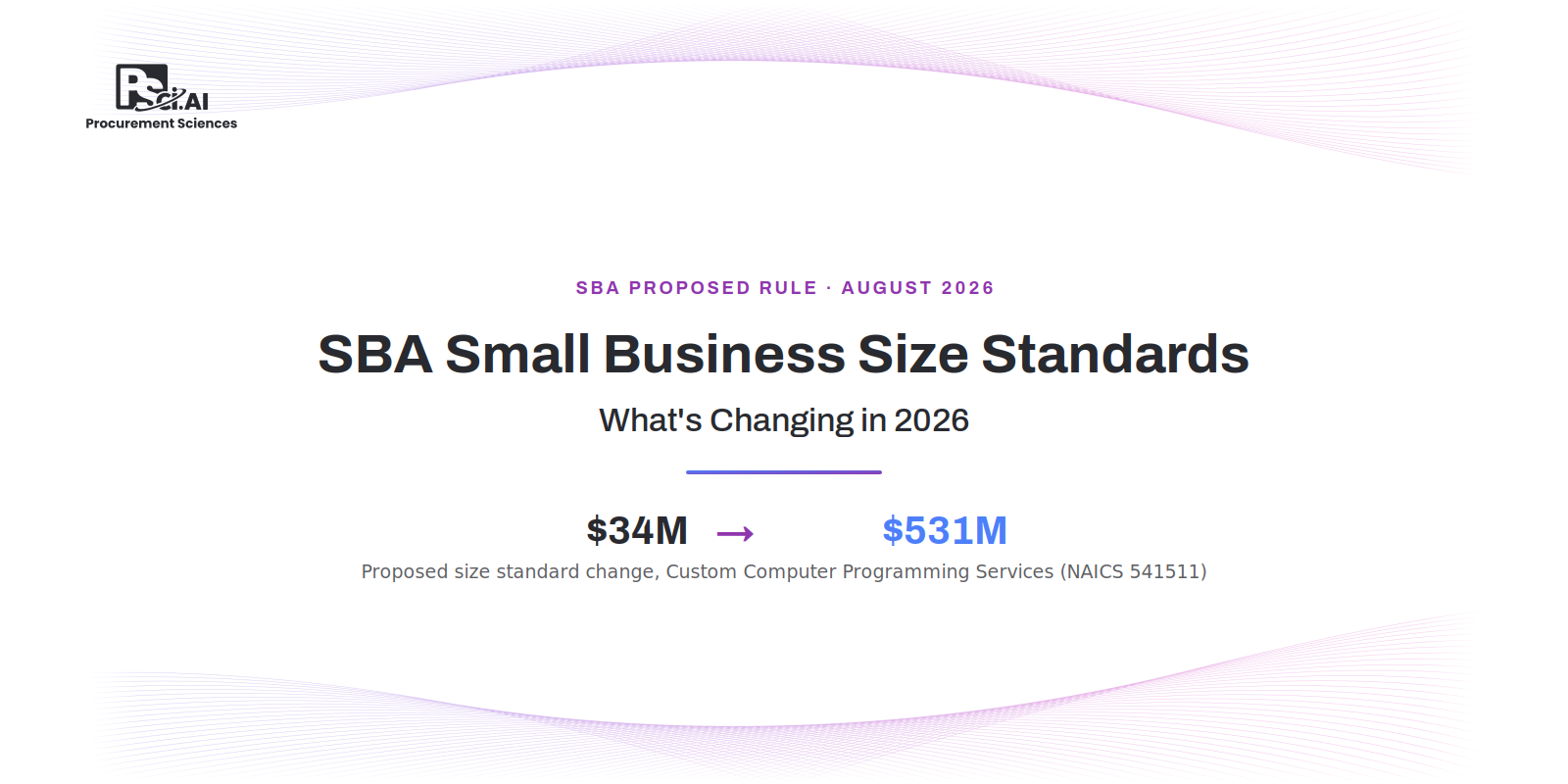
SBA Small Business Size Standards Are Changing: Here's What Government Contractors Need to Know
On August 20, 2026, the Small Business Administration (SBA) published a proposed rule that would rewrite its small business size standards, the thresholds that determine which companies qualify as "small" for federal contracting, SBA loans, and related programs.
SBA Small Business Size Standards Are Changing: Here's What Government Contractors Need to Know
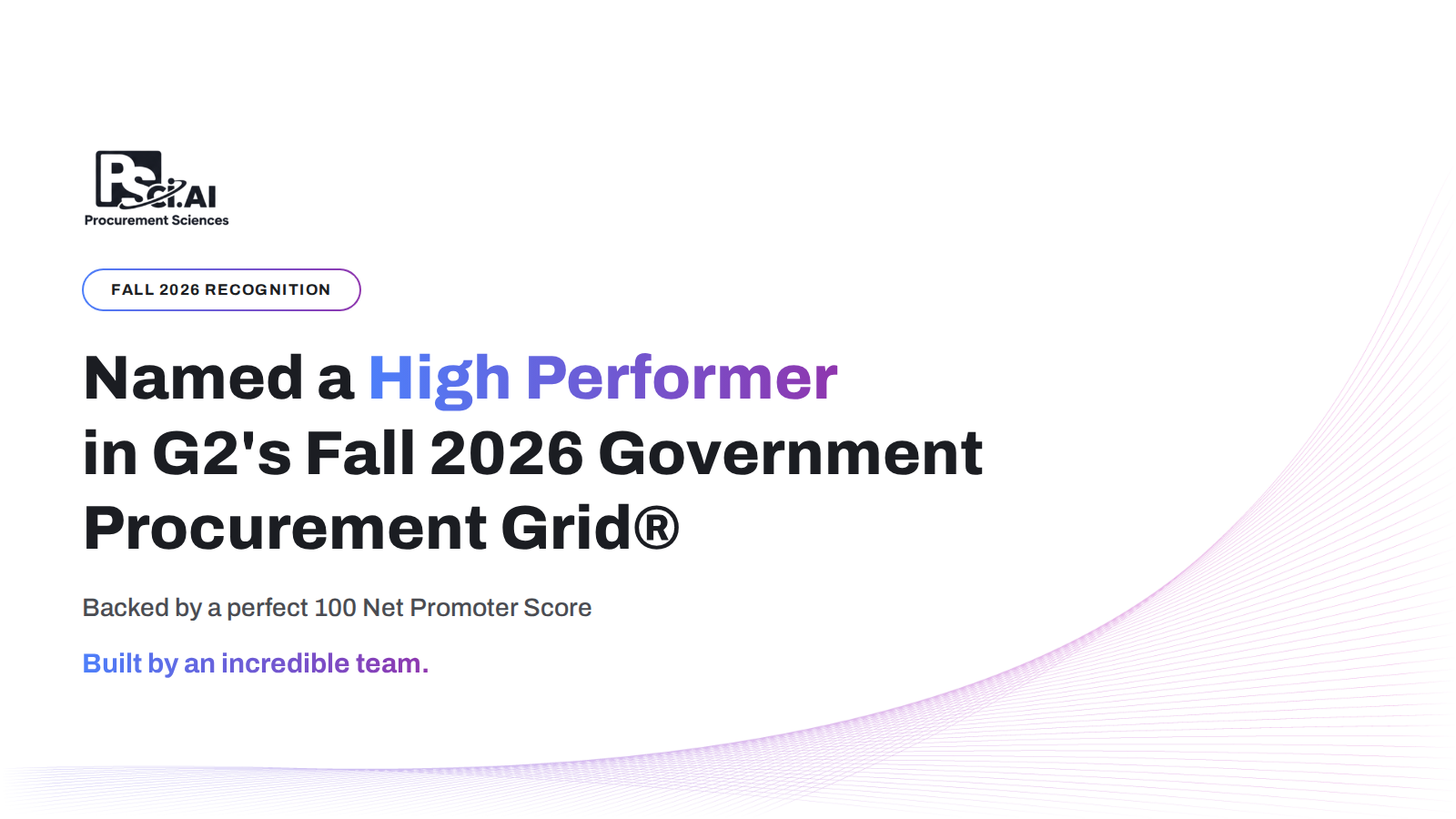
Procurement Sciences AI Named a High Performer in G2's Fall 2026 Government Procurement Grid®
We're proud to share that Procurement Sciences AI has been named a High Performer in G2's Fall 2026 Grid® Report for Government Procurement Software.
Procurement Sciences AI Named a High Performer in G2's Fall 2026 Government Procurement Grid®