
AI Won the Boardroom, Now It Must Win the Workforce
.webp)
This week I attended the retirement party of a former colleague who achieved something increasingly rare in today's business environment: more than 40 years in the same company lineage. A lineage I know well, having followed much of the same path through EDS, HP, HP Enterprise, DXC, Perspecta, and Peraton.
The EDS family tree has produced an extraordinary number of leaders throughout the Government Contracting industry. As I made my way through the room, I found myself speaking with CEOs, CIOs, CTOs, Chief Growth Officers, Division Presidents, and senior executives from many of the industry's largest and most respected contractors. And before long, nearly every conversation found its way to artificial intelligence.
Despite representing different companies and different perspectives, there was a remarkable consistency in what I heard. Virtually every executive agreed that AI has been embraced at the corporate level. Nobody is questioning whether AI will play a role in the future of Government Contracting. What was far less consistent was what happens after those executive decisions are made.
The challenge is no longer convincing executives that AI matters. That battle has largely been won. The real challenge now is the workforce.
Where the Industry Actually Stands
Across the GovCon community, there is little debate about whether AI will become a permanent part of BD, Capture, and Proposal operations. Over the last three years, I have watched the industry move from curiosity to commitment. A few years ago, AI demonstrations were often viewed as interesting technology showcases. Today, executive teams increasingly view AI as a strategic business capability.
At the same time, most organizations would readily admit they are still early in their maturity journey. Questions around security, governance, workflow integration, and user adoption continue to dominate executive discussions. This is especially true in Government Contracting, where trust and compliance are non-negotiable.
What I find encouraging is that very few executives view AI as a replacement for experienced professionals. The emerging consensus is clear: AI will not replace great capture managers, proposal professionals, and business developers. It will amplify them.
What Companies Are Doing Right
The organizations seeing the greatest success with AI adoption are approaching it as a business transformation initiative rather than a technology project.
What Companies Are Doing Wrong
Not every AI initiative achieves its intended results. The most common mistakes follow a predictable pattern.
The four failure modes: Treating AI as a technology purchase rather than an organizational change initiative. Getting stuck in perpetual pilot syndrome with no commitment to broader adoption. Chasing AI because of competitive pressure rather than a clearly defined business objective. Underestimating the importance of data quality and process maturity before introducing AI into broken workflows.
AI can enhance a strong process, but it cannot fix a broken one. If workflows are fragmented, information is outdated, or governance is inconsistent, introducing AI often magnifies those challenges rather than solving them.
What Separates the Best Platforms
As AI adoption accelerates, the differences between platforms are becoming increasingly important. One of the most overlooked differentiators is the quality of the people supporting the platform.
Organizations achieve much higher adoption rates when they have access to customer success professionals who have actually lived in the world of Government Contracting. Former capture managers, proposal leaders, and business development executives bring credibility and practical guidance that cannot be replicated through technical support alone. Users naturally feel more comfortable working with someone who understands the pressures of a proposal deadline or the complexity of a billion-dollar pursuit.
Trust, transparency, security, workflow integration, and domain specialization also continue to separate market leaders from the rest. Government Contracting is not the same as commercial sales. The organizations achieving the best outcomes are selecting platforms designed specifically for federal contracting, not forcing generic AI tools into highly specialized workflows.
The Question That Follows Every Demo
As I reflect on those conversations from the retirement party, I keep coming back to one conclusion. The GovCon industry has already decided that AI matters. What remains undecided is how quickly organizations can move from executive commitment to workforce adoption.
One of the comments we hear most frequently during demonstrations is some version of the same observation:
"I can't believe that took thirty minutes. It used to take me two weeks."
"Does this mean AI is going to take my job?"
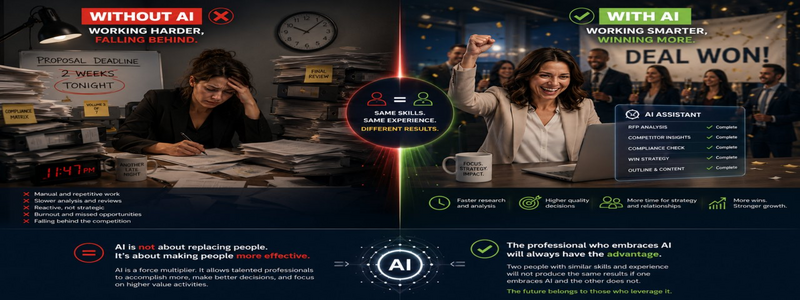
The answer is no. AI is a force multiplier. It allows talented professionals to accomplish more, make better decisions, and focus on higher-value activities. The goal is not to replace people. The goal is to make people more effective.
In the future, two people with similar skills and experience will not produce the same results if one embraces AI and the other does not.
The same will be true for companies. The future belongs to organizations that view AI not as a threat, but as an opportunity to elevate the performance of their people and accelerate the growth of their business.
Book a demo to see how Procurement Sciences helps you find, win and deliver government contracts.
Click here to schedule a demo to get the full scoop on how our product actually works and discover how AI can transform your approach to government contracting.
Explore More Resources
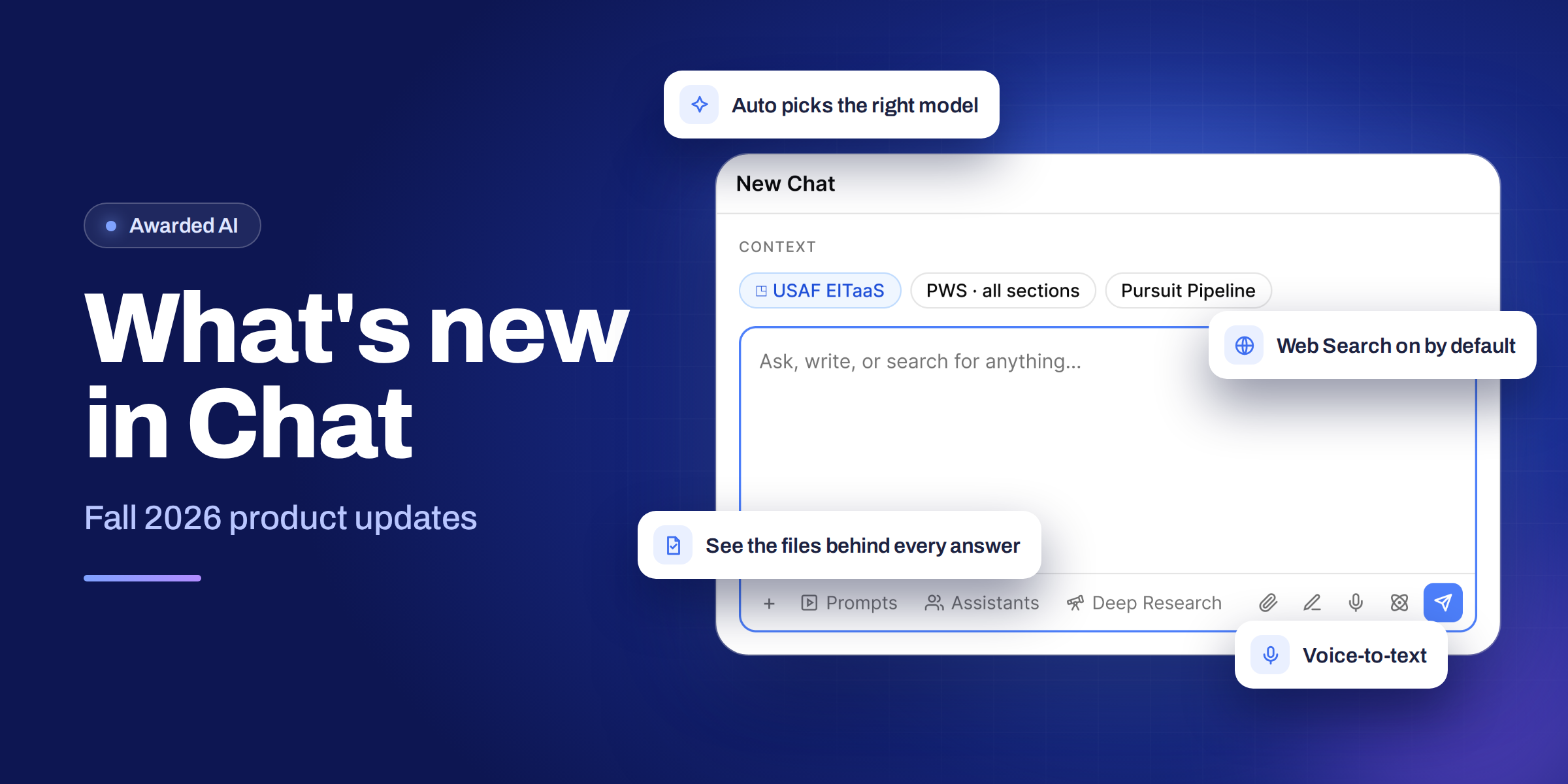
What's New in Awarded AI Chat: Fall 2026 Product Updates
Over the last few weeks, we shipped a steady run of small but mighty improvements to Chat in Awarded AI. Together, they change how it feels to do real capture and proposal work in Chat.
What's New in Awarded AI Chat: Fall 2026 Product Updates
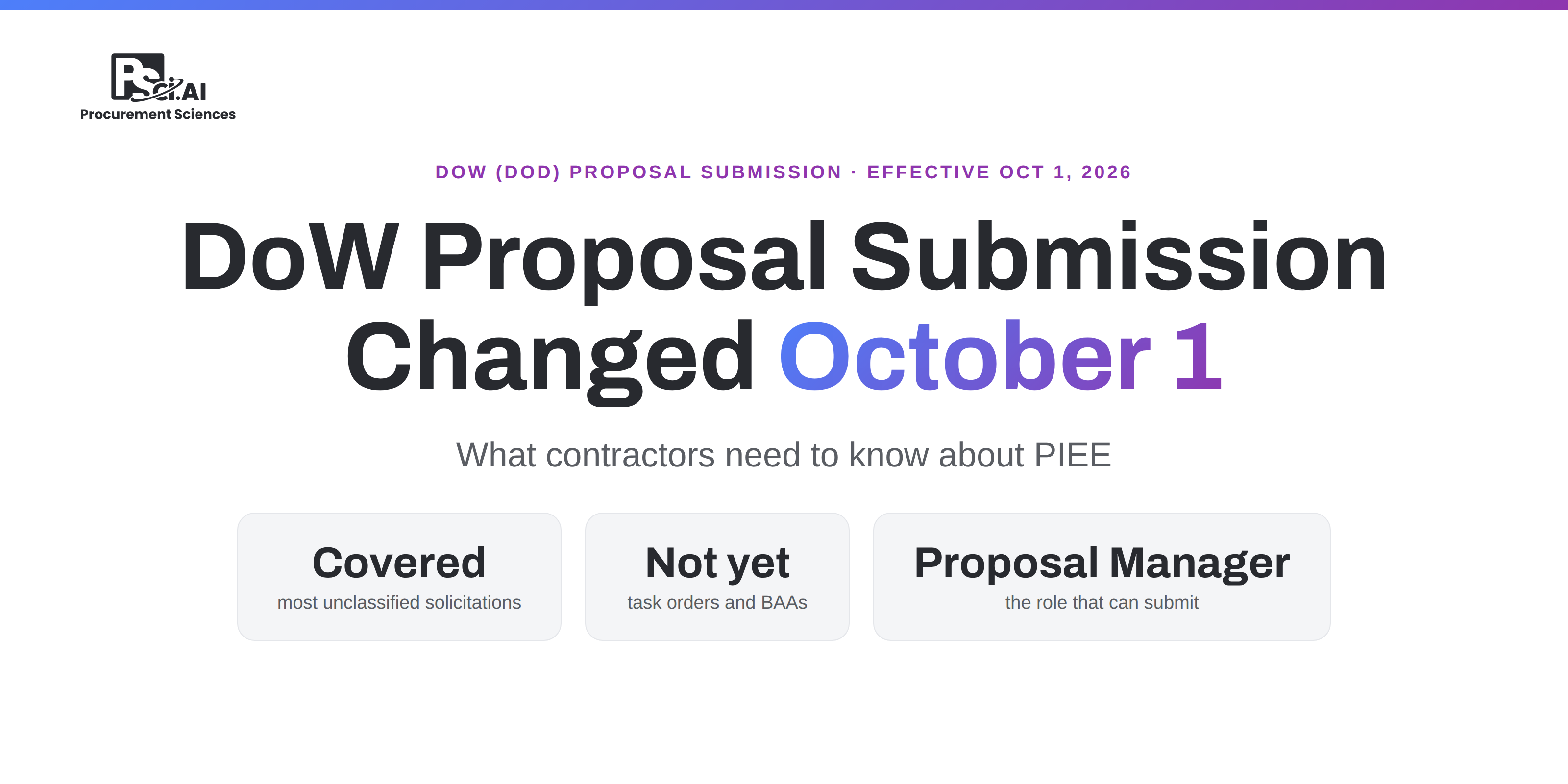
DoW Proposal Submission Changed October 1: What Contractors Need to Know About PIEE
As of October 1, 2026, Department of War (DoW) contracting officers must publish unclassified solicitations and receive offers through the PIEE Solicitation Module, unless an exception applies.
DoW Proposal Submission Changed October 1: What Contractors Need to Know About PIEE
.png)
What Is SEWP VI? A Guide to NASA's Next-Generation IT GWAC
NASA SEWP VI is the sixth generation of one of the federal government's oldest and largest IT acquisition vehicles, a Government-Wide Acquisition Contract (GWAC) that lets any federal agency buy commercial IT, communications, audio/visual, cloud, cybersecurity, and enterprise IT services without running its own competition.
What Is SEWP VI? A Guide to NASA's Next-Generation IT GWAC