
AI Proposal Software: Cut Draft Time and Boost Win Rates

.png)
Government contractors are running out of runway. RFP volume continues to increase, SME calendars are overbooked, and proposal teams are still rebuilding compliance matrices from scratch on every bid, burning hours that should be going toward winning proposals.
That's the operational reality for most government contractors right now, and manual processes under strict timelines only make it worse.
AI proposal software uses machine learning and natural language processing to automate the parts of proposal work that consume the most time: parsing RFP requirements, assembling first drafts from approved content, and generating compliance matrices before a writer types a single word. The best tools can cut draft time significantly while improving responsiveness to evaluation criteria.
Below, we’ll walk through how AI proposal software works, which features matter most in a government contracting environment, and how to evaluate tools against GovCon-specific requirements including FAR/DFARS alignment, color-team workflows, and pWin support.
Key Takeaways
- AI proposal software automates repetitive drafting tasks like requirement parsing, content assembly, and formatting, freeing proposal teams to focus on strategy and win themes rather than administrative work.
- The most effective proposal development software learns from your approved content library and past submissions, producing drafts that reflect your team’s expertise instead of generic AI output.
- Government contractors benefit more from purpose-built tools than generic AI writers because GovCon proposals require FAR/DFARS compliance, evaluation criteria alignment, and structured workflows that horizontal platforms miss.
What AI Proposal Software Does
AI-powered proposal software combines machine learning, natural language processing, and structured content libraries to automate proposal creation from RFP intake through final submission. These platforms can analyze RFP requirements, generate tailored first drafts from historical data, and support compliance alignment without starting from scratch on every bid.
A common question from teams evaluating these tools is, "Why can't we just use ChatGPT?" The short answer is that you could, but you wouldn’t save yourself much time (or work).
Consumer-grade generative AI is designed to produce text or images. Its best use case is to understand your prompt, not your RFP. It has no knowledge of your agency's evaluation priorities or specific needs, your firm's past performance, or the compliance structure the solicitation requires.
That context remains entirely manual, which means teams using a genAI tool for proposal work often create more administrative burden than they eliminate. They're still shredding requirements by hand, still hunting for approved content, still verifying compliance section by section.
Purpose-built AI proposal platforms are built around a different model. They understand structured requirements, evaluation criteria, and GovCon-specific terminology. In environments where FAR/DFARS language, compliance matrices, and color-team review workflows are standard, that difference is visible in every draft.
Core Capabilities That Save Time
- AI extracts and organizes RFP requirements into structured, actionable tasks, eliminating hours of manual parsing at kickoff. So, instead of a proposal manager spending the first day of the process reading through a dense solicitation and assigning sections from a blank spreadsheet, the platform produces a structured work breakdown with requirements mapped to sections and owners assigned. The team starts writing, not organizing.
- Content library integration pulls approved language, past performance narratives, and boilerplate based on requirement intent rather than keyword matching. The practical result: a writer working on a cloud security section doesn't search a shared drive for the right past response. The platform surfaces it. Writers spend time refining and positioning, not locating.
- Automated formatting handles complex document structures on multi-volume proposals with strict page layouts and section templates. That work is typically invisible until it isn't, when a section template breaks or a header hierarchy needs rebuilding two days before submission. Removing it from the writer's plate recovers real time before review cycles begin.
Awarded AI, Procurement Sciences' GovCon-specific platform, is trained on DoD, civilian agency, and state/local RFP nuances, which means more accurate output out of the box. See the full platform here.
Features That Improve Win Rates
- Personalization at scale tailors proposals to agency evaluation criteria and solicitation language. Adapting content to match how a specific agency weights and evaluates responses previously required manual research and significant writer effort per pursuit. A platform that handles that systematically makes it repeatable across every bid.
- Compliance checking flags missing requirements, outdated content, and responses that don't map cleanly to evaluation factors before submission. Finding a gap in review costs a few hours. Finding it after submission costs the contract.
- Collaboration features, including version control and role-based access, replace the email chains and file versioning that slow down review cycles. Analytics dashboards give teams visibility into proposal performance over time, which sharpens the approach on future pursuits rather than repeating the same decisions without insights.
How Proposal Development Software Cuts Draft Time
Manual proposal processes consume time in predictable places: reading and shredding RFPs, briefing SMEs, writing sections from a blank page, tracking down inputs, and reconciling document versions before reviews. AI compresses the most repetitive parts of that cycle into minutes.
The output is a workable first draft, but it’s not a finished proposal. SMEs and proposal managers react and refine rather than create from scratch.
That shift is important, because subject matter experts are often the bottleneck. When they spend 30 minutes reviewing and annotating an AI-generated draft instead of four hours writing one from scratch, they have bandwidth for more pursuits. Faster drafting is also a capacity multiplier for teams, who can move through the early proposal stages in less time, freeing them up to pursue more opportunities without adding headcount.
Requirement Parsing and Shredding
AI "shreds" RFPs by identifying individual requirements, evaluation criteria, and compliance obligations buried in dense solicitation documents. The output is a structured breakdown with each requirement mapped to a response section and a clear owner, not a highlighted PDF someone still has to interpret. The team knows what needs to be addressed, who owns it, and where it lives in the document before anyone writes a word.
The earlier payoff is strategic. Capture teams that understand evaluation factor weights before kickoff write to their strengths from page one. When that intelligence surfaces mid-draft instead, strategy adjustments cost time and often mean rewriting sections that went in the wrong direction.
Content Library Reuse
A searchable content library gives proposal teams approved responses, past performance narratives, and technical content on demand. Context-aware retrieval surfaces material based on requirement intent: a query about cloud security architecture pulls the right content even if the original response used different phrasing.
Reuse eliminates the redundant rewriting that happens when writers start fresh on every pursuit. It also drives consistency, since responses across proposals reflect the same approved language and positioning rather than varying by whoever drafted that section last time.
And because each completed proposal adds to the library, the efficiency gains compound: a team that builds and maintains its content library well writes the next proposal faster than the one before it.
How AI Proposal Tools Boost Win Rates
Speed alone doesn't win contracts. Proposals need to be compliant, responsive to evaluation criteria, and strategically positioned against the competition. AI tools improve win rates by addressing each of those dimensions at a level of consistency that manual processes just can't sustain at scale.
Personalization and Compliance Alignment
AI adapts content to agency requirements, evaluation criteria, and solicitation language at scale. Cross-referencing evaluation factors, adjusting section emphasis, and matching agency-preferred terminology previously required careful manual effort on every pursuit. A platform that handles it systematically means every proposal gets that level of attention, not just the ones where the team had enough time.
Compliance checking ensures every requirement is addressed and mapped to the correct response section. In complex, multi-section solicitations with layered evaluation factors and sub-factors, that mapping is where proposals most often fall short. A missed sub-factor or a response in the wrong section creates disqualification risk that the technical quality of the proposal can't recover from. Catching misalignment before submission (when there's still time to fix it) is where this capability pays off most directly.
GovCon compliance alignment also requires understanding FAR/DFARS structures, not just checking a list. Tools trained on that domain handle the nuances with far less manual correction than generic AI repurposed for government work.
Collaboration and Color-Team Reviews
Proposal workflows depend on task assignments, review gates, and progress tracking across a team that typically includes SMEs, subcontractors, pricing staff, and management reviewers, most of whom are contributing between other responsibilities.
Without structure, that coordination happens in email chains with conflicting document versions and unclear ownership. With it, each person knows exactly what they're responsible for and where their contribution lives.
Pink, Red, and Gold team reviews work better when reviewers can see the full context for what they're evaluating. In a centralized platform, a reviewer opens a section and immediately has access to the requirement it addresses, the draft response, and any prior comments from earlier passes.
That prep work is built into the system rather than handed off in a briefing packet the night before the review, which shortens prep time and tends to produce sharper, more specific feedback.
How To Automate Proposals Without Disrupting Workflow
The most common failure mode in AI adoption is with the rollout. Teams that try to implement new tools across every pursuit at once create confusion and resistance. A phased approach that demonstrates value on one real pursuit first is more likely to build the kind of durable adoption that actually changes how the team works.
Pilot on a Real RFP
Test AI proposal software against a recent RFP your team knows well. Evaluate how the tool breaks down requirements, retrieves content from your library, and produces a first draft.
A solicitation your team has already responded to is particularly useful: you have a baseline for what a good breakdown and a good draft look like, which makes it easier to see where the tool performs and where it needs correction.
Vendor demos reveal what the software can do in ideal conditions. A live pilot on your own content reveals what it will actually do in your workflow. If you're evaluating multiple tools, running the same RFP through each one gives you the clearest side-by-side comparison.
Develop Your Content Library Early
AI output quality is directly tied to the quality and organization of approved content in the platform. A team that goes live with an empty library gets generic output. One that loads curated past performance narratives, technical approaches, and frequently used boilerplate before the first live pursuit gets a draft that actually sounds like them.
Start with the content your team reuses most. Past performance narratives, standard technical approaches, and core boilerplate sections are the highest-leverage starting point because they appear in some form across most proposals.
Content library maintenance is ongoing work: every proposal cycle is an opportunity to add stronger responses, retire outdated content, and improve retrieval accuracy. Teams that treat the library as a living asset see the benefits grow with each proposal cycle.
Evaluating AI Proposal Software for Government Contractors
The evaluation criteria that matter for GovCon proposal software are different from what matters for a commercial sales proposal tool. Generic platforms are built around speed and polish: getting a proposal out the door quickly with clean formatting and e-signature support.
GovCon proposals have those requirements, plus FAR/DFARS compliance, structured evaluation factor responses, color-team review gates, and secure handling of sensitive information. A platform that doesn't account for those requirements adds workarounds rather than eliminating them.
Before selecting a platform, run it against these criteria:
- GovCon-specific training: Does the AI understand FAR/DFARS language, evaluation factor structures, and agency-specific terminology out of the box, or does it require extensive customization to get there?
- Compliance matrix automation: Can the platform generate and maintain a requirement-by-requirement compliance matrix throughout the proposal lifecycle?
- Requirement traceability: Does the tool map every requirement to a specific response section and track whether it has been addressed?
- Color-team workflow support: Are Pink, Red, and Gold team reviews built into the platform with version control and comment tracking?
- Secure deployment options: For contractors handling sensitive government data, does the platform offer on-premises or private cloud deployment?
- pWin and bid/no-bid support: Does the platform support capture strategy, or does it only engage once a team has already decided to bid?
(For a deeper evaluation checklist, check out these 10 Questions to Ask Before Choosing an AI Proposal Solution.)
Ensure FAR and DFARS Alignment
Many federal and DoD solicitations require proposals to reflect FAR and DFARS compliance frameworks in both structure and language. A platform trained on GovCon data can surface relevant compliance language and flag gaps without requiring manual verification at every step.
Generic AI tools require heavy prompt engineering and ongoing manual compliance review to approximate the same result. In practice, that overhead often consumes as much time as the drafting work the tool was supposed to eliminate.
Awarded AI is trained on GovCon terminology and compliance requirements from the start. It supports pWin analysis to help capture teams prioritize the opportunities most worth pursuing, and it supports bid/no-bid decisions with qualification criteria, competitor signals, and resource requirements, so those decisions are grounded in data rather than instinct.
Modernize Your GovCon Pipeline With Awarded AI
Procurement Sciences built Awarded AI specifically for government contractors, not as a generic AI tool adapted for GovCon use. The platform covers the full contract lifecycle: opportunity discovery, bid/no-bid qualification, automated proposal generation, compliance matrices, color-team reviews, and post-award contract management.
GovCon-specific training means FAR/DFARS awareness, evaluation criteria alignment, and multi-stakeholder proposal workflows are built into the platform's baseline. Teams that have spent time engineering workarounds to make a generic AI tool function in a GovCon environment can replace that effort with a platform where those capabilities are already there.
The most direct way to evaluate it is to walk one of your current RFPs through the platform. See how requirements are parsed, how tasks are assigned, and how the first draft compares to what your team would have produced starting from scratch.
Want to see what Awarded AI can do for your team? Get started with a demo.
FAQs
What is the best AI for proposals?
The best AI for proposals depends on your industry and workflow requirements. For government contractors, purpose-built tools like Awarded AI are often a better fit than generic AI because they support FAR/DFARS compliance, evaluation criteria alignment, and GovCon terminology.
Is there an AI that can write a proposal?
Yes, AI proposal software can generate workable first drafts by analyzing RFP requirements and drawing on your content library. Human oversight is still required to confirm accuracy, ensure compliance, and sharpen strategy.
What is the best AI for business proposals?
For commercial sales proposals, tools like Proposify and Responsive can help automate drafting and content reuse. For government contracting, platforms designed for GovCon typically perform better because they support compliance matrices and structured review workflows.
How does AI proposal software differ from generic AI writing tools?
AI proposal platforms integrate content libraries, parse RFP requirements, support compliance checking, and enable team collaboration in one workflow. Generic AI tools can produce text but typically lack the governance, audit trails, and proposal-specific structure that GovCon proposals require.
Can AI proposal software replace proposal managers?
Proposal managers remain essential for strategy, orchestration, and compliance accountability. AI reduces manual drafting and administrative effort so proposal managers can spend more time on the decisions that affect win probability.
Click here to schedule a demo to get the full scoop on how our product actually works and discover how AI can transform your approach to government contracting.
Explore More Resources
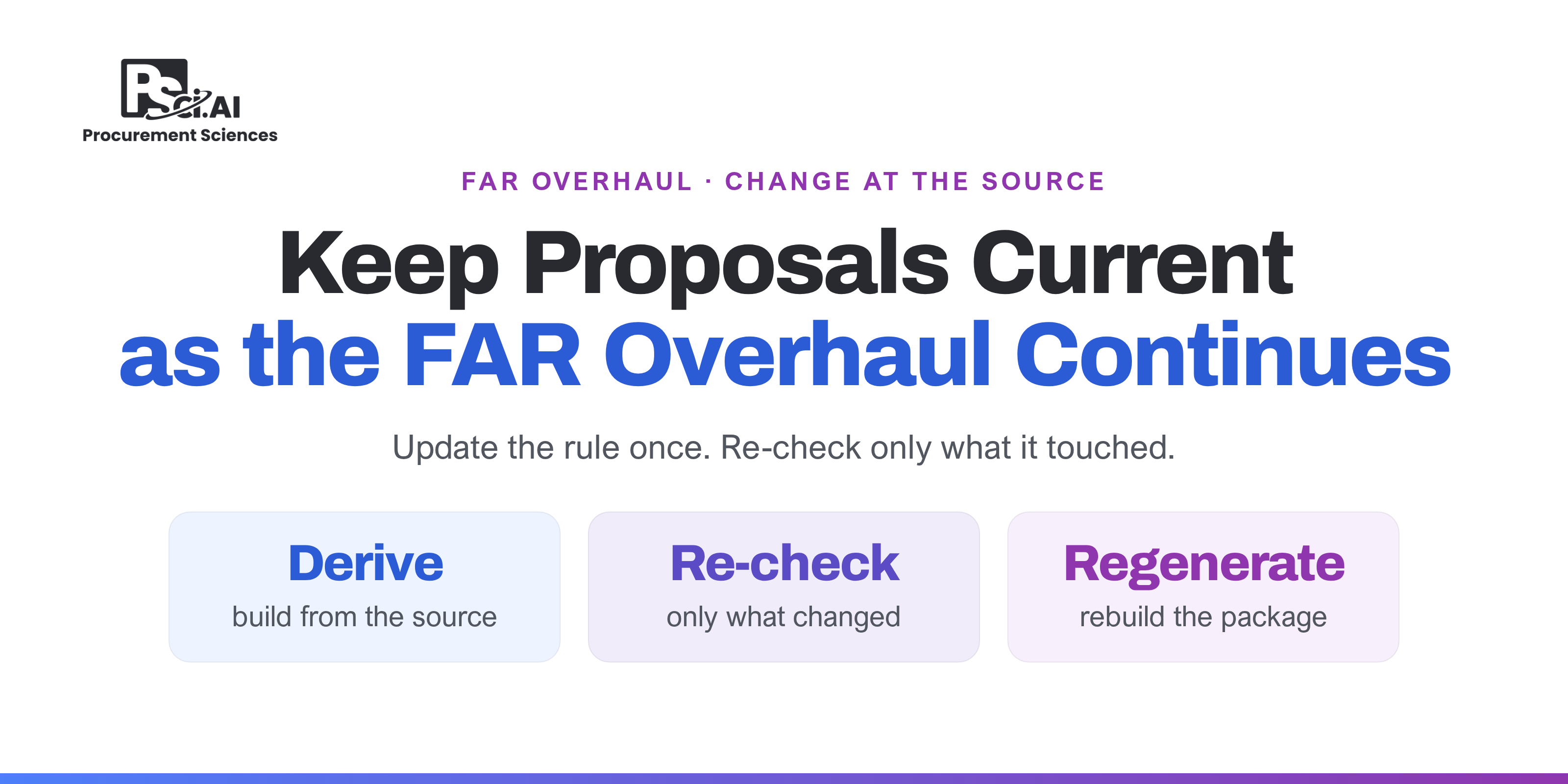
How to Keep Proposals Current as the FAR Overhaul Continues
The FAR overhaul means the rules governing your bid can change while you write it. The fastest way to keep up is to organize your proposal content so every item traces back to the rule it relies on. Update the rule once, and you know exactly what to re-check. We call this Change at the Source.
How to Keep Proposals Current as the FAR Overhaul Continues
Webinar Recap: Outgrowing Small Business, Using AI to Write and Win Like a Prime
Procurement Sciences recently joined APMP for a webinar on one of the most challenging transitions in government contracting: what happens when a small business outgrows its set-aside protections and has to compete in the full and open market against primes with ten times the resources.
Webinar Recap: Outgrowing Small Business, Using AI to Write and Win Like a Prime
Microsoft Copilot Alternatives for Government Contracting: What GovCon Teams Should Know
Microsoft Copilot has become a significant part of the enterprise AI landscape, bringing generative AI directly into applications many government contractors already use every day.
Microsoft Copilot Alternatives for Government Contracting: What GovCon Teams Should Know